








A lot of folks are angry that they have been forced from their homes, especially over a holiday weekend when families travel to visit families. I understand their anger, and I applaud the OCFA for their communication efforts to explain their decisions. So, for those of you who do not live and work in the emergency response arena, I thought it would be helpful to explain the LIMITATIONS the OCFA faces...
Read More
We keep hearing all these different temps from the media and OCFA. I am pretty sure they are both using Farenheit and Celsuis interchangably in their remarks and this can be confusing as heck. I just heard a media update state that “50 degrees is the happy place” for MMA. 50°F is the Flash Point of MMA and yes, below 50°F the material is BELOW its FP and thus less dangerous from its...
Read More
Methyl Methacrylate (MMA) is a flammable liquid used to manufacture plastics and resins. While it is regulated by OSHA and the EPA for occupational safety and toxic release reporting, it is currently NOT included on the EPA’s Risk Management Program (RMP) regulated list. It is a PSM Covered Chemical with a TQ of 10,000 pounds. MMA monomer weighs approximately 7.84 pounds per gallon; meaning...
Read More
Following its September 19th-20th, 2024 inspection, EPA alleges Respondent’s failure to:
…
HomeRead More »
Read More
An uncontrolled polymerization event in a Methyl Methacrylate (MMA) storage tank is a classic, catastrophic thermal runaway scenario. When the monomer begins linking into polymer chains, the system enters a self-accelerating feedback loop that can rapidly overwhelm the vessel’s pressure-relief systems, leading to a violent rupture that often resembles a Boiling Liquid Expanding Vapor Explosion...
Read More
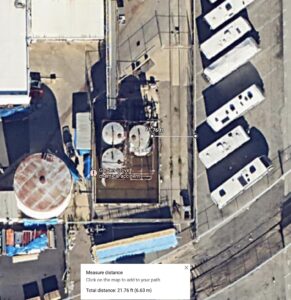
5/29/262 UPDATED using NFPA 30, Tables 22.4.1.5 and 22.4.1.1(b). It was brought to my attention that CA has more stringent requirements, so I have updated my post using NFPA 30, Chapter 22 – Storage of Ignitible (Flammable or Combustible) Liquids in Tanks — Aboveground Storage Tanks. My previous post was using IFC Tables.
Using Google Maps and Information from the Fire Authority dealing...
Read More
While routine, closed-loop transfers are inherently safe from internal static ignition, bonding and grounding become critical whenever the system is opened to the atmosphere or when specific maintenance activities generate massive static charges. When we break the closed loop or introduce external energy, the hazard profile shifts from NFPA 58 back to the static mitigation principles found in NFPA...
Read More
This post is a follow-up to my earlier post about NH3 being a CAT 2 Flammable Gas, as there are still businesses that dont fully grasp the full hazard profile of NH3. The fact that the facility is under the OSHA/RMP TQ of 10,000 pounds has NOTHING to do with needing the engine/mechanical room to be “adequately ventilated” in order to exempt the space from being a Class 1, Div 2, Group...
Read More
The fundamental conversion rule is that 1% equals 10,000 ppm. Here is the conversion table scaling down from a completely pure atmosphere (100%) to a microscopic trace (1 ppm).
…
HomeRead More »
Read More
A company has been fined £350,000 after the catastrophic collapse of a storage tank at its premises, which left a self-employed worker with life-changing injuries. The Health and Safety Executive (HSE) investigated the incident, which occurred on 21 June 2023 at an offshore supply base. The base handles around two thousand ship movements per year, supplying North Sea oil and gas installations with...
Read More
The 2027 edition of NFPA 704, Standard System for the Identification of the Hazards of Materials for Emergency Response, includes new definitions of the terms “battery energy storage system” and “lithium-based battery,” along with associated annex material. Updates have been made in Section 6.2, Degrees of Hazards for Flammability Hazards, to align with NFPA 1 regarding Category...
Read More
NFPA has updated its NFPA 497, Recommended Practice for the Classification of Flammable Liquids, Gases, or Vapors and of Hazardous (Classified) Locations for Electrical Installations in Chemical Process Areas, with a few minor revisions. Probably the most significant revision is NFPA’s position on “intentional releases and maintenance venting.” The most beneficial revision was NFPA...
Read More