












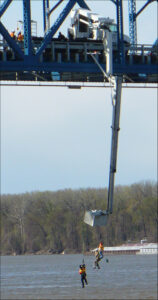
Workers hang by their PFAS after the hydraulic arm of their under bridge inspection man lift collapsed. Just another good reason to wear your PFAS when in a telescopic boom lift!
…
HomeRead More »
Read More

With all the changes to Ammonia Refrigeration RAGAGEPs, many businesses forget that the IFC and their state fire code no longer cover refrigeration; they gave all that to IIAR. But since the IFC no longer covers refrigeration, how does NH3 get covered under the IFC? Is it flammable, toxic, or corrosive?
…
HomeRead More »
Read More
In ASME B31.3, the number of welds that require visual inspection depends entirely on the Fluid Service Category designated for the piping system. Because visual inspection is the primary quality control method, the requirements are strict.
For the vast majority of process piping (Normal Fluid Service), 100% of the completed welds must be visually inspected.
…
HomeRead More »
Read More

MANY THANKS to my NEW & RENEWING
“Partners in Safety”for their support!
since 2012
since 2012
since 2007
since 2010
2012 Fatality Tracker
Electrical
25
(2011 = 81)
(2010 = 90)
(2009 = 100)
Forklift/Manlift
Mobile Equipment
14
(2011 = 84)
(2010 = 110)
(2009 = 88)
Mining
26
(2011 = 248)
(2010 = 480)
(2009 = 586)
Explosions
45
(2011 = 218)
(2010 = 246)
(2009...
Read More
EXCELLENT Fall Protection video to incorporate into our training programs. The video does an great job of showing the forces involved in a fall and how the deceleration devices work! It also shows the forces applied to a guardrail when worker tie off to one (keeping in mind that a guardrail is only designed for a force of 200 pounds!).
Read More
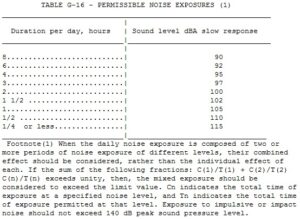
Like all Personal Protective Equipment (PPE), hearing protection has limitations. Often, workers use hearing protection that is inadequate for their exposures. 1910.95(j) is intended to ensure this does not happen to workers, but…
…
HomeRead More »
Read More
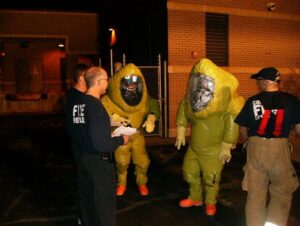
Take five seconds (THATS ALL) and tell me the first thing that comes to your mind that you feel is ODD about this photo? This was NOT a drill, but an actual release of CHLORINE at a WWTP. The photo is from the article regarding the CL2 release published by the local ABC News Affiliate. Click Read More below to see my thoughts.
…
HomeRead More »
Read More
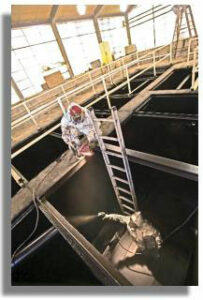
This was sent to me stating this is an actual contractor marketing photo in their “contractor safety packet”! A member had just received it in their contractor evaluation process. How many OSHA compliance issues can you find in this one photo? Do you see a more safe way they could go about doing this project?
…
HomeRead More »
Read More
This is the first of several articles I intend to write over the next several months regarding incentive programs and how they can PLAY a SIGNIFICANT and POSITIVE role in improving our true safety performance. Recently OSHA issued an internal memo discussing the use of “safety incentive programs” and this has caused quite a stir in the safety and incentive program community. ...
Read More
MANY THANKS to my NEW & RENEWING
“Partners in Safety”for their support!
since 2012
since 2012
since 2007
since 2010
2012 Fatality Tracker
Electrical
24
(2011 = 81)
(2010 = 90)
(2009 = 100)
Forklift/Manlift
Mobile Equipment
14
(2011 = 84)
(2010 = 110)
(2009 = 88)
Mining
26
(2011 = 248)
(2010 = 480)
(2009 = 586)
Explosions
39
(2011 = 218)
(2010 = 246)
(2009...
Read More
Consider this scenario
A chemical facility has a processed covered by OSHA Process Safety Management standard. The facility has extensive in-house response capabilities with a well staffed and equipped HAZMAT team, which trains all of the responders to the Technician level and supervisors are trained as Incident Commanders.
But is this all the training from 1910.120(q) that applies to this facility? ...
Read More
This is one of the most asked questions when I do HAZMAT training in the public sector. Many fire departments know when OSHA regulates them and when they do not, but those professional fire fighters and volunteer firefighters who respond to chemical releases ARE IN FACT covered by the SAME EXACT rule as private HAZMAT teams at industrial facilities. Bottom line… EVERYONE who responds is...
Read More