








If you have a non-conductive flammable liquid and you are passing them through a filter, the hazard associated with static electricity generation can be up to 300X greater. This actually goes with any type of obstruction in the pipe/hose (orifice plate, partly opened valve, flow probe, etc). If you must have a filter/strainer in your delivery system, “relaxation time” becomes critical!...
Read More
The most common generators of static electricity are processes involving flammable liquids. Static electricity is generated by liquids flowing through pipes, and in mixing, pouring, pumping, filtering, or agitating liquids. The rate of generation is influenced by the conductive of the liquids, the amount of turbulence in the liquid, the interfacial surface area between the liquids and other surfaces,...
Read More
Here is the condensed version of what NFPA 2113 requires when FRC are determined to be needed:
The organization shall define those facilities and areas of the workplace and tasks that require personnel to wear flame-resistant garments.
Organizations shall provide users with the instructions provided by the manufacturer on the care, use, and maintenance of flame-resistant garments, including...
Read More
So far I have tried to explain how a vapor cloud develops by discussing Flash Point, Vapor Density, etc. Now I would like to explain how a vapor cloud develops and just how LITTLE energy is needed to be an ignition source. If you ever experience a spill of a flammable/combustible liquid and the temperature of the liquid is even CLOSE TO THE FP, then we MUST treat the spill as a HAZMAT situation....
Read More
I want to touch a bit more on two of the elements I mentioned in my original post…Vapor Density and Lower Explosive Limit (sometimes called Lower Flammable Limit). Vapor Density is basically the weight of the vapor or gas in air. It tells us whether the gas/vapor will rise or fall when it flashes off the liquid surface. As it is flashing off, the energy created from the liquid reaching...
Read More
1910.38 Employee Emergency Action Plans
1910.119 Process Safety Management of Highly Hazardous Chemicals
1910.120 Hazardous Waste Operations And Emergency Response
1910.134 Respiratory Protection
1910.146 Permit-Required Confined Spaces
1910.147 The Control of Hazardous Energy (Lockout/Tagout)
1910.156 Fire Brigades
1910.272 Grain Handling Facilities
1910.1001 Asbestos
1910.1017 Vinyl Chloride
1910.1018...
Read More
In the USA, our Occupational Safety and Health Administration (OSHA) has an exception to Lockout/Tagout (LOTO) for “cord and plug” equipment. The exception, 1910.147(a)(2)(iii)(A), states:
Work on cord and plug-connected electric equipment for which exposure to the hazards of unexpected energization or start-up of the equipment is controlled by the unplugging of the equipment...
Read More
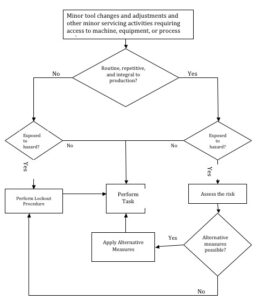
Control of Hazardous Energy Sources covers the servicing and maintenance of machines and equipment in which the unexpected energization or start-up of the machines or equipment or release of stored energy could cause injury to employees. (See Appendix A)
The Rule, 1910.1470(a)(2)(ii) reads:
“Normal production operations are not covered by the standard. Servicing and/or maintenance which take place...
Read More
I Chose to Look The Other Way
I could have saved a life that day,
But I chose to look the other way.
It wasn’t that I didn’t care,
I had the time, and I was there.
But I didn’t want to seem a fool,
Or argue over a safety rule.
I knew he’d done the job before,
If I spoke up, he might get sore.
The chances didn’t seem that bad,
I’d done the same, He...
Read More
It’s Up To Me
I want a workplace, that’s Injury Free
And if that’s going to happen, then it’s up to me.
I can’t take for granted, that anyone,
Has done all the things, that I should have done.
I must, take the time, with each task I do,
To look for the hazards, and think the job through.
To check the procedures and follow them all
And reject taking shortcuts, no...
Read More
Listing of Hardhats that can be worn backwards as allowed by ANSI/ISEA Z89.1-2009
Click Here
Read More
M-1 INTRODUCTION
M-2 CORROSION
M-3 MARKING ON THE VESSEL
M-4 PRESSURE RELIEVING DEVICES
M-5 STOP VALVES LOCATED IN THE RELIEF PATH
M-6 INLET PRESSURE DROP FOR HIGH LIFT, TOP GUIDED SAFETY, SAFETY RELIEF, AND PILOT OPERATED PRESSURE RELIEFVALVES IN COMPRESSIBLE FLUID SERVICE
M-7 DISCHARGE LINES FROM PRESSURE RELIEF DEVICES
M-8 PRESSURE DROP, NONRECLOSING PRESSURE RELIEF DEVICES
M-9 GENERAL ADVISORY...
Read More