









I have mentioned the former plant managers that I was so privileged to have had to opportunity to work for these pioneers in safety. These were Chemical Engineers, but they were safety geniuses before their time. In 1996, I went to work for Dale Fannin, and I had no idea what I was in for. In two years, he taught me more about Safety Metrics than I have learned in the 20 years since. ...
Read More
INTRODUCTION
Recent inspection programs for metallic pressure containment vessels and tanks have revealed cracking and damage in a considerable number of the vessels inspected. Safety and hazard evaluations of pressure vessels, as also presented in OSHA Instruction PUB 8-1.5, need to consider the consequences of a leakage or a rupture failure of a vessel.
Two consequences result from a complete...
Read More
Twas the night before Christmas, when all through the house
Not a creature was stirring, not even a mouse.
When down through the chimney, all covered with soot
Came the “Spirit of Fire,” an ugly galoot.
His eyes glowed like embers; his features were stern
As he looked all around him for something to burn.
What he saw made him grumble-his anger grew higher
For there...
Read More
The Incident:
In September 2000, a steel lecture bottle located within a hood in a UNR laboratory ruptured with explosive force. The explosion occurred at night, and no one was present in the laboratory at the time. However, there was significant damage to the lab hood.
The gas cylinder contained methyl nitrite (CH3ONO), which had been synthesized and transferred to the cylinder by a postdoctoral...
Read More
In the realm of process safety, a Functional Test of the Safety Instrumented System (SIS) is a periodic procedure performed to ensure that an SIS will operate as designed when a real-world demand occurs. While a system might look operational on a control panel, internal “hidden” failures could prevent it from actually shutting down a process during an emergency. The functional test is designed...
Read More
In determining threshold quantities for toxic chemicals, OSHA used the Gaussian dispersion model. OSHA made the following assumptions:
…
HomeRead More »
Read More
I encountered something new this week; well, new to me, as I have never seen an RT Rejection rate of 26%. So I knew that was crazy high, as the normal rate is around 2-3%. So I had to go back to my ASME B31 Course and research an acceptable rate:
…
HomeRead More »
Read More
On Tuesday, April 8, 1997, at approximately 8:59 a.m., a 5,700-gallon hydrochloric acid (HCl) storage tank ruptured during filling. The failure of the HCl tank caused a significant portion of its liquid contents (which totaled about 4,800 gallons of 31% HCl) to suddenly surge over the secondary containment. The force of the liquid also caused a break in the secondary containment wall. Witnesses described...
Read More
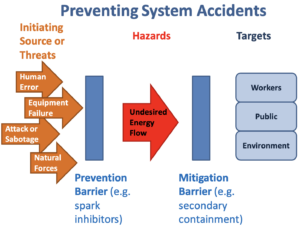
The use of risk controls or barriers to protect the people from hazards is a core principle of safety. Barriers are employed to serve two purposes:
to prevent the release of hazardous energy and to
mitigate harm in the event hazardous energy is released
Energy is defined broadly as used here and includes multiple forms, for example: Kinetic, biological, acoustical, chemical, electrical, mechanical,...
Read More
Safety Management Systems (SMS) was developed to integrate safety as part of an organization’s management of safety performance. The benefits of process-based management systems are a well-established component of quality performance. As organizations and the technologies they employ became more complex and diverse, and the rate of change in the pace of societal expectations, technical innovations,...
Read More