
Reading blinds and blanks identifiers (ASME B16.48)

Paddle Blind

Many organizations use blinding/blanking as their main means for isolating a Permit-Required Confined Space.  But a number of years ago, an unqualified operator mistook a “Paddle Spacer” for a “Paddle Blind,” thus leaving the flammable gas pipe to the PRCS improperly isolated.  There is a very distinct way to tell these two in-line devices apart from one another – do you know how?

Here are the definitions and images of these devices:

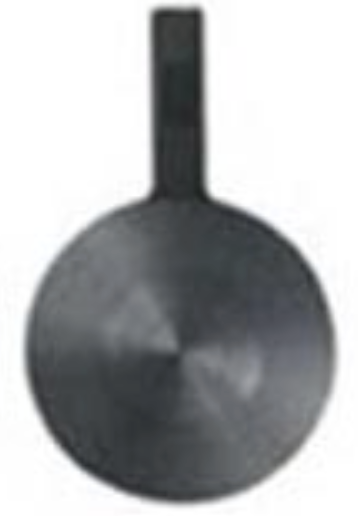
Paddle Blind  Paddle Blank: These blinds are solid circular discs with seals. There is a handle on the outer diameter of the disc so an operator can insert it between the flanges and isolate the piping.
 Paddle Spacer Paddle Spacers: These spacers are like paddle blanks but have an inner-diameter hole to allow unrestricted flow.


As you can see from the images above, the spacers are REQUIRED to have a hole in their handle, whereas the blank has a solid handle.  The “hole” is NOT for hanging Tagout Tags or Lockout Locks from!  It indicates that the device has a hole that allows flow through the device.

8 PADDLE BLANK AND SPACER IDENTIFICATION

8.1 Paddle Handles

In order to differentiate between an installed paddle spacer and a paddle blank, it is required that there be an externally visible distinction between the two as required by paras. 8.2 and 8.3.

8.2 Paddle Blank Handles

Handles for paddle blanks shall be solid with no openings.

8.3 Paddle Spacer Handles

Handles for paddle spacers shall have a single through indicator hole located near the end of the handle. The hole diameter shall not be less than 12 mm (1⁄2 in.).


Just an FYI, this info makes for a great safety talk during or in preparation for turnarounds/shutdowns.

Scroll to Top