
Reflief Valves… “Upwards and Unobstructed” (Video)

Upward and Unobstructed

Upward and Unobstructed

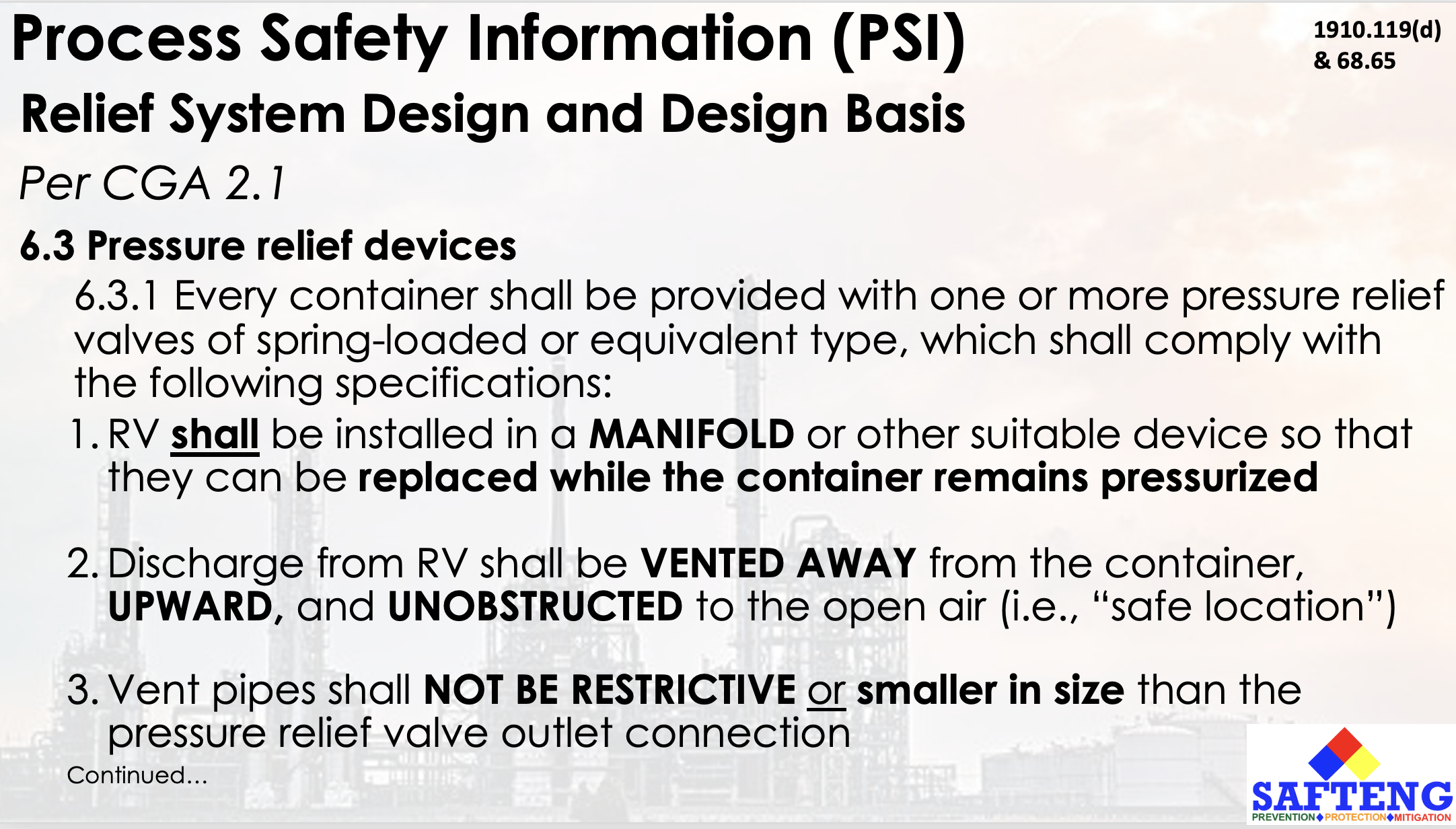
 I had the pleasure of teaching another Advanced Course on Process Safety (40-hr). When discussing Relief Systems, their design, and their RAGAGEP(s), the UPWARDS and UNOBSTRUCTED piece got many questions.

ALL RAGAGEPs regarding PRDs will state “UPWARDS and UNOBSTRUCTED” or similar language.

Even the older OSHA standards uses the phrase “Upward and Unobstructed” in the following standards…


Hydrogen

1910.103(b)(1)(ii)(b) Safety relief devices shall be arranged to discharge upward and unobstructed to the open air in such a manner as to prevent any impingement of escaping gas upon the container, adjacent structure or personnel. This requirement does not apply to DOT Specification containers having an internal volume of 2 cubic feet or less.


LPG

1910.110(d)(4)(ii)(c) On a container having a water capacity greater than 125 gallons, but not over 2,000 gallons, the discharge from the safety relief valves shall be vented away from the container vertically upwards and unobstructed to the open air in such a manner as to prevent any impingement of escaping gas upon the container; loose-fitting rain caps shall be used. Suitable provision shall be made for draining condensate which may accumulate in the relief valve or its discharge pipe.


1910.110(d)(4)(ii)(e) On a container having a water capacity greater than 2,000 gallons, the discharge from the safety relief valves shall be vented away from the container vertically upwards to a point at least 7 feet above the container, and unobstructed to the open air in such a manner as to prevent any impingement of escaping gas upon the container; loose-fitting rain caps shall be used. Suitable provision shall be made so that any liquid or condensate that may accumulate inside of the safety relief valve or its discharge pipe will not render the valve inoperative. If a drain is used, a means shall be provided to protect the container, adjacent containers, piping, or equipment against impingement of flame resulting from ignition of product escaping from the drain.


1910.110(h)(4)(ii)(b) The discharge from safety relief valves shall be vented to the open air unobstructed and vertically upwards in such a manner as to prevent any impingement of escaping gas upon the container; loose-fitting rain caps shall be used. On a container having a water capacity greater than 2,000 gallons, the discharge from the safety relief valves shall be vented away from the container vertically upwards to a point at least 7 feet above the container. Suitable provisions shall be made so that any liquid or condensate that may accumulate inside of the relief valve or its discharge pipe will not render the valve inoperative. If a drain is used, a means shall be provided to protect the container, adjacent containers, piping, or equipment against impingement of flame resulting from ignition of the product escaping from the drain.


Anhydrous Ammonia

1910.111(b)(9)(i) Every container used in systems covered by paragraphs (c), (f), (g), and (h) of this section shall be provided with one or more safety relief valves of the spring-loaded or equivalent type. The discharge from safety-relief valves shall be vented away from the container upward and unobstructed to the atmosphere. All relief-valve discharge openings shall have suitable rain caps that will allow free discharge of the vapor and prevent entrance of water. Provision shall be made for draining condensate which may accumulate. The rate of the discharge shall be in accordance with the provisions of Table H-36.


Here is NOT how to design your PRD discharge!  This is from an ice plant that uses Anhydrous Ammonia as its refrigerant.  PLEASE NOTE, the NH3 standard above does NOT apply to the refrigeration process. Still, the IIAR standard that would cover this PRD system in the video requires a UPWARD and UNOBSTRUCTED discharge.

Scroll to Top