
I do a lot of work in Ammonia and Chlorine, from process safety to emergency response, and the one thing I commonly get asked is why do I write so much about ammonia accidents and not so much about chlorine accidents. Well, to be honest, the vast majority of my chlorine clients are much better at containment than are my ammonia clients and this can be seen on a grander scale by looking at OSHA and EPA accident data. Yes, we have a fair number of Chlorine incidents, but the vast majority of these are NOT from a chlorine process; most are at swimming pools or involving improper mixing of chemicals which generates chlorine gas. One reason, I believe, we have a disparity in the number of process accidents involving ammonia and chlorine (both widely used chemicals) is due to the work the Chlorine Institute, a “Partner in Safety” with SAFTENG, has done over the years with their RAGAGEPs, which they call Pamphlets. Take for example the task of opening a chlorine process; they are the only trade group that I know of that has tackled this hazardous task. In their Pamphlet 65, Personal Protective Equipment for Chlor-Alkali Chemicals, Edition 6, they have provided some very logical protection for “opening” a chlorine process for BOTH routine and non-routine openings…
(emphasis by me)
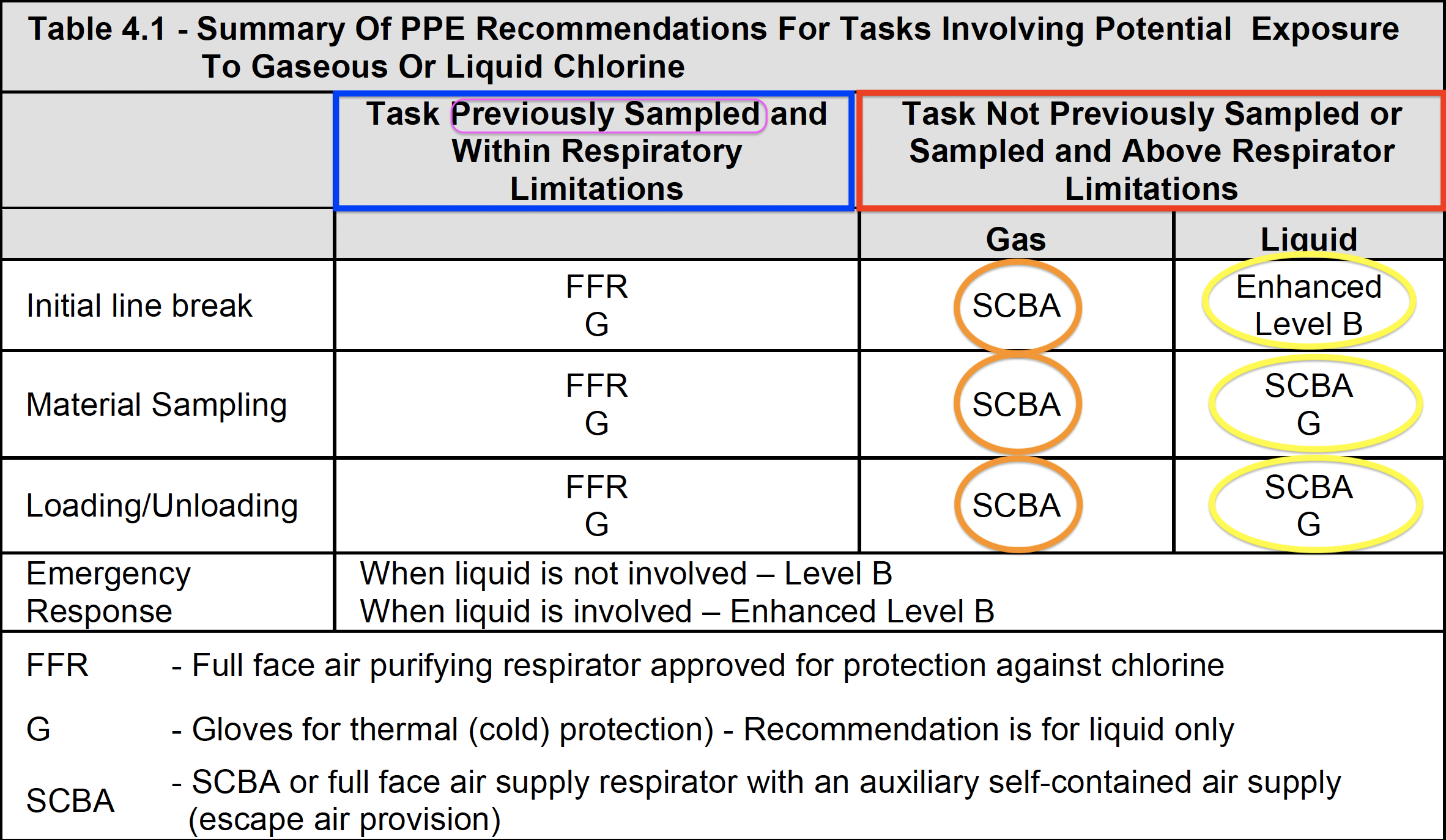
4.1 INITIAL LINE BREAK
If the specific initial line break currently being performed has been performed periodically in the past AND it has been demonstrated that the evacuation techniques and the maintenance procedures utilized will result in chlorine concentrations no more than the capability of the respirator.
Recommendations:
Chlorine Gas – Full face air-purifying respirator approved for protection against chlorine.
Chlorine Liquid – Full face air-purifying respirator approved for protection against chlorine. Gloves for thermal (cold) protection.
If the above criteria have not been met, Recommendations:
Chlorine Gas – SCBA or full-face air supply respirator with an auxiliary self-contained air supply (escape air provision).
Chlorine Liquid – Enhanced Level B
4.2 MATERIAL SAMPLING
If the specific sampling task has been periodically undertaken in the past and industrial hygiene sampling results demonstrated that the techniques being utilized may result in
chlorine concentrations no more than that for which the respirator is approved, Recommendations:
Chlorine Gas – Full face air purifying respirator approved for protection against chlorine.
Chlorine Liquid – Full face air purifying respirator approved for protection against chlorine. Gloves for thermal (cold) protection.
If the above criteria have not been met, Recommendations:
Chlorine Gas – SCBA or full face air supply respirator with an auxiliary self-contained air supply (escape air provision).
Chlorine Liquid – SCBA or full face air supply respirator with an auxiliary self-contained air supply (escape air provision) gloves for thermal (cold) protection.
PLEASE TAKE NOTICE how the respiratory protection BEGINS with an SCBA and can ONLY be LESSENED when we have actual experience and evidence of doing the task before AND we know what the exposure is while doing said OPENING task! Here is their PPE Matrix for OPENING a Chlorine Process, includes BOTH routine and non-routine openings:
(enhancements by me)
The Institute’s Enhanced Level B consist of:
- Positive pressure, full-face self-contained breathing apparatus (SCBA) or air supply respirator (ASR) with an auxiliary self-contained air supply (escape air provision).
- Fully encapsulated protective suit, but it is NOT gas-tight. This is what we call a LEVEL B Fully Encapsulated Suit – looks the same as a LEVEL A, but it not gas-tight!