
For nearly 25 years I have seen CLOSED relief systems used successfully on a multitude of processes involving Extremely Hazardous Substances (EHS) and for many years I have been proposing they be used in the Ammonia Refrigeration industry. The leading trade group for ammonia refrigeration has had a long-standing position against the need for hydrostatic relief protection on liquid piping runs. This long-standing position is not rooted in any type of engineering or risk analysis, as is proof when we look at the ammonia fertilizer process designs (OSHA and RAGAGEPs), which specifically call for hydrostatic protection on liquid NH3 piping.
With my experience being from the chemical industry, we had hydrostatic protection on our liquid NH3 runs on our refrigeration/latent heat plants, as we built into our design the ability to discharge each hydrostat to the atmosphere just because that was always possible in a chemical facility. But when ammonia is used in a mechanical refrigeration process like that found in a food plant, these hydrostats would/could be located in “normally occupied enclosed spaces” which means we could gas some folks with NH3 and/or contaminate large volumes of product with NH3; both not very desirable outcomes. So why not vent the hydrostat RV discharge outside? The push back on this is that “our pipe runs were built without this hydrostatic RV discharge consideration”, meaning that the discharge vents would have to travel long distances to reach outdoors. That is a fair argument to make on an existing process and the costs associated with moving the ammonia piping for just this reason is NOT a good business decision – so what can an existing process do so that it can be provided with Hydrostatic Relief protection but can not vent the discharge outside?
Solution: Using the Chlorine Institutes CLOSED hydrostatic relief system design. Here is the ultra-simple design from the Chlorine Institute…
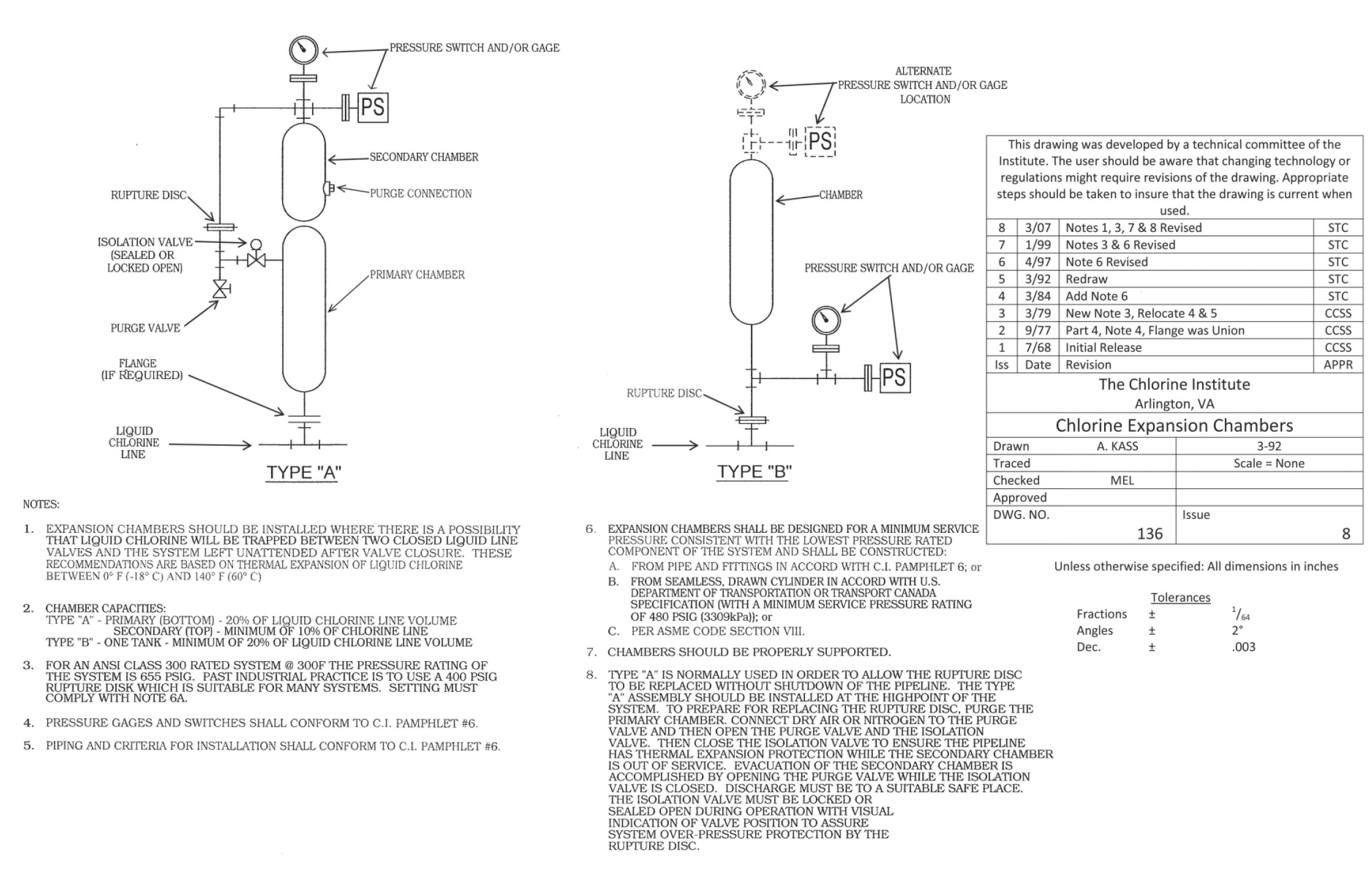
The RV System sizing basis is quite simple as well… the expansion tank must be able to receive at least 20% of the pipe volume. This means that a 2.5-gallon tank is sufficient for a pipe volume of 13 gallons, which corresponds to a 1″ pipe that is 325′ long. So these “expansion chambers” are quite small and take up very little space. We always built ours with either a tell-tale indicator gauge or in these modern times we have a pressure switch to tell us a hydrostat lifted and popped our rupture disc. Yes, this design will incorporate a rupture disc and these would be a new safety-critical device in most ammonia refrigeration processes; but this is easily managed for the value these expansion systems would bring to the process!
So wich is more reliable protection:
- a trained operator and SOPs to ensure we do not trap liquid NH3, or
- a trained operator and SOPs to ensure we do not trap liquid NH3 – backed up by hydrostatic relief system in those locations where the accidental trapping of NH3 could result in serious consequences
I’ll let you be the judge of that, but the argument that “we can’t use hydrostatic protection inside” is a bad response to the level of risks posed by the hydrostatic expansion of NH3. We have a proven design for just this application – take it or leave it, but in my training, an engineering control is much better than an administrative control (SOP and Training) for this level of risks. And combining the SOP, Training, and the Relief system is the level of process safety we should always be striving for!
NOTE: I have one (1) client in ammonia refrigeration who has successfully adopted this design. They were forced to do something different after two serious incidents across the business where liquid NH3 was trapped, expanded, and caused significant hardship to the business. They recalled our many conversations about my belief that NH3 is NH3 and it matters not what process it is in – it must have hydrostatic expansion protection. Their “trained operators” were failing and had caused these incidents so they were seeking alternatives. So far so good – they had an incident where another operator trapped NH3 and overnight the hydrostat lifted and the expansion system contained all the NH3 – not even a smell of NH3 in the production area. The only way they knew they had an overpressure event was the pressure switch alarm on their control panel. They are now believers!