
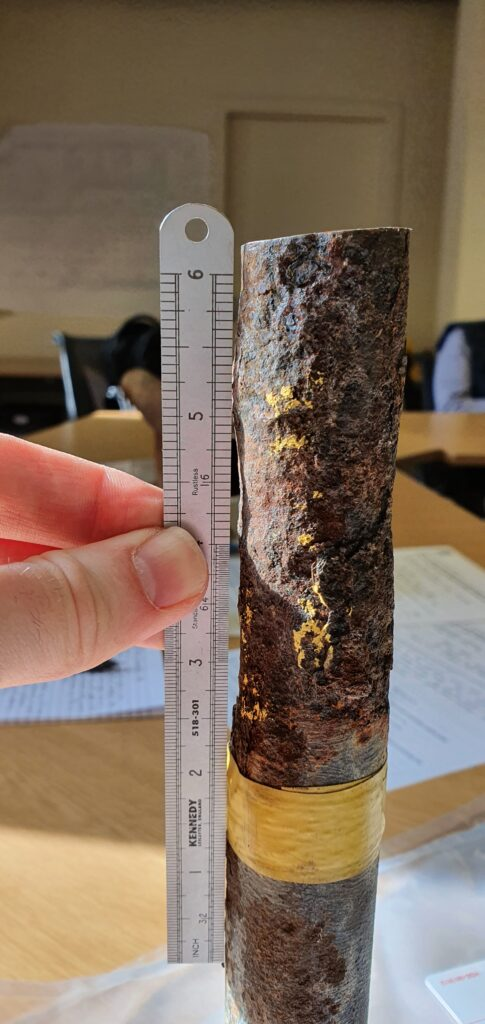
Five leaks of extremely flammable hydrocarbons occurred at the plant between February 2018 and September 2019, including one that lasted four months. The leaks were discovered after Health & Safety Executive inspectors detected a strong smell of flammable gas on a routine inspection – all five leaks were attributed to Corrosion Under Insulation (CUI). An investigation by the Health and Safety Executive concluded that the company did not have adequate arrangements for inspection of insulated pipework.
The business was fined £267,000 after health and safety inspectors found corroded pipes had caused five leaks of flammable gas at its Ethylene Plant. The plant was an Upper Tier COMAH [Control of Major Accident Hazards] establishment as defined by the 2015 COMAH Regulations, due to the volume of hazardous substances on site and the risk they posed to people and the environment. This means it was subject to the strictest controls because of the potential for catastrophic consequences of health and safety failings.
On 21 May 2019, Health and Safety Executive (HSE) inspectors visited the site for a routine inspection. They noticed a strong smell of Dimethyl Sulfide (DMS), a highly flammable liquid that irritates eyes and skin and is harmful if swallowed. An operator confirmed that DMS and ethane were leaking from an overhead pipe, and that the company had known about the leak for around four months but had kept operating without taking extra precautions.
Two holes can be seen in the affected part of the pipe
HSE launched an investigation. This revealed that the leak was not a one-off. There had been an earlier leak on the same pipe in February 2018, and another on a different pipe elsewhere on site in December 2018, both caused by Corrosion Under Insulation (CUI). As the investigation progressed, two more leaks were discovered, meaning five leaks in total, all caused by CUI. The investigation broadened to examine how the company managed CUI risk across the site.
23 February 2018: A pinhole leak of DMS and ethane developed on a 2-inch steel pipe (the “DMS line”), which was under high pressure and running at 115 degrees Celsius. The leak went on for around four months before being fixed.
15 December 2018: A leak of ethane gas was spotted by chance on a different pipe (the “ST01 Overheads line”) when a worker noticed a haze coming through the insulation while doing unrelated work. Corroded cladding had let four small holes form. The leak lasted around six weeks and an estimated 82 tonnes of hydrocarbons escaped into the atmosphere.
21 May 2019: The leak that triggered HSE’s routine inspection was found on the same DMS line as before, but at a different point. This time the leak was a mix of 20% DMS and 80% ethane. The company had first detected it on 29 January 2019, meaning it had been leaking for about four and a half months. HSE issued a Prohibition Notice on 24 May 2019 banning access to the area, followed by an Improvement Notice on 28 May 2019 ordering repairs. The company fixed the problem on 13 June 2019 by installing a bypass.
26 June 2019: While HSE’s investigation was still underway, a process technician found another pinhole leak, this time on the inlet line to the acetylene converter. X-ray testing showed the pipe had corroded below its safe minimum thickness. The company shut down part of the plant to make repairs, and the leak lasted around two weeks. Unlike the earlier leaks, this time the company acted swiftly rather than continuing to operate without extra safeguards.
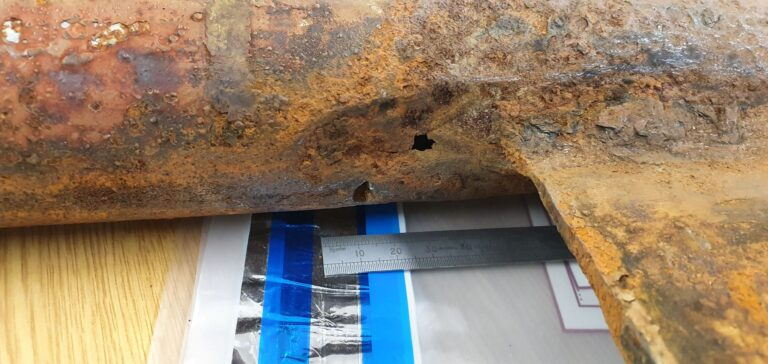
A straight ruler can be seen placed against the pipe, demonstrating extensive corrosion around the area of the leak
September 2019: While carrying out inspections required by HSE’s Improvement Notice, the company found a further pinhole leak on the ST01 Overheads line, close to the site of the December 2018 leak. This was repaired by purging the line and applying an epoxy wrap.
Why this matters
Every leak released highly flammable hydrocarbons into the atmosphere. In all but one case, this happened while the plant was operating normally, with staff and contractors working on site.
Corrosion Under Insulation happens when water gets in under that insulation and corrodes the pipe underneath. Left unchecked, it weakens pipes until they fail and leak. The industry accepts that CUI can’t be prevented entirely where insulation is needed, but it must be properly monitored and managed to keep the risk under control.
HSE’s investigation found the company’s inspection system was not fit for purpose. Inspectors carried out visual “scoping” checks on each pipe, and the results were fed into a computer tool alongside data on the pipe and its operating conditions. This produced a risk score from 1 (high risk) to 4 (low risk), and the company would only investigate further if a pipe scored 1 or 2. In practice, these visual inspections were often inadequate. Overhead pipes were typically checked from ground level, sometimes several meters away, with limited visibility, and insulation was not always removed to allow a proper look underneath. Despite suffering repeated leaks caused by CUI, the company did not recognize that its inspection process was flawed until HSE took enforcement action.
The company was required to shut part of the plant down in order to effect a repair after a pinhole leak was identified on a one-inch small bore connection