
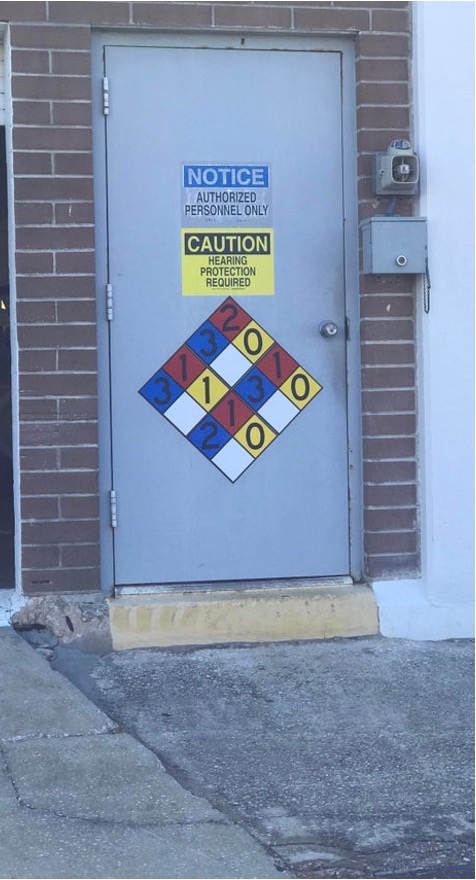
What PPE do you wear for a leak behind this door? What is the primary hazard that causes you the most concern?
We see so many failures with the NFPA 704 Diamond. From them being applied as a square, rather than a diamond. We see them applied upside down. We see numbers larger than 4.

Where more than one chemical is present in a building or specific area, professional judgment shall be exercised to indicate ratings using the following methods:
(1) Composite Method.
Where many chemicals are present, a single sign shall summarize the maximum ratings contributed by the material(s) in each category and the special hazard category for the building and/or the area.
The purpose of the Composite Method is to characterize the hazards as simply as possible when many chemicals are present. The sign reflects the area’s rating, not individual chemicals. For example, say a building contains materials with individual chemical ratings of 1-2-1 OX, 1-2-2 , 3-1-2, and 2-3-4, and a specific area of the building contains individual chemicals with ratings of 1-2-1 OX and 2-3-4. This situation would result in the following:
(1) The building would be placarded as 3-3-4 OX
(2) This specific area would be placarded as 2-3-4 OX
The specific area of the building would have two signs with the ratings of 1-2-1 OX and 2-3-4, each of which would include the chemical name below the sign. It should be recognized that the purpose of the standard is for recognition of hazards in an emergency; therefore, the number of signs displayed in a single place generally should not exceed five.
(2) Individual Method.
Where only a few chemicals are present or where only a few chemicals are of concern to emergency responders (taking into account factors including physical form, hazard rating, and quantity), individual signs shall be displayed. The chemical name shall be displayed below each sign.
Using the Individual Method for the same building containing the same chemicals, there would be four signs with the following ratings: 1-2-1 OX, 1-2-2, 3-1-2, and 2-3-4. Each sign would include the chemical name below the sign.
(3) Composite–Individual Combined Method.
A single sign shall be used to summarize the ratings via the Composite Method for buildings or other areas containing numerous chemicals. Signs based on the Individual Method shall be used in rooms or smaller areas within the building that contain small numbers of chemicals.
The Composite–Individual Combined Method allows users to utilize the best features of the other two methods. The outside of the building, enclosure, or area is posted with a single Composite sign for quick recognition of the overall hazards. Areas or rooms within the building are posted using either the Individual Method or the Composite Method, depending on the number of chemicals they contain.
When rating mixtures of chemicals, actual data on the mixture itself shall be used to obtain ratings for health, flammability, and instability.
Source: NFPA 704