The serious flaw in OSHA’s PRCS application

As I grow old I think I have mellowed out too much with “sutle” hints at hazards and how we “should consider” certain things.  Well, its time to throw some cold water on the issue and WAKE THE HELL UP PEOPLE!  We have done our last audit of 2019 and like many before them we found a serious issue regarding Permit-Required Confined Spaces (PRCS), or should I say Confined Spaces.  You see, in the eyes of OSHA 1910.146 and 1926.1201-.1213 only apply when the space rises to the level of being a PRCS.  And this application method means that if the hazard evaluation is done incorrectly, entrants could be exposed to serious dangers.  But what about the space that really does not contain any PRCS at the time of the evaluation and thus is NOT identified as a PRCS.  Often times these spaces are left out in left field and receive little to no safety efforts when workers enter them.  Over the past six years, we have been looking for these types of arrangements during our work, especially during our audits, and it has been quite shocking how many spaces we find workers inside doing work that has a high potential to generate a hazardous atmosphere (HAZ ATM) with no safeguards and the reasoning is always… “it’s not a PRCS”… but the work taking place makes it one!  Let me explain…

Those of you that follow my posts regularly may have noticed some of the OSHA case files I have been sharing this year.  It was a subtle attempt to raise awareness of these situations.  Frankly, when I found the first situation, it scared the hell out of me as I immediately thought back to the thousands of CS/PRCS evaluation I had done over my career and how many times I let a “confined space” just be a space like any other space AND THAT WAS A MISTAKE!  The OSHA standard is weak in this area as it only requires the employer to evaluate the workplace for CS and then to evaluate those CS’s to determine if they rise to the level of being a PRCS.

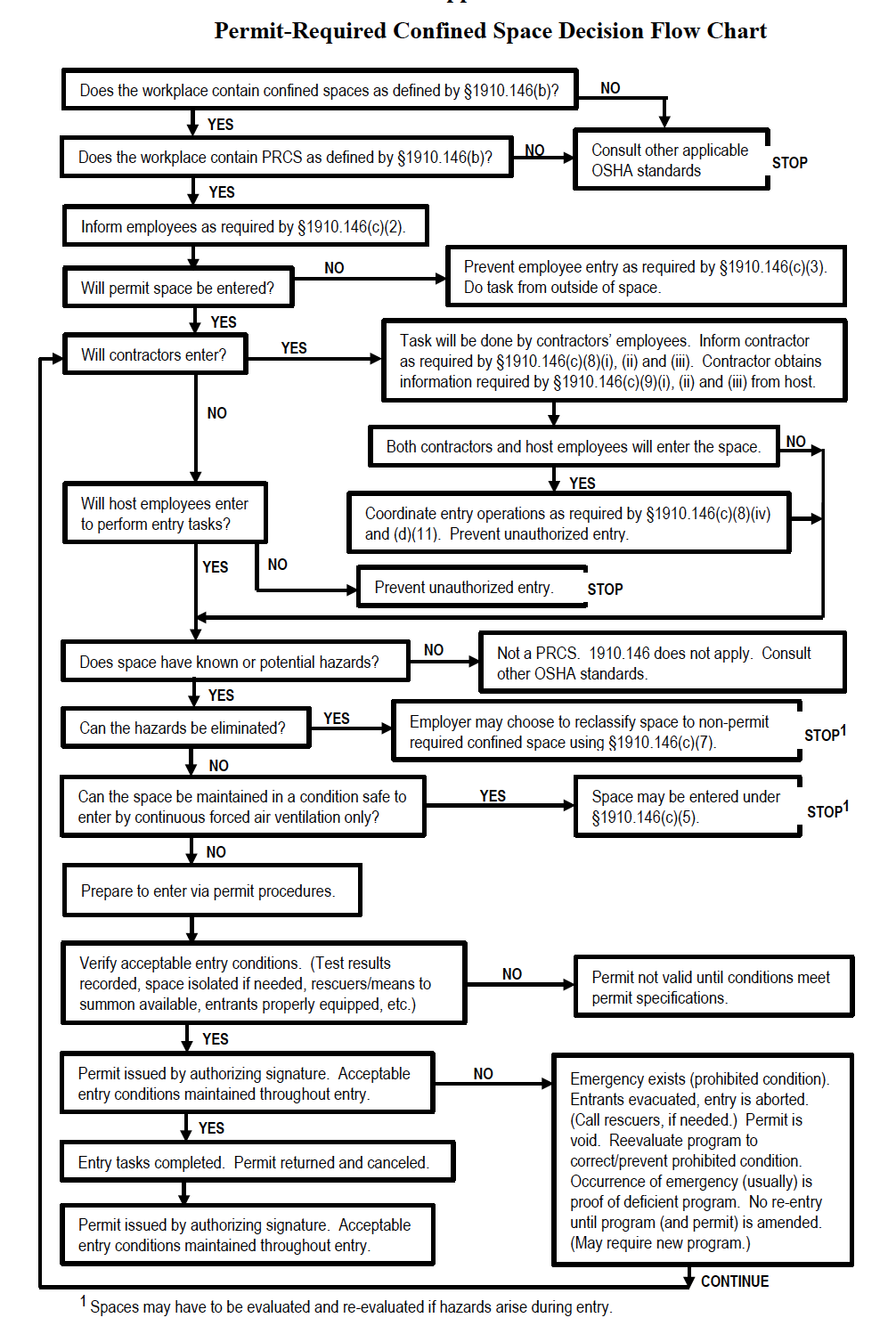
1910.146(c)(1) The employer shall evaluate the workplace to determine if any spaces are permit-required confined spaces.

NOTE: Proper application of the decision flow chart in Appendix A to section 1910.146 would facilitate compliance with this requirement.

1910.146(c)(2) If the workplace contains permit spaces, the employer shall inform exposed employees, by posting danger signs or by any other equally effective means, of the existence and location of and the danger posed by the permit spaces.

NOTE: A sign reading DANGER — PERMIT-REQUIRED CONFINED SPACE, DO NOT ENTER or using other similar language would satisfy the requirement for a sign.


Take for instance a 8′ deep pit – just a concrete pit with nothing in it.  Just four concrete walls and a floor. The pit is used as a housekeeping pit for waste paper from the process to be swept into.  But from time to time, someone has to climb down into the pit to clean and inspect it. A portable extension ladder is used to gain entry and to exit the pit;  therefore this space meets the definition of a Confined Space:

(1) Is large enough and so configured that an employee can bodily enter and perform assigned work; and

(2) Has limited or restricted means for entry or exit (for example, tanks, vessels, silos, storage bins, hoppers, vaults, and pits are spaces that may have limited means of entry.); and

(3) Is not designed for continuous employee occupancy.

But because its an empty pit, or one that will have waste paper in it, during the evaluation the pit gets classified as a Confined Space and such that OSHA’s PRCS standard(s) may not be applied toward any entry into this space. 

But what prevents a worker from taking a cleaning solvent down into the pit to clean the concrete.  The solvent certainly has the “potential” to generate a HAZ ATM, but since the space was not identified as a PRCS, the facility may never have the chance to stop this potential fatality and the hazard was self-created.  This has led a lot of businesses to manage their CS’s in a similar fashion as entering a PRCS.  This at least places an administrative control in place to prevent errant entry.  Businesses will use DANGER signs on their PRCS and something like a WARNING or CAUTION signs on their CS’s.  Maybe the entry procedures into a CS are not as robust as those for entry into PRCS, but we need something to ensure the entry will NOT generate a HAZ ATM.

Scroll to Top