The revised Heat National Emphasis Program (NEP), relaunched on April 10, 2026, represents a major shift in how OSHA handles heat-related enforcement. This isn’t just a renewal of the 2022 program; it is a full five-year directive (running through 2031) that gives inspectors more power to enter workplaces without a prior complaint.
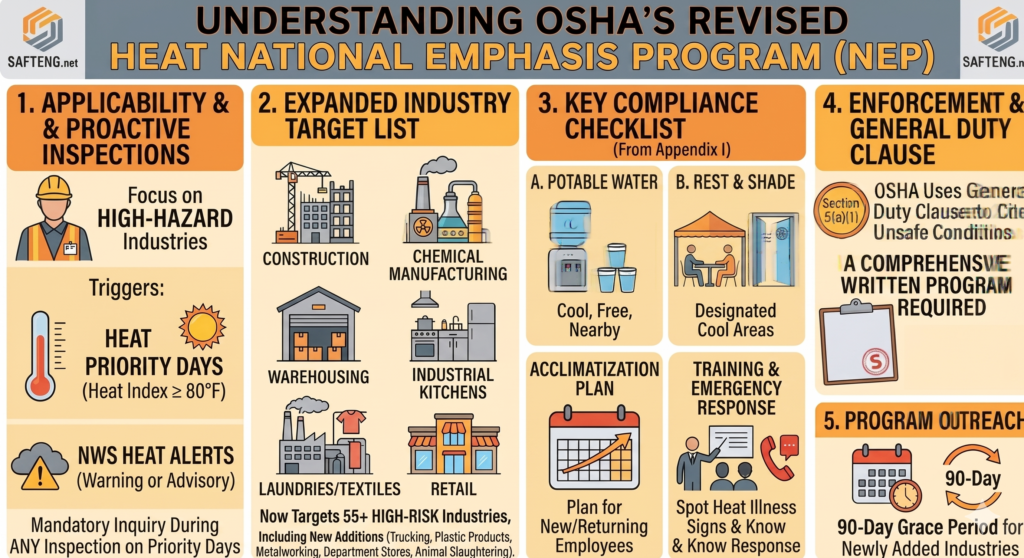
OSHA no longer waits for a heatwave to act. The program defines a Heat Priority Day as any day where the heat index reaches 80°F or higher
- Expansion of Scope: If an inspector is at your facility for a routine matter (like a PSV audit or a LOTO inspection) and it is a Heat Priority Day, they are now required to inquire about your heat illness prevention program.
- National Weather Service (NWS) Alerts: On days when the NWS issues a Heat Warning or Advisory, OSHA area offices are directed to conduct random, unannounced inspections of businesses on the high-hazard target list.
Expanded Industry Target List (55 Industries)
The 2026 update used BLS data from 2021–2024 to refine who they target. There are now 55 high-risk industries, including:
- Added sectors: General freight trucking, plastic product manufacturing, metalworking machinery, department stores, and animal slaughtering.
- Maintained sectors: Construction, chemical manufacturing, and warehousing.
- Indoor Focus: OSHA is aggressively looking at indoor environments with “radiant heat” sources—think industrial kitchens, laundries, and manufacturing floors—not just outdoor construction sites.
The “90-Day Outreach” Window
For the 22 newly added industries, OSHA is observing a mandatory 90-day outreach period (ending roughly mid-July 2026). During this time, they provide webinars and compliance assistance rather than programmed inspections. If you fall into a new category, this is your grace period to get a written program in place.
What Inspectors Look For (Appendix I Checklist)
The revised NEP includes a formalized evaluation tool. An inspector will look for:
- Potable Water: Is it cool, free of charge, and located close to work areas?
- Rest & Shade: Are there designated cool-down areas (shade for outdoors, AC/ventilation for indoors)?
- Acclimatization: This is the #1 “gotcha.” You must have a plan for new employees or those returning from a long break (e.g., the “20% per day” rule for increasing heat exposure).
- Training: Do supervisors and workers know how to spot the difference between heat exhaustion and heat stroke?
Enforcement via the General Duty Clause
Because there is still no final federal heat standard (the proposed rule remains in the rulemaking process), OSHA issues citations under the General Duty Clause [Section 5(a)(1)].
- To defend against these, you must show you have a “recognized hazard” management plan.
- Tip: If you have a written program that follows the NEP’s Appendix I, it is much harder for OSHA to sustain a General Duty Clause violation against you.
Quick Comparison: 2022 vs. 2026 NEP
| Feature | 2022 Original NEP | 2026 Revised NEP |
| Duration | 3 Years | 5 Years (Active until 2031) |
| Industries | 70+ (Generalized) | 55 (Data-driven high-risk) |
| Inspection Goal | Numerical target (e.g., 100/yr) | Eliminated (Focus on impact/data) |
| “Drive-bys” | Informal | Formally instructed (Inspectors must stop if they see hazards) |