
I have written extensively about James Reason’s Human Failure model and how it applies to almost all workplaces. Today I want to discuss specifics on how to use his model in our causal analysis.
For those already using some form of a Fault-Tree Analysis, such as TapRoot, you already have this capability built into your software. But many are not using commercial software to aid in this ability. So this article is for you and your introduction to defining Errors, Mistakes, and Violations associated with incidents.
So remember, we have Errors, Mistakes, and Violations. The following set of questions will help a team performing a Human Factors analysis of an incident determine what types of failures played a role. From there, the team can use the HF Worksheet of Solutions based on the type of error(s), mistake(s), and/or violation(s) found.
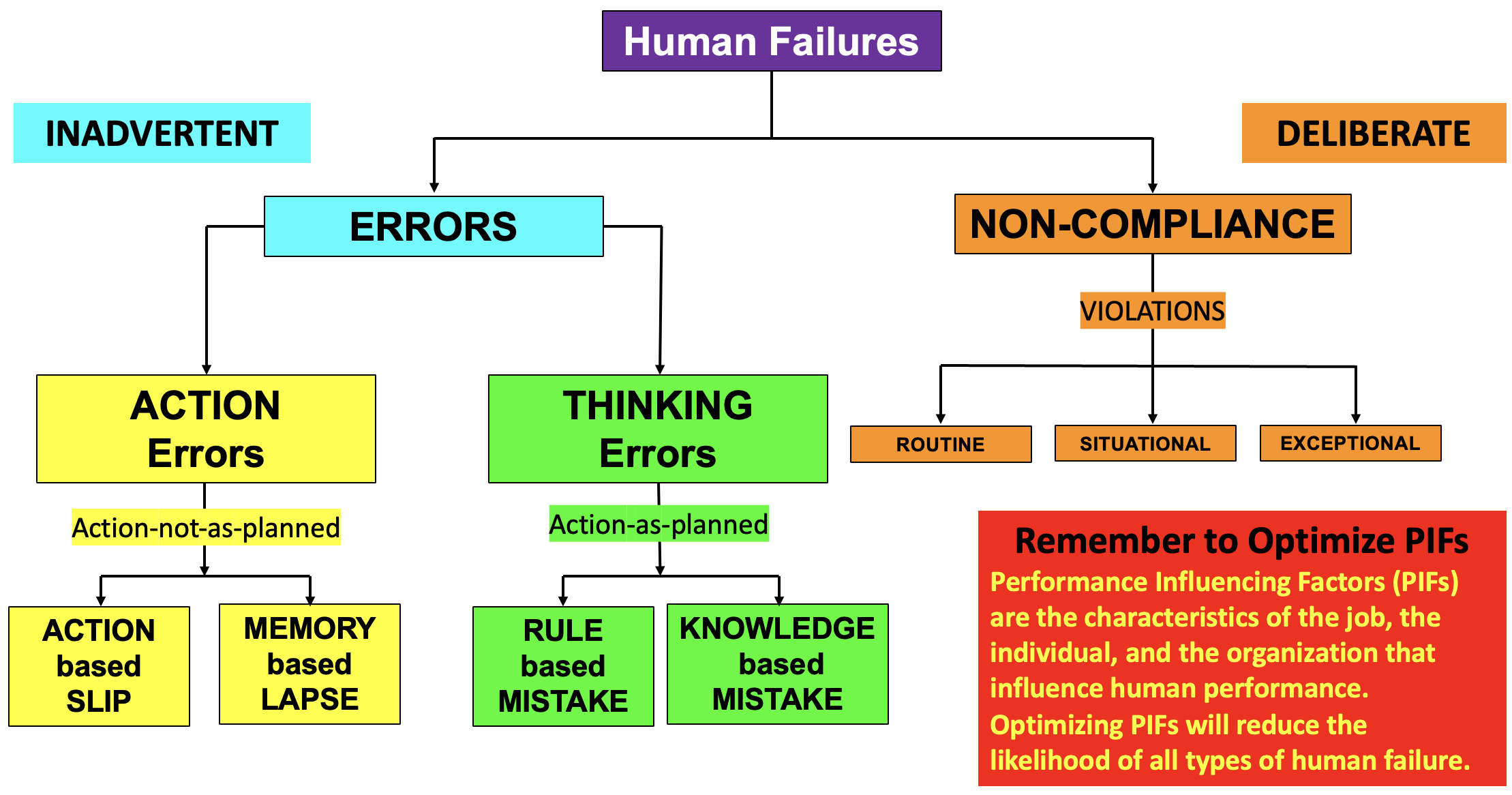
Let us examine workers’ many demands, working alone and with each other.
OPERATOR/INDIVIDUAL(S) FACTORS TO CONSIDER
This section examines crew members’ many demands, working alone and with each other.
Skill Based Errors
- Was the employee distracted?
- Was there a memory lapse? Did the employee forget to take the required action?
- Did the employee attend to one part of the job and miss a different piece of task-relevant information?
- Did the employee apply the wrong technique?
- Did the employee execute the correct procedure incorrectly (missing a step or skipping a step)?
- Did the employee execute a procedure or task that was in keeping with past practice but inappropriate for the current situation?
Decision Errors
- Did the employee’s actions misapply a rule or procedure?
- Did the employee carry out the wrong procedure correctly?
- Was the employee in a situation with no rule or procedure to follow, or the situation about which procedure to apply was ambiguous?
- Did the employee have the knowledge, skills, and abilities to do the job?
- Did the employee receive adequate training for the job?
- Was the crew qualified to perform the job?
- Was the work to be accomplished unclear or not well understood?
- Did the employee need to create a novel solution to complete the work?
- Was the crew experienced with this equipment, tools, and materials?
Perceptual Errors
- Did the employee fail to see, hear, or feel all the information needed to complete the job?
- Was the information needed by the employee degraded, ambiguous, or incomplete?
- Did the employee misjudge the information needed to accomplish the job?
Routine Violations
- Did the employee routinely violate the rules, operating practices or procedures with good intent (e.g., to get the job done)?
- Was there meaningful enforcement of the violations involved in the event?
- Is non-compliance with the rules and procedures common?
- Did communication follow standard procedures and protocol?
Situational Violations
- Was the violation dictated by situation-specific factors such as time pressure, workload, weather, or lack of equipment or resources?
- Was the employee placed in a situation where the decision involved choosing which rule to violate?
Exceptional Violations
- Was the violation an unusual or rare activity?
- Was the violation not condoned by management and vigorously enforced?
- Did something go wrong that required the employee to take an unusual step of breaking the rule?
PRECONDITIONS (CONTEXT) FOR OPERATOR ACTS
This section examines the contextual factors that fostered, enabled, or set up the operator to make an error or violate a rule, procedure, or practice.
Condition of Operators
This section addresses the individual’s cognitive and physiological conditions that affect job performance.
Adverse Mental States
- Was the employee fatigued?
- Did the employee’s workload impact their performance?
- Was the employee preoccupied with thoughts unrelated to the job?
- Was the employee attending to work-related activities unrelated to the event?
- Was the employee’s attention focused narrowly on a specific task or a warning?
- Was the employee monitoring for potential hazards?
- Did the employee’s motivation or emotional state impact their ability to do the job?
- Did the employee’s expectation or anticipation impact their ability to detect or attend to a potential hazard?
- Did problems outside work impact the employee’s ability to focus on their job?
Adverse Physiological States
- Did the employee have any medical conditions that impacted their performance?
- Was the employee adversely impacted by heat or cold?
- Did the employee have a disturbed sleep pattern?
- Did the environment make it difficult to see, hear or feel?
- Was the employee taking any over-the-counter or prescription medication that adversely impacted them?
- Was the employee exposed to any hazardous chemicals or biological substances, during the event?
ENVIRONMENTAL FACTORS
This section looks at the physical and technological environment where employees work.
Physical Environment
- Was the site properly maintained (good housekeeping)?
- Did the ambient environment (temperature, lighting, space, vibration, safe paths) support the work environment?
- Was the work site clean, and ready for work, with safeguards in place?
- Was the site clean and free of tripping hazards?
Physical/Cognitive Limitations
- Did the operational requirements exceed the physical limitations of the employees?
- Did the operational requirements exceed the cognitive limitations of the employees?
- Did the employee have any visual or auditory deficits?
- Was the employee adequately trained to perform the work?
- Did they have adequate experience to operate the equipment or perform the task?
PERSONNEL FACTORS
This section addresses deficiencies in coordination and communication between employees and failure to prepare for duty.
Resource Management
- Did the employees conduct a job (safety) briefing?
- Did the employees coordinate effectively with each other?
- Was there a miscommunication (misunderstanding)
- Was there a breakdown in communications (equipment failure)?
- Was the message inaccurate?
- Did one or more of the employees misunderstand the communication?
- Did a member of the extended crew (dispatcher, foreman, employee-in-charge, etc.) keep information from his/her teammates?
Personal Readiness
- Was the employee adequately rested before performing their work?
- Was the employee impaired due to self-medication (prescription or over-the-counter)?
- Was the employee impacted by poor diet, drugs, alcohol, or over-exertion before starting work?
Technology Environment
- Is the technology designed to support the work that employees need to do?
- Were safeguards in place and operable?
- Was the equipment or technology in working order?
- Were equipment inspections and audits up to date and documented?
- Was any new technology in place at this location? If so, was there proper training at this site?
- Is equipment (signage, alarms, vehicles, tools, etc.) working correctly?
- Did the employee have the equipment, tools, and materials they needed?
- Were the limits of the equipment or technology exceeded?
SUPERVISORY FACTORS TO CONSIDER
This section looks at the challenges supervisors face and their decisions while safely getting work done through others.
Inadequate Supervision
- Did the supervisor provide sufficient support for the operators to do their jobs
- Did the supervisor monitor the employees’ performance?
- Did the supervisor provide adequate training and resources to do the job?
- Did the supervisor track employees’ qualifications to do their jobs?
- Did the supervisor allow employees to receive adequate rest?
- Did the supervisor provide current documentation (e.g., rulebooks, special instructions, etc.)?
- Was the supervisor knowledgeable about how to perform the work and the procedures for doing the work?
- Was the supervisor overworked?
- Does the supervisor have time and resources to balance the competing demands they must respond to?
Planned Inappropriate Operations
- Did the supervisor require the employee to work under excessive workload conditions?
- Did the supervisor expect the employees to complete the work in less than usual?
- Did the supervisor make the workload low enough for the employees to become complacent?
Failure to Correct Problem
- Did the supervisor know about the problem?
- Did the supervisor fail to correct observed or known behaviors, conditions, or hazards?
Supervisory Violations
- Did the supervisor disregard existing operating rules, regulations, or policies to allow employees to save time and/or money?
- Did the supervisor encourage employees to disregard the rules or operating practices?
- Did the supervisor fail to enforce the rules and regulations?
- Did the supervisor permit unqualified employees to work?
ORGANIZATIONAL FACTORS TO CONSIDER
This section addresses senior management and executive-level decisions, policies, practices, and procedures which guide operations.
Resource Management
- Have organizational policies or practices impacted the recruitment, selection, staffing or scheduling of employees (including managers)?
- Have organizational policies or practices impacted the training and retention of employees (craft & management employees)
- How have organizational decisions impacted equipment and infrastructure acquisition, operation, and maintenance?
- Have organizational decisions resulted in the delay of needed equipment or infrastructure or equipment shortages?
- Have organizational decisions resulted in the acquisition of equipment/infrastructure that is poorly designed or inappropriate for its intended use?
- Is there inadequate or insufficient funding for safety, operational, and maintenance programs?
- Do cost-cutting measures impact staffing and equipment needed to perform work?
- Does senior management have time and resources to balance the competing demands they must respond to?
Organizational Climate
- Did the organizational structure (chain of command, a delegation of authority, and formal accountability for actions impact the event)?
- How visible was the management presence?
- Did the frequency of management interaction with employees play a role (e.g., micromanagement or lack of supervision?
- Did the organizational policies in place support the work environment?
- How did the unofficial or unspoken rules that the employees hold about the organization impact the event?
- Are shortcuts and rule violations routinely condoned?
Organizational Processes
- Did the operational tempo, time pressure, or competing goals impact performance?
- Is the production level steady and predictable, or does it vary?
- Did pressure to meet the production level overshadow safety concerns?
- Were competing or conflicting goals involved in the event?
- How did incentives (rewards or punishment) influence people’s behavior?
- Were the operational practices (rules, tasks, procedures) inadequate, ill-defined, or inappropriate?
- Was the information communicated about the practices inadequate, ill-defined, or inappropriate (e.g., rulebooks, paperwork, checklists, training)?
- Did the organization provide adequate oversight through safety programs, hazard identification and mitigation, and investigation procedures?
- Did the organization monitor the adequacy of resources and operating practices necessary for safe operation?
Change Management
- Did changes in organizational structure or processes, or equipment occur?
- Has the organization recently acquired new equipment or technology?
- Is there a formal process for managing changes in organizational structure, process, technology, and equipment?
OUTSIDE INFLUENCES TO CONSIDER
This section looks at how influence from outside the railroad that can affect safe railroad operations.
Regulatory Oversight
- Are the relevant regulations or laws antiquated, or ambiguous?
- Are the relevant regulations or laws poorly designed or written?
- Do the relevant regulations or laws contribute to unsafe working conditions or an unsafe environment?
- Are the regulations or laws targeted at the wrong group?
- Does the regulator consistently enforce the regulation?
- If no, is noncompliance routine, the exception, or on purpose?
Economic/Political/Social/Legal Environment
- Did industry standards or guidelines play a role?
- Were there outside pressures, tensions, or expectations from the media, national labor-management negotiations, standards-setting organizations, local communities, Congress, and court decisions that influenced behavior?
- How did collective bargaining agreements influence the event?
- Did passengers, shippers, suppliers, or contractors contribute?
- Did the business climate impact the event?
- Did national, state, or local political figures influence the working environment or conditions?
- Did media attention impact the environment in which the event occurred?
- Have changes in the workforce taken place that impacted the event?
CLICK HERE for the Checklist in a WORD document