
PHMSA identifies the hazardous materials that have been linked to the most serious consequences in terms of deaths and major injuries relative to exposure. The Office of Hazardous Materials Safety (OHMS) periodically reviews the incident data to explore, develop and refine methodologies that illustrate which hazardous materials are most likely to be involved in death and major injury relative to how much is transported and how far they are transported. The specific methodology presented here has limitations, but it provides one potential indicator for identifying these “top consequence” hazardous materials.
This indicator is called the “normalized hazard rating,” and is calculated in a few steps.
DOT’s 2016 guidance on the economic Value of a Statistical Life (VSL) uses a coefficient of 0.266 for the injury class of MAIS 4, “Severe,” so 0.266 is used to weigh the severity of major injuries downward relative to the severity of deaths, which has a coefficient of 1.48.
First, calculate the product of 0.266 and the total number of major injuries for each hazardous material.
Second, add this product to the total number of deaths for each hazardous material.
Third, to normalize by exposure, divide the resulting sum by U.S. Census Commodity Flow Survey (CFS) estimates for million ton-miles transported.
Lastly, multiply by 1,000 as a neutral way to change the scale of the normalized hazard rating.
Please note, the normalized hazard rating is NOT an index where figures are relative to 1, 10, 100, or some other index baseline.
Because of several limitations, PHMSA urges stakeholders to exercise care in interpreting the aggregated results. In particular, PHMSA cautions against equating a commodity’s ranking with safety risk; a commodity’s ranking may not be indicative of the extent of the risks associated with the transport of that commodity.
Further, the commodity is just one of many factors to be considered as influencing the occurrence or severity of an incident. PHMSA also cautions against using the rankings as a driver for a policy or business decisions.
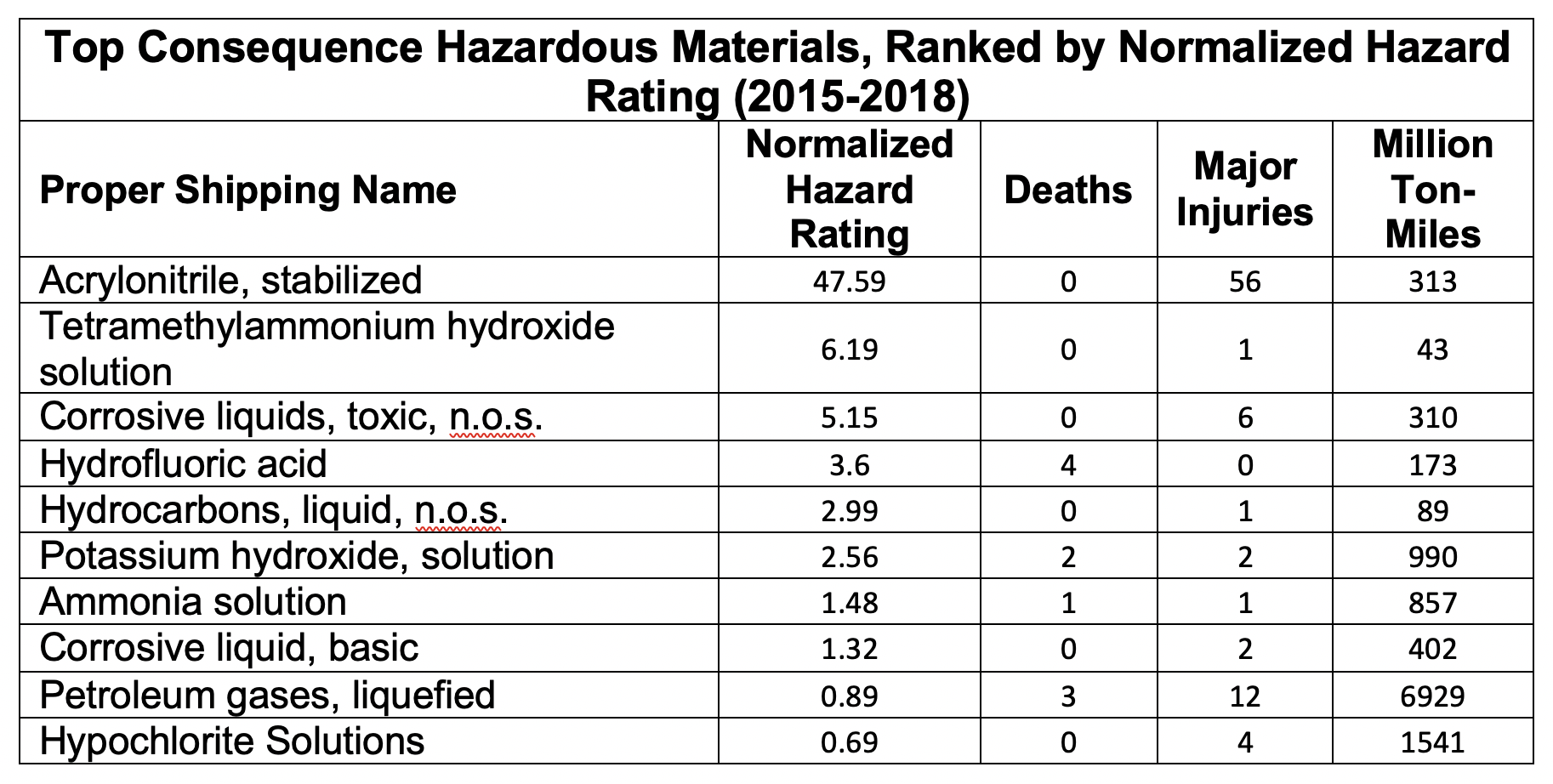
In Figure 3.6 below, OHMS presents the hazardous materials with the ten (10) highest, normalized hazard ratings over 2015-2018, sorted in descending order. Higher ratings may suggest which hazardous materials have a greater potential for death and major injury consequences, relative to other hazardous materials with lower ratings.

As seen above, from 2015-2018, the hazardous material with the highest, normalized hazard rating was Acrylonitrile, stabilized, a Class 3 flammable liquid with a toxic subsidiary hazard (6.1). The incident data for 2015-2018 also shows that this material was only involved in one incident with death or major injury, which occurred in Maryville, Tennessee on July 1, 2015 as a result of a derailment. However, that one incident resulted in 56 major injuries, which was the greatest number of major injuries in any one incident during the reporting period.
As previously noted, this finding illustrates the potential overrepresentation of low-probability, high-consequence events in this ranking system. The normalized hazard rating for Acrylonitrile, stabilized is more than seven times higher than the second-ranked hazardous material, Tetramethylammonium hydroxide solution.
