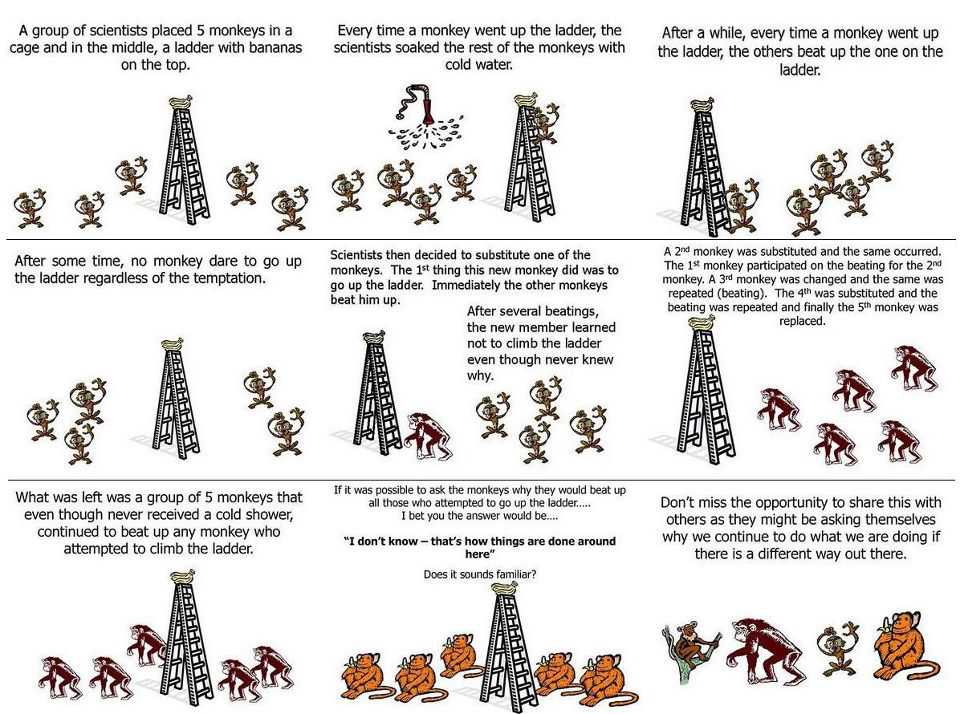
A researcher puts five (5) gorillas in a cage where a cluster of bananas is hanging from a string, with a ladder leading to the bananas. When the first gorilla goes for the bananas, the researcher sprays ALL five (5) gorillas with freezing water for five minutes. Sometime later, when a second gorilla inevitably tries to go for the bananas, the researcher once again sprays all five (5) gorillas with the cold water for five minutes.
The researcher then puts the hose away and never touches it again. But, when a third gorilla tries to go for the bananas, the other four (4) attack him to prevent him from climbing that ladder. They are afraid of the punishment that may come.
Then, the researcher replaces one (1) of the gorillas with a new gorilla that wasn’t part of the original experiment and was never sprayed with water. And, as soon as he touches the ladder to go for the bananas, the other four (4) gorillas attack him to keep him from doing so. If he tries again, they attack him again. Thus, the new gorilla learns not to go after the bananas because he’ll get attacked if he does.
The researcher replaces a second gorilla. When this new gorilla goes for the bananas, the other four (4) attack him, including the new gorilla who was never sprayed with water.
The researcher then continues to replace all the gorillas one at a time, until all five (5) of the original gorillas are removed from the cage. Each time the newcomer goes for the bananas, the others attack, even when they, as new gorillas, have never received punishment for going after the bananas. And thus, the new gorillas, who have never been sprayed with cold water, learn not to go after the temptation of the bananas.
The researchers hypothesize that, if they were to ask the Gorillas why they don’t go for the bananas, they’d answer “because that’s the way it’s always been done”.
PLEASE NOTE: the story was changed to make it simple and short, but this was an actual study from 1967. They used blasts of air rather than cold water…
|
|
E. Summary The social learning situation suggested by field and laboratory observations to be involved in the acquisition of culture by individuals in groups of macaque monkeys was studied by a controlled laboratory method. In six of eight critical tests sequences with pairs of socially normal lab-reared rhesus monkeys, the behavior of one subject toward an object altered, with lasting consequences, the independent behavior of a second subject toward that same object. Observational learning and admonition are distinguished as two types of information transfer between subjects which mediate the acquisition of culture in monkeys. |
Department of Zoology, University of Wisconsin
Madison, Wisconsin 53706
Cultural Acquisition of a Specific Learned Response Among Rhesus Monkeys
Gordon R. Stephenson