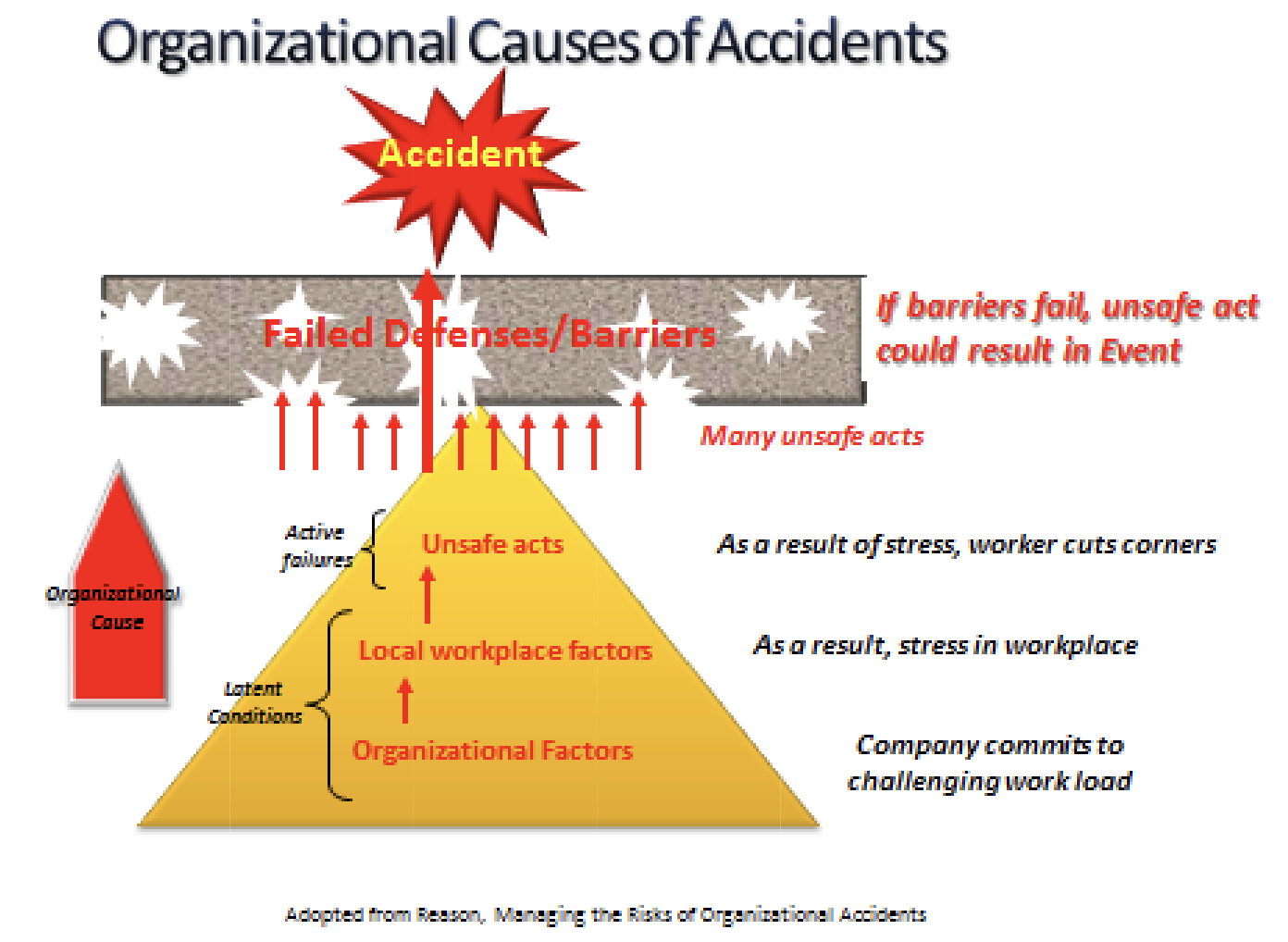
Investigations of accidents in a number of hazardous domains suggest that a cluster of organizational pathologies—the “vulnerable system syndrome” (VSS)—render some systems more liable to adverse events. This syndrome has three (3) interacting and self-perpetuating elements:
- Blaming front-line individuals,
- Denying the existence of systemic error provoking weaknesses and
- Blinkered pursuit of productive and financial indicators of safety
VSS is present to some degree in all organizations, and the ability to recognize its symptoms is an essential skill in the progress towards improved safety performance.
Key messages
- Accident investigations in various hazardous domains suggest that a cluster of organisational pathologies—the “vulnerable system syndrome” (VSS)—render some systems more liable to adverse events.
- VSS has three interacting and self-perpetuating elements: blaming front-line individuals, denying the existence of systemic error-provoking weaknesses, and the blinkered pursuit of productive and financial indicators. The need to achieve the latter targets is often cited as the reason why necessary systemic improvements cannot be made.
- VSS is present in some degree in all organizations. Recognizing its presence and taking remedial action is an essential prerequisite of effective risk management.
- A crucial remedial step is to engage in “double-loop” organizational learning that goes beyond the immediate unsafe actions to question core assumptions about human fallibility and to identify and reform the organizational conditions that provoke it.
It’s argued that the ability to recognize the symptoms of VSS is a critical system’s capability in order to drive toward safe and reliable performance.
The elements are:
1) Blame
Of the three core pathologies, the very human tendency to blame individuals for bad outcomes—or excessive adherence to the “person model” —is the most tenacious and
perhaps the most pervasive in its harmful effects on organizational safety. It has its origins in a quartet of psychological factors:
- the fundamental attribution error,
- the illusion of free will,
- the just world hypothesis, and
- hindsight bias
THE FUNDAMENTAL ATTRIBUTION ERROR
The fundamental attribution error3 is one of the main reasons why people are so ready to accept the phrase “human error” as an explanation rather than something that needs explanation. When we see or hear of someone performing less than adequately, we tend to put it down to the individual’s personality or ability. We say that he or she was careless, silly, stupid, thoughtless, incompetent, or reckless.
But if you were to ask the people in question why they acted in that way, they would almost certainly describe how the circumstances had constrained their actions. Everyone is capable of a wide range of actions, sometimes ill-judged, sometimes inspired, but mostly somewhere in between. Of the three elements, blame is said to be the “most tenacious and perhaps the most pervasive in its harmful effects upon organizational safety.”
Blame focus can relate to an excessive focus on the “person model” of performance. Systems are ordinarily safe, and people introduce variability and risk.
THE ILLUSION OF FREE WILL
Another reason we are inclined to blame people rather than situations stems from the illusion of free will. People, especially in Western cultures, place great value in the belief
that they are, in large part, the controllers of their own destinies. They can even become mentally or physically ill when deprived of this sense of personal freedom. Feeling capable of choice naturally leads us to assume that other people are the same. They, too, are seen as free agents, able to choose between right and wrong and between correct
and erroneous courses of action. When people are presented with accident reports and asked to judge which causal factors were the most avoidable, they almost invariably pick out human actions. These processes act in concert to drive the blame cycle.
THE JUST WORLD HYPOTHESIS
Another factor is the just world hypothesis. This is the belief shared by most children and many adults that bad things only happen to bad people, and conversely. In the safety context, the healthcare professionals implicated in an adverse event are seen as bad by virtue of the unhappy outcome.
incidents of intrathecal administration of medication since 1975. Analysis of these incidents has identified common factors, including transportation practices between the pharmacy and wards, poor training and risk awareness among junior doctors, and the design and labeling of drug syringes.
the fleeting psychological precursors of fallibility—for example, inattention or forgetting—are the last and the least manageable aspects of the error-producing sequence.
2) Denial
The American social scientist Ron Westrum distinguished three (3) kinds of safety culture:
- pathological,
- bureaucratic, and
- generative
The main distinguishing feature is the way in which an organization handles safety-related information. Generative or high-reliability organisations “encourage individuals and
groups to observe, to inquire, to make their conclusions known, and, where observations concern important aspects of the system, actively bring them to the attention of higher management”. In sharp contrast, pathological organizations muzzle, malign, or marginalize whistle-blowers, shirk collective safety responsibility, punish or cover up failures, and
discourage new ideas. In short, they do not want to know. Bureaucratic or calculative organizations (the large majority) lie somewhere in between. They will not necessarily
shoot the messenger, but new ideas often present problems. Safety management tends to be compartmentalized. Failures are isolated rather than generalized and are treated by local fixes rather than by systemic reforms.
Having thus dispelled any nagging concerns about the institution’s stance on patient safety, the top managers of a pathological—or sometimes even a bureaucratic—are now free to pursue the efficiency and cost-saving targets that feature so prominently in the delivery of modern health care. Managing by such objectives is what professional managers have been trained for, and not unreasonably, they feel that their performance will be judged primarily by the extent to which they achieve these goals. This opens the way to the single-minded pursuit of the wrong kind of excellence.
3) The wrong kind of excellence
They argue that even the most diligent and mature organizations can still be miscalibrated in their pursuit of excellence. For instance, many companies with hazardous operations still measure plant safety by injury metrics. Such personal injury metrics “provide little or no indication of a system’s liability to a major disaster.”
The authors argue that the origins of this “blinkered pursuit of excellence” include:
- The human tendency to think in linear sequences. We form impressions based on causal series, A leads to B then C, rather than in networks of interacting factors
- People are “sensitive to the main effects of their actions upon the progress towards an immediate goal, but frequently remain unaware of their side effects upon the rest of the system”
- In highly interactive and tightly coupled systems, the knock-on effects of interventions are said to radiate outwards like ripples in a pool; but people can often only see their own narrow area of concern
- People also aren’t good at controlling processes that develop or radiate in an exponential or non-linear fashion
In wrapping up VSS, it’s argued that these three interlinked pathologies drive a focus towards the human model of performance, and thus:
- “Seriously sick” organizations forget to be afraid or never learned to be afraid
- They remain “firmly and fatally” attached to their comfort zone of safety, where serious issues relating to people and can be addressed via retraining and the like can be a vicious cycle to break
- In their view, there is “no organization involved in hazardous work in any domain that is entirely free from the VSS. Some symptoms are to be expected everywhere: after all, complex systems are designed, built, managed, operated, and maintained by human beings.”