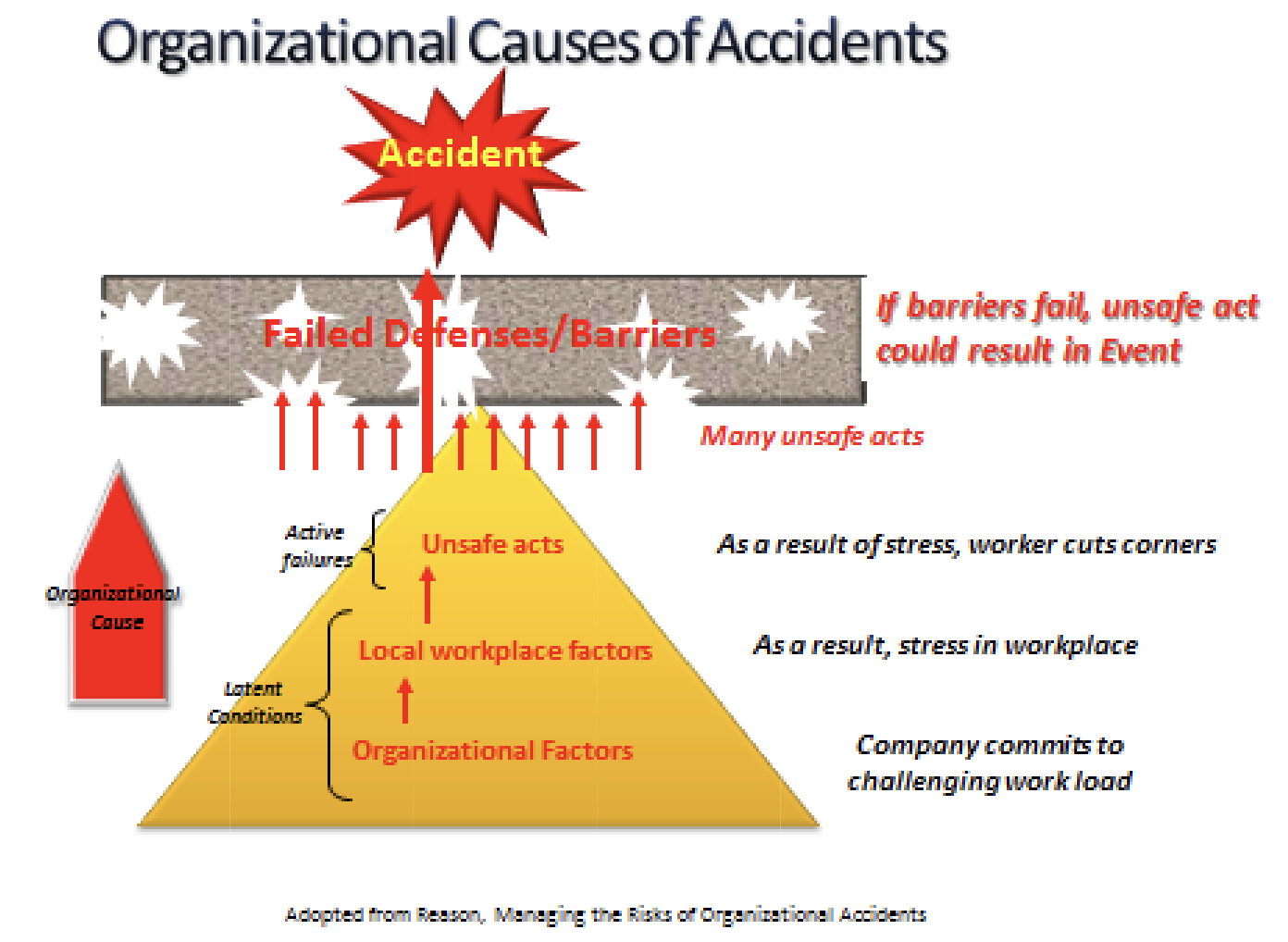
A comparison of the characteristics of active and latent failures suggests that avoiding active failures tends to drive down the frequency of events while finding and rectifying the results of latent failures tends to drive down the severity of events.
| Characteristics | ACTIVE FAILURES | LATENT FAILURES |
|
Who? (so-called “perpetrators”) |
People in production areas: front-line workers in direct contact with hazardous processes (sharp end) | Most people in administration: executives, managers, engineers, and clerical staff, but front-line workers can also play a part (blunt and sharp ends) |
|
What? (the result of failure) |
Damage, loss, or injury to tangible assets (in general): people, facilities, hardware, equipment, tools, systems, product, property, environment, etc. |
Weaknesses or defects in system defenses such as facility design; equipment configuration; procedure content, accessibility, and usability; tools and resources; training program content or delivery; management policies; management systems; corporate values and norms. Tend to contribute to the creation of land mines, error traps in the workplace (latent conditions) |
|
When? (onset of harm) |
Immediate: usually faster than human beings are |
Later: harm realized when triggered by subsequent human activity or other triggering activity. Note: latent condition created right away; time-at-risk starts |
|
Visible? (detectability) |
Yes: observable injury, damage, or loss | No: usually hidden in plain sight (without looking for them) |
|
Duration? |
Momentary: time needed to dissipate energy, move mass, or transmit information |
Long-lasting: conditions persist and accumulate until detected and corrected |
| Event frequency or severity? |
Tend to drive the frequency of occurrence of events—the more active errors the more events | Tend to drive the severity of events that occur by reducing or inhibiting the effectiveness, presence, and robustness of defenses |
Source: Risk-Based Thinking – Managing the Uncertainty of Human Error in Operations, Tony Muschara, 2018