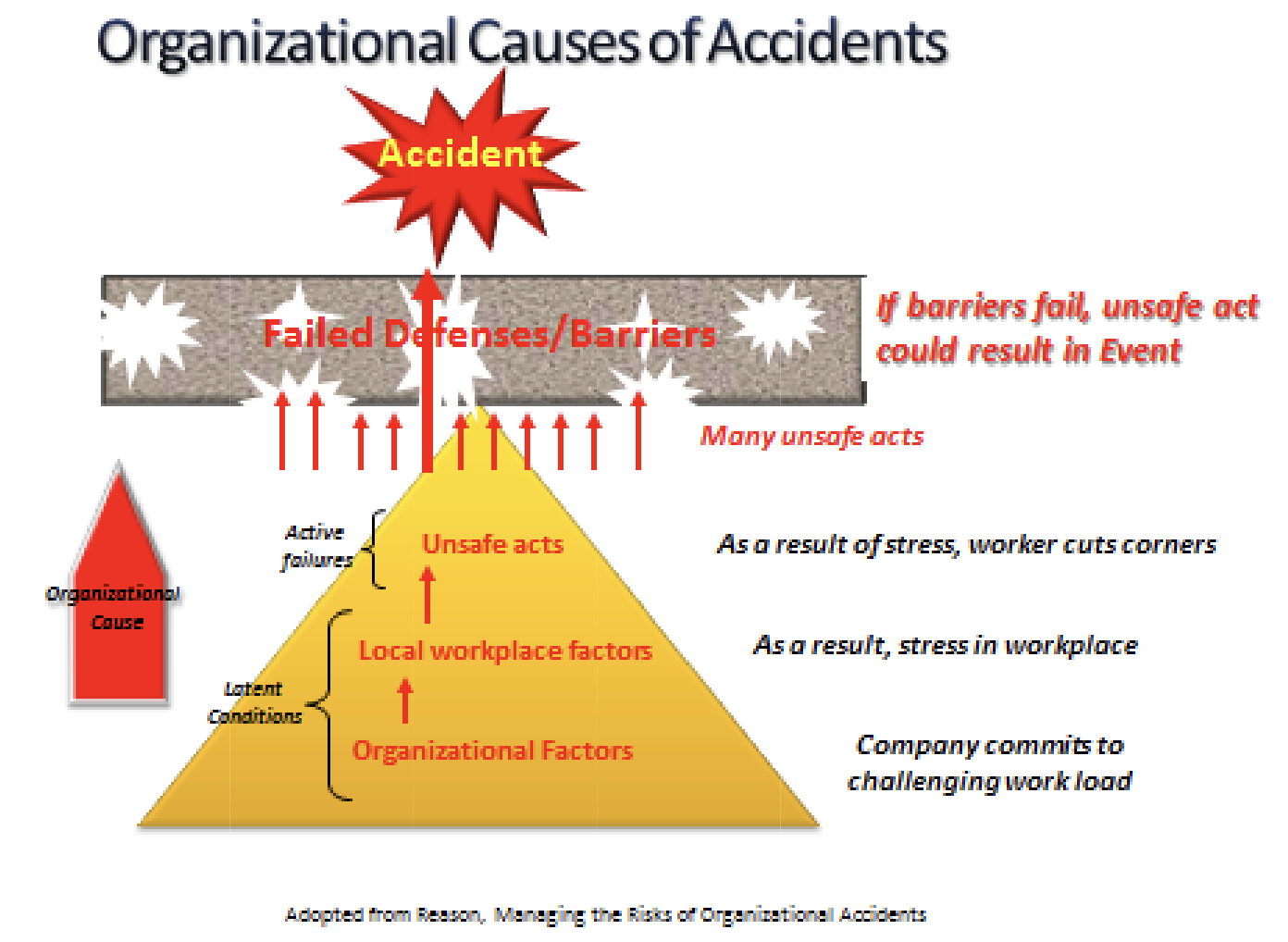
Error Management (EM) has two (2) components:
- error reduction and
- error containment
Error reduction comprises measures designed to limit the occurrence of errors. Since this will never be wholly successful, we also need error containment measures designed to limit the adverse consequences of those errors that still occur. At this general level, EM is indistinguishable from quality management or, indeed, from good management of any kind.
Error management includes:
- Measures to minimize the error liability of the individual or team.
- Measures to reduce the error vulnerability of particular tasks or task elements.
- Measures to discover, assess, and then eliminate error-producing (and violation-producing) factors within the workplace.
- Measures to diagnose organizational factors that create error-producing factors within the individual, the team, the task, or the workplace.
- Measures to enhance error detection.
- Measures to increase the error tolerance of the workplace or system.
- Measures to make latent conditions more visible to those who operate and manage the system.
- Measures to improve the organization’s intrinsic resistance to human fallibility.
The balance of scientific opinion clearly favors the situational rather than the personal approach to error management. There are many reasons for this.
- Human fallibility can be moderated up to a point, but it can never be eliminated entirely. It is a fixed part of the human condition, partly because errors, in many contexts, serve a useful function (for example, trial-and-error learning in knowledge-based situations).
- Different error types have different psychological mechanisms, occur in different parts of the organization, and require different management methods.
- Safety-critical errors happen at all system levels, not just at the sharp end.
- Measures that involve sanctions, threats, fear, appeals, and the like have only very limited effectiveness. And, in many cases, they can do more harm to morale, self-respect, and a sense of justice-than good.
- Errors are a product of a chain of causes in which the precipitating psychological factors-momentary inattention, misjudgment, forgetfulness, and preoccupation are often the last and least manageable links in the chain.
- The evidence from many accident inquiries indicates that bad events are more often the result of error-prone situations and activities than they are of error-prone people. Such people exist, of course, but they seldom remain at the hazardous sharp end for very long. Quite often, they get promoted to management
Organizational Accidents Revisited, James Reason, 1997