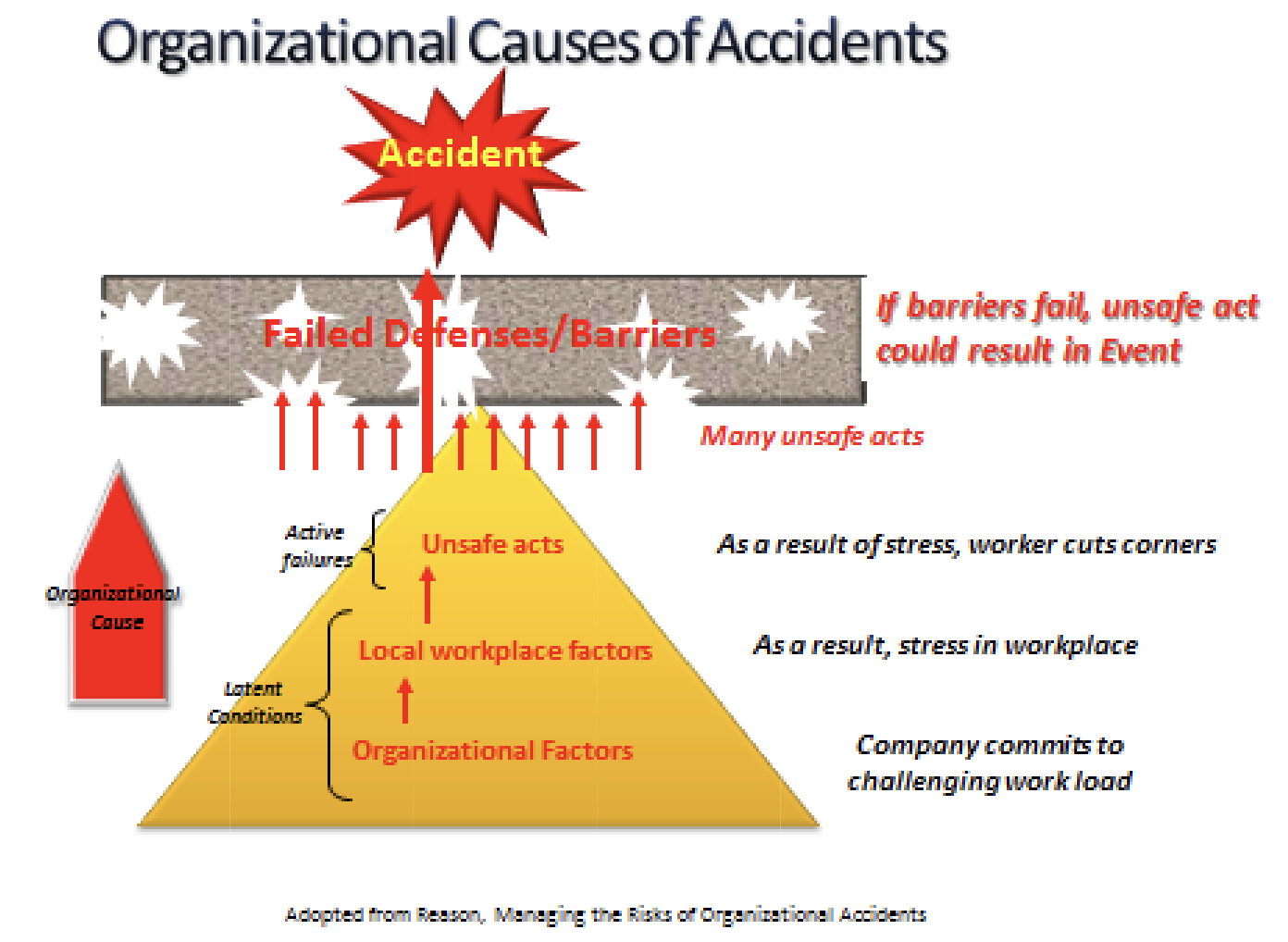
The main elements of a safety culture and their various interactions are previewed below. Each subcomponent will be discussed more fully below:
- An ideal safety culture is the engine that continues to propel the system towards the goal of maximum safety and health, regardless of the leadership’s personality or current commercial concerns. Such an ideal is hard to achieve in the real world, but it is nonetheless a goal worth striving for.
- The power of this engine relies heavily upon continuing respect for the many entities that can penetrate and breach the defense. In short, its power is derived from not forgetting to be afraid.
- In the absence of bad outcomes, the best way-perhaps the only way to sustain a state of intelligent and respectful wariness, is to gather the right kinds of data. This means creating a safety information system that collects, analyses, and disseminates information from incidents and near-misses as well as from regular proactive checks on the system’s vital signs. All of these activities can be said to make up an informed culture, one in which those who manage and operate the system have current knowledge about the human, technical, organizational, and environmental factors that determine the safety of the system as a whole. In most important respects, an informed culture is a safety culture.
- Any safety information system depends on the workforce’s willing participation and the people in direct contact with the hazards. To achieve this, it is necessary to engineer a reporting culture-an organizational climate in which people are prepared to report their errors and near-misses.
- An effective reporting culture depends, in tum, on how the organization handles blame and punishment. A ‘no-blame’ culture is neither feasible nor desirable. A small proportion of unsafe human acts are egregious (for example, substance abuse, reckless non-compliance, sabotage, and so on) and warrant sanctions, severe ones in some cases. A blanket amnesty on all unsafe acts would lack credibility in the eyes of the workforce. More importantly, it would be seen as opposing natural justice. What is needed is a just culture, an atmosphere of trust in which people are encouraged, even rewarded, for providing essential safety-related information-but in which they are also clear about where the line must be drawn between acceptable and unacceptable behavior.
- The evidence shows that high-reliability organizations-domain leaders in health, safety, and environmental issues-possess the ability to reconfigure themselves in the face of high-tempo operations or certain kinds of danger. A flexible culture takes several forms, but in many cases, it involves shifting from the conventional hierarchical mode to a flatter professional structure, where control passes to task experts on the spot and then reverts back to the traditional bureaucratic mode once the emergency has passed. Such adaptability is an essential feature of the crisis-prepared organization and, as before, depends crucially on respect-in this case, respect for the skills, experience and abilities of the workforce and, most notably, the first-line supervisors. But respect must be earned, and this requires a major training investment on the part of the organization.
- Finally, an organization must possess a learning culture, the willingness and the competence to draw the right conclusions from its safety information system, and the will to implement major reforms when their need is indicated.
Organizational Accidents Revisited, James Reason, 1997