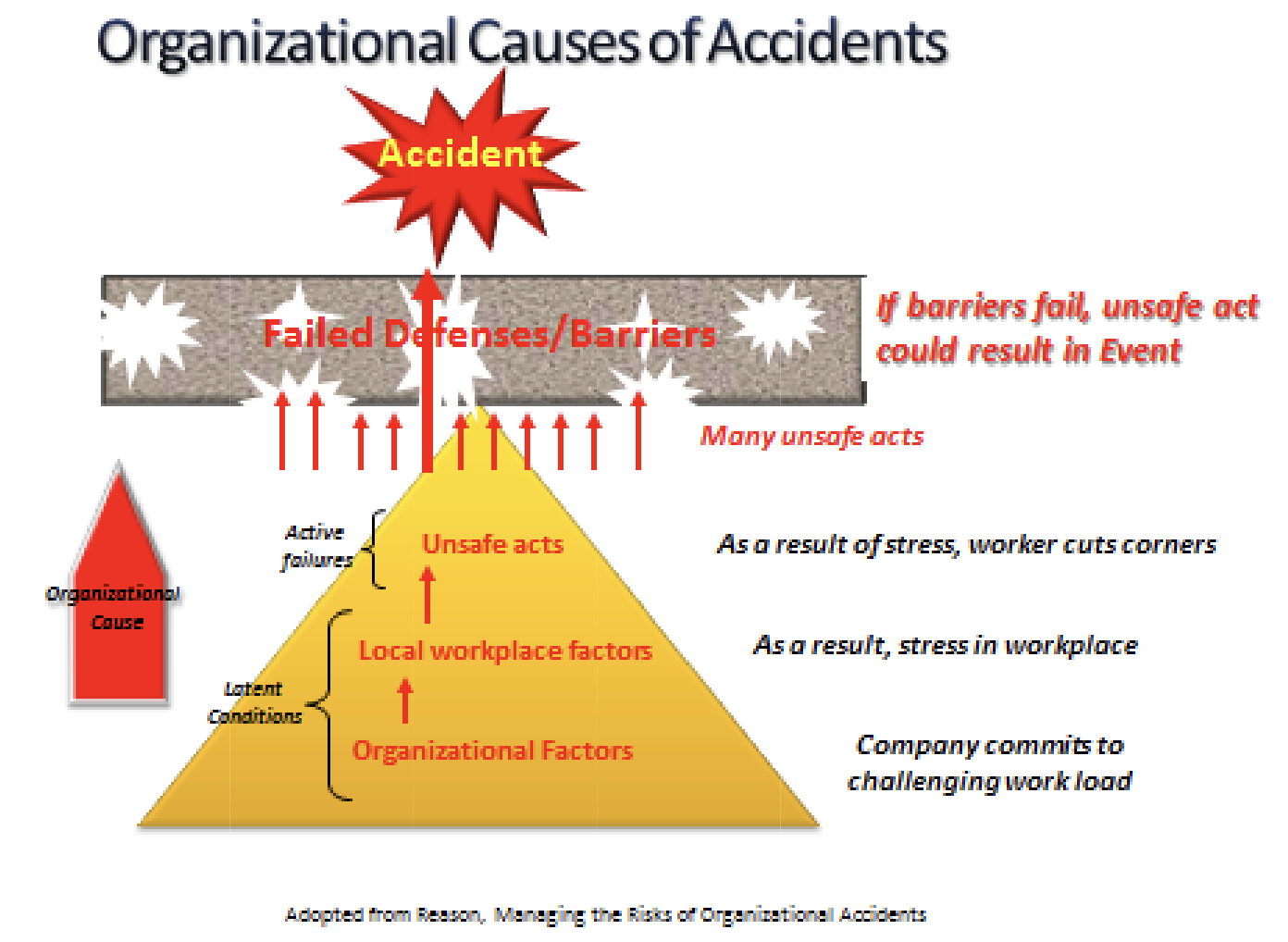
Despite their differences in tradition, emphasis, and application domains, there is no reason why these various models and their associated practices should not coexist harmoniously within the same organization so long as the strengths and weaknesses of each approach are recognized.
The Person Model
The person model is exemplified by the traditional occupational safety approach. The main emphases are on individual unsafe acts and personal injury accidents. It views people as free agents capable of choosing between safe and unsafe behavior. This means that errors are perceived as being shaped predominantly by psychological factors such as:
- inattention,
- forgetfulness,
- poor motivation,
- carelessness,
- lack of knowledge, skills, and experience,
- negligence and on occasions-culpable recklessness
Its main applications are in those domains involving close encounters with hazards. As such, it is the most widely adopted of the three models. It is also the approach with the most extended history, stretching back to the beginnings of industrialization. It is usually policed by safety departments and safety professionals, though more recently, the accent has been upon personal responsibility.
The most widely used countermeasures are ‘fear appeal’ poster campaigns, rewards, and punishments, unsafe act auditing, writing another procedure, training, and selection. Progress is measured by personal injury statistics, such as fatalities, lost-time injuries, medical treatment cases, first aid cases, and the like. It is frequently underpinned by the “iceberg” or “pyramid” views of accident causation. Frank Bird’s analysis of 1,753,498 accidents reported by 297 companies representing 21 different industries provided the empirical basis for such beliefs. This yielded the now widely used 1:10:30:600 ratio (see below), though other comparable ratios are also employed:
- 1 serious or major injury
- 10 minor injuries
- 30 property damage accidents
- 600 incidents with no visible damage or injury.
The Engineering Model
The engineering model originates in reliability engineering, traditional ergonomics (and its modern variant-cognitive engineering), risk management, and human reliability assessment. Safety is viewed as something that needs to be ‘engineered’ into the system and, where possible, to be quantified as precisely as possible. Thus, the focus is on engineered system reliability, often expressed in probabilistic terms. In contrast to the person model, human errors are not regarded simply as the product of what goes on between an individual’s ears. Instead, they emerge from human-machine mismatches or poor human engineering, that is, the system designers’ failure to tailor the system appropriately to its human controllers’ cognitive strengths and weaknesses. Typically, the model focuses on how the performance of front-line operators (for example, control room operators and pilots) is influenced by the characteristics of the workplace or, more specifically, by the informational properties of the human-machine interface.
Research in this area was initially supported by the nuclear power industry, the military, the space agencies, the chemical process industry, and aviation, in which the safety of a system hinges critically on the reliability of a small number of human controllers. More recently, the requirement for oil and gas companies to produce formal safety assessments as part of their safety cases has greatly extended its application area. The practical applications of this approach include:
- hazard operability studies (HAZOPS),
- hazard analysis studies (HAZANS),
- probabilistic risk assessment (PRA),
- technical safety audits,
- reliability and maintainability studies (RAMS),
- human reliability assessment (HRA),
- cognitive task analyses,
- ergonomic guidelines,
- databases, and
- the application of decision support systems.
Excellent accounts of the nature and application of these tools can be found in a number of recent texts.
The Organizational Model
If the organizational model, the newest of the three, has a disciplinary link, then it would probably be with crisis management. Although not always apparent to its practitioners, it owes its intellectual origins to two books. The first was Man-Made Disaster by the late Barry Turner, published in 1978. The second significant influence was Charles Perrow’s Normal Accidents. In retrospect, credit must also go to the Hon. Peter Mahon for his remarkable report on the Mt. Erebus tragedy that occurred in 1979. As Neil Johnston has pointed out, the Mahon Report was ten years ahead of its time. Most of the accidents that have shaped our current thinking about organizational factors had yet to happen.
The organizational model views human error more as a consequence than as a cause. Errors are the symptoms that reveal the presence of latent conditions in the system at large. They are important only in so far as they adversely affect the integrity of the defenses. The model emphasizes the necessity for proactive measures of “safety health” and the need for continual reforms of the system’s basic processes. As such, it has much in common with Total Quality Management. Indeed, the organizational model deliberately blurs the distinction between safety-related and quality-determining factors. Both are viewed as important for increasing the system’s intrinsic resistance to its operational hazards. Both are seen as being implicated in organizational accidents. In many respects, the organizational model is simply an extension of the engineering model and is in no way incompatible with it.
Human-machine mismatches are seen as being the result of prior decisions in the upper echelons of the system. And these, in tum, are shaped by broader regulatory and societal factors. It is pretty clear that both are necessary for understanding the etiology of organizational accidents and for limiting their occurrence. Where there is a conflict, it is between both of these models and the largely person-directed approach of the traditional occupational safety professionals. However, these differences are often more a matter of circumstance than of substance.
Organizational Accidents Revisited, James Reason, 1997