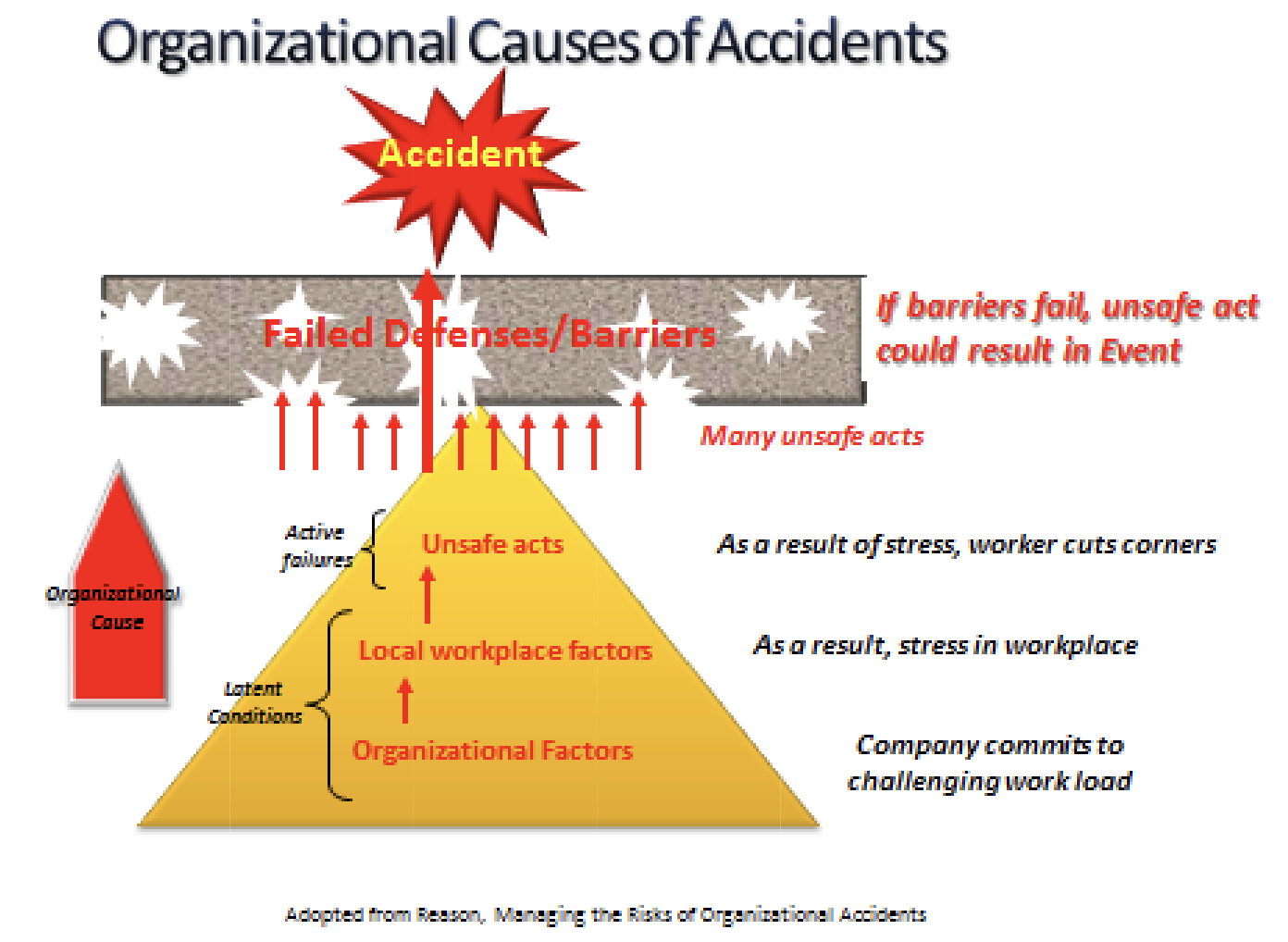
H. W. Heinrich, Assistant Superintendent Engineering and Inspection Division of The Travelers Insurance Company, is known as the “Father of Industrial Safety.” But today, there is a movement in the safety profession to denounce his work. To me, this is just disrespectful; hell, most of us owe our professional safety careers to Heinrich. The work he did was over 90 years ago! Was it perfect, far from it, but fundamentally speaking, much of what he taught us in the 1930-50s still holds true today. Here are his 10 Axioms of Industrial Safety from 1931. Ask yourself… if we could support 7 of these 10 axioms, how far would industrial safety have come from 1931!
- The occurrence of an injury invariably results from a completed sequence of factors — one factor being the accident itself.
- An accident can occur only when preceded by or accompanied and directly caused by one or both of two circumstances — the unsafe act of a person and the existence of a mechanical or physical hazard.
- The unsafe acts of persons are responsible for the majority of accidents.
- The unsafe act of a person does not invariably result immediately in an accident and an injury, nor does the single exposure of a person to a mechanical or physical hazard always result in an accident and injury.
- The motives or reasons that permit the occurrence of unsafe acts of persons provide a guide to the selection of appropriate corrective measures.
- The severity of an injury is largely fortuitous — the occurrence of the accident that results in the injury is largely preventable.
- The methods of most value in accident prevention are analogous with the methods required for the control of the quality, cost, and quantity of production.
- Management has the best opportunity and ability to prevent accident occurrence and, therefore, should assume the responsibility.
- The foreman is the key man in industrial accident prevention.
- The direct costs of injury, as commonly measured by compensation and liability claims and by medical and hospital expenses, are accompanied by incidental or indirect costs, which the employer must pay.
Industrial Accident Prevention – A Scientific Approach, Second Edition, 1941, H. W. Heinrich, Assistant Superintendent Engineering and Inspection Division, The Travelers Insurance Company