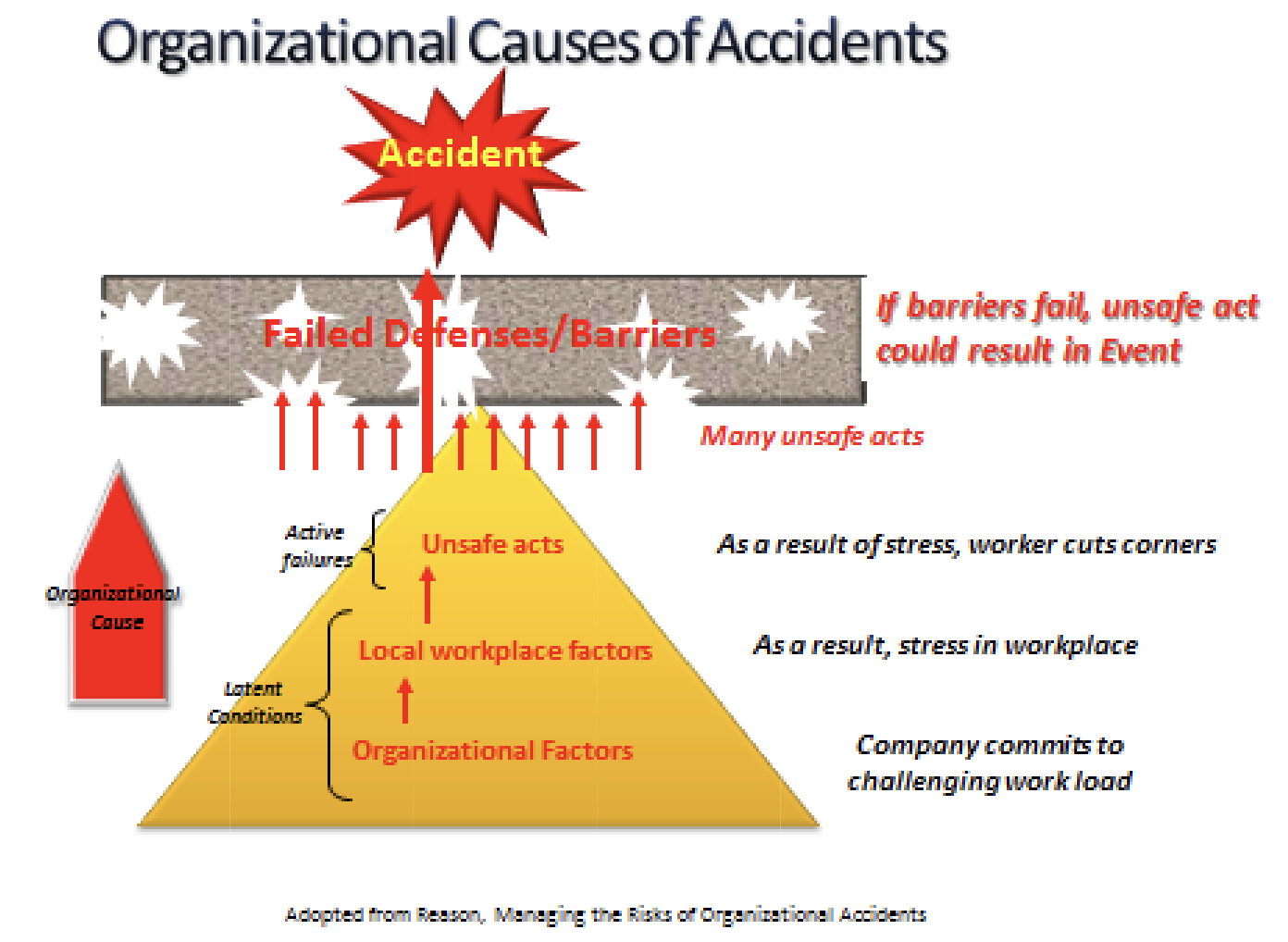
It has become fashionable to claim that human error is implicated in 80-90 percent of all major accidents. While probably close to the truth, this statement adds very little to our understanding of how and why organizational accidents happen.
In the first place, it could hardly be otherwise, given the range of human involvement in hazardous systems.
Second, the term ‘human error’ conveys the impression that all unsafe acts can be lumped into a single category.
But errors take different forms, have different psychological origins, occur in different parts of the system, and require different management methods. In addition, this assertion fails to acknowledge that people’s behavior within hazardous systems is far more constrained than it is in everyday life. The actions of pilots, ships’ crews, control room operators, and the like are tightly governed by managerial and regulatory controls. These administrative controls form a major part of any hazardous system’s defenses and are of two (2) main kinds:
- External controls made up of rules, regulations, and procedures that closely prescribe what actions may be performed and how they should be carried out. Such paper-based controls embody the system’s collective wisdom on how the work should be done.
- Internal controls derived from the knowledge and principles acquired through training and experience.
External controls are written down and need to be close at hand when people are carrying out the prescribed activities. Internal controls, on the other hand, exist mainly within an individual’s head. Any attempt to classify organizational behaviors must begin by considering how various combinations of administrative controls work to confine the natural variability of human action to safe and productive pathways.
Source: Managing the Risks of Organizational Accidents, James Reason, 1997