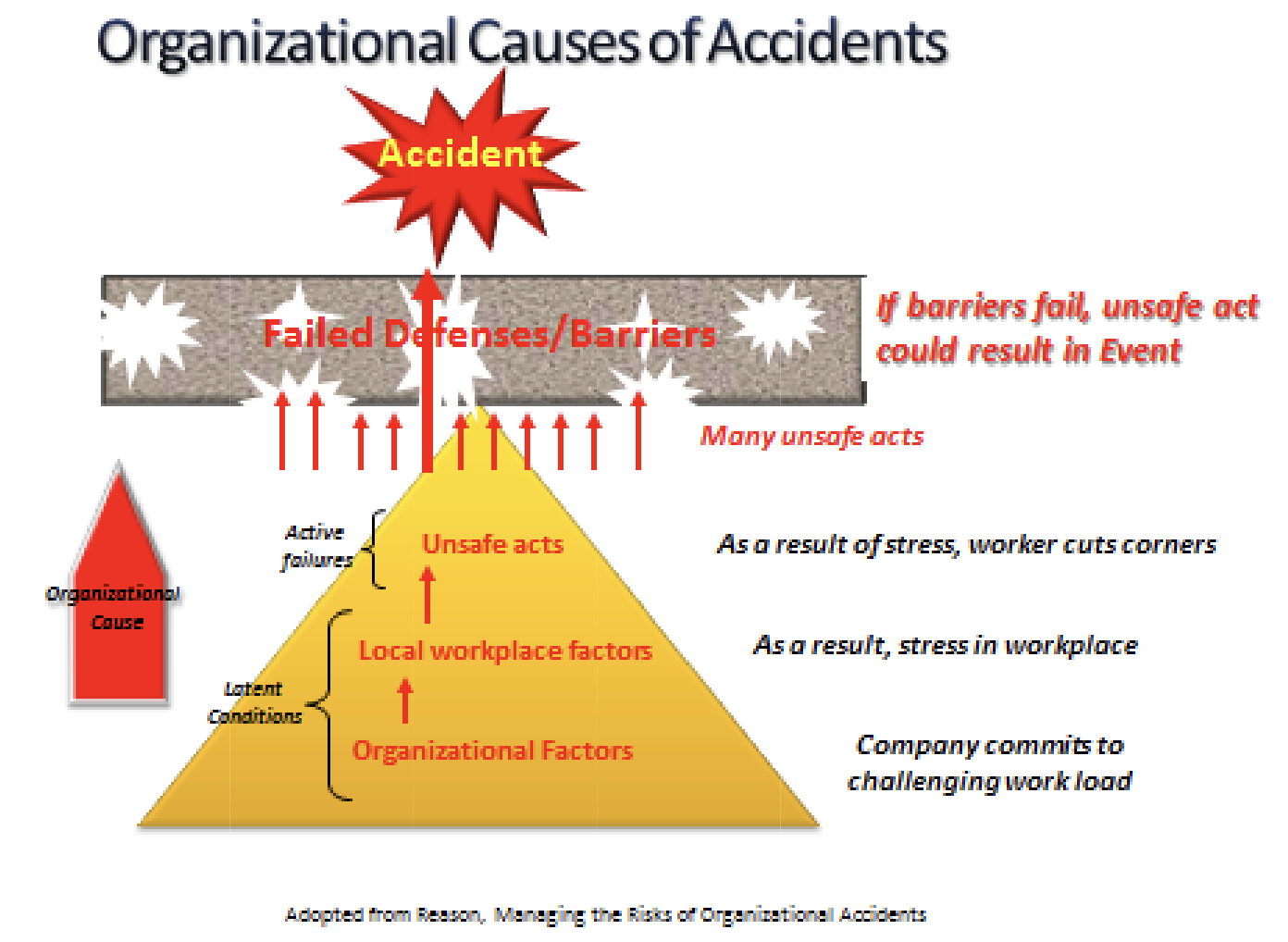
Earlier this month, I wrote Cuts so deep that workers can’t participate in their safety process concerning how reorganizational changes can lead to a lean workforce that the workers who need to participate in their safety process do not have the time to. Now, let’s take a look at what happens when the layer of field supervision is cut so deep that we lose the ability to have the capacity for “supervisors actually to supervise” the high-risk work.
We usually see the impacts of reduced supervision via our safe work permitting performance. We see a decrease in the quality of the permits being issued, which can even lead to work happening without the required permits in some situations. But these reductions in supervision, especially in immature cultures in their safety management system, will lead to larger-scale failures within the Safety Process/SMS.
I loved this approach from our HSE friends in the UK, regarding the role that supervisors play in the safety process/SMS, especially when that process/SMS is associated with the SIF approach.
Supervision is an important Performance Influencing Factor (PDF) that is believed to have contributed to a number of significant accidents (Texas City, 2005; Texaco Milford Haven, 1994; Hickson and Welch, 1992). Problems can emerge because of poorly defined responsibilities, heavy workloads, inadequate resources, or as a result of removing supervisory roles altogether.
Many supervisors are given a vital role during emergency response yet are often poorly trained in these critical responsibilities. Supervisors may also have an important part to play in managing contractors and/or issuing permits-to-work (the public inquiry into the Piper Alpha explosion in 1998 concluded that the operating company failed to ensure that a key supervisor was sufficiently competent in the operation of the PTW system).
Other essential supervisory functions include planning and allocating work, making decisions, monitoring performance and compliance, providing leadership, building teamwork, and ensuring workforce involvement.
Crucially, supervisors can have a significant, positive impact on a range of local performance influencing factors (compliance with procedures, training and competence, safety-critical communication, staffing levels and workload, shift work and fatigue, organizational culture, etc.)
The traditional ‘supervisor’ represents a crucial, final link between planning a job and its execution. However, it is worth remembering that supervisory functions may be shared between a number of front-line “shift managers” or between individual employees in a self-managed team (SMT). While the switch to SMTs is often associated with significant commercial benefits and improvements to job satisfaction, it is also argued that the effectiveness of supervision – especially in the context of safety – is reduced. However, this need not be the case: health and safety performance can be assured, provided the team has the necessary focus, competence, and resources to deliver a set of clearly defined supervisory functions. Research also suggests that the introduction of SMTs can foster active employee involvement.
Whatever the management structure, supervision remains a critical organizational factor, and its importance should be duly and proportionately reflected within an organization’s safety management system.
Key principles in supervision
- Assess your current supervisory arrangements to ensure that all key supervisory functions are clearly defined and appropriately allocated (and re-assess them prior to any organizational change). A helpful free checklist and assessment tool are provided in RR292
- Select the right people for the job and provide additional training where appropriate. Ensure relevant individuals have:
- the necessary skills and aptitude for supervisory activities (planning, communication, delegation etc.);
- a thorough understanding of local hazards and control measures;
- the experience and credibility to gain respect from others.
- Provide adequate supervision for contractors and other third parties on site, and make these arrangements clear to everyone.
- Support supervisors / self-managed teams in their roles and responsibilities eg, give them achievable targets, support them in conflict resolution etc.
- Ensure relevant individuals have the time and the opportunity to interact with others to fulfill all of their supervisory responsibilities (the requirement to provide adequate resources is a critical senior management function).
- Measure, audit, and review all aspects of supervisory performance.
Source: https://www.hse.gov.uk/humanfactors/topics/supervision.htm