For years, I have advised my clients to use the ANSI/ASSE Z590.2 standard when building their Safety Management System (SMS), as it provides a clear-cut model for the Scope and Function of the safety professional’s role within an organization. Members can read the following two articles on how this can be done.
- Establishing the scope, function, role(s), and responsibilities of the organization’s safety professional(s)
- The role of the safety pro(s) within an organization
But today, I want to take this discussion to the next level. The two articles above are how we manage the safety professional(s) role early in the development of the SMS. After several years into this journey, the role(s) may change somewhat as the SMS matures. Thus, the “safety leader” role will also change.
Recently, the Safety Management International Collaboration Group (SM ICG) published “The Safety Manager’s Role in Safety Management Systems.”
NOTE: The Safety Management International Collaboration Group (SM ICG) was founded by the United States Federal Aviation Administration (FAA), the European Aviation Safety Agency (EASA) and Transport Canada Civil Aviation (TCCA) and is a joint cooperation between many regulatory authorities for the purpose of promoting a common understanding of safety management and Safety Management System (SMS)/State Safety Program (SSP) principles and requirements, facilitating their implementation across the international aviation community.
Although this organization focuses on Aviation Safety, the SMS model everyone uses today was born from the Aviation industry, so this latest publication is an EXCELLENT read and tool for those looking to solidify the role of the safety professional(s) within their organization. This latest publication focuses on the organization’s SAFETY LEADER, making it even more valuable to an organization looking to take safety to another level.
The Accountable Executive and senior management are responsible for developing, maintaining, and making the SMS effective. The Safety Manager focuses more on the applicability, coherence, promotion, and relevance of SMS implementation across the organization. Therefore, one major responsibility of the Safety Manager is ensuring that the right topics with the right evidence and safety information are brought to the attention of the Safety Committee (or equivalent functional body) and/or the Accountable Executive. This is so senior management can prioritize and assign the best use of resources, make safety-based decisions, justify them, take appropriate actions, and document accordingly. The Safety Manager’s responsibility is to verify that an accurate picture of the organization’s risk landscape is communicated. This will ensure a constructive discussion can take place and the risks within the operations are kept as low as reasonably practicable.
The Safety Manager assists management by clarifying the SMS policies and practices for the organization, thereby facilitating the understanding of safety risks and controls. The Safety Manager should not be seen as the one responsible for managing safety throughout the organization. Some decisions have to be made at the executive level (e.g., allocating resources and financing barriers), and others have to be taken at the operational level. In no case is it incumbent upon the Safety Manager to make those decisions.
Depending on the size and the complexity of the operations, the Safety Manager’s responsibilities may cover:
- Maintaining safety documentation;
- Communicating across the organization so that everyone has the appropriate level of awareness and is on the same page in terms of expectations for their role and their responsibilities related to safety;
- Ensuring that everyone understands safety policies, processes, and procedures;
- Supporting operational departments and managers on the use of Safety Management processes (e.g., assisting operational personnel in conducting risk assessments according to a common risk assessment methodology and assigning effective, operationally relevant controls);
- Challenging, inspiring, mentoring, and encouraging positive employee attitudes, behaviors, and actions toward safety;
- Coaching and training staff in the use of Safety Management tools and methodologies as described in the SMS manual (or equivalent);
- Collecting, evaluating, processing, analyzing, and storing safety information from within their own organization as well as the wider aviation industry (notably within the sector risk profile);
- Providing impartial safety advice and guidance to management and staff;
- Gathering, producing, and disseminating safety information throughout the organization;
- Ensuring that proper safety training is provided so that risk assessment processes are ingrained within the organization and that safety discussions are facilitated throughout the organization;
- Fostering a positive safety culture throughout the organization; this includes promoting an open reporting culture and ensuring that punitive actions are not taken against individuals making voluntary or mandatory safety reports;
- Monitoring how the just culture policy is applied and reporting to the Accountable Executive when issues are identified;
- Ensuring that the reporting system is effective and that occurrences have been timely and properly analyzed; in particular, ensuring that identified root cause(s) of incidents, accidents, and failures within the system are relevant and mitigated accordingly to prevent recurrence;
- Encouraging operational departments and/or individuals to take ownership of safety issues and risks;
- Ensuring consistency and coherence of safety processes across the organization;
- Ensuring that corrective and preventive actions are managed and implemented by the relevant departments, are performing as intended, and are reported to the safety committee (or other functional body);
- Supporting the organization in monitoring the implementation process to achieve the safety goals;
- Ensuring that the organization has policies, procedures, and plans for responding to emergency situations (i.e., overseeing emergency response for the organization);
- Ensuring safety issues are properly coordinated, communicated, and addressed between internal and external bodies, including:
- Third-party service providers;
- Regulatory authorities and
- Investigative bodies.
- Ensuring that communication is maintained within the safety team when responsibility is delegated to other staff; ensuring they are regularly informed in all areas of the safety program, including how things are being managed; remaining active and up to date within the safety program; and
- Considering internal or external factors that may result in emerging risks or require reviewing existing risk assessments. In particular, evaluation of risks should occur as a result of major disruptive events (e.g., many risk assessments conducted before the COVID-19 crisis were no longer valid during and after the crisis).
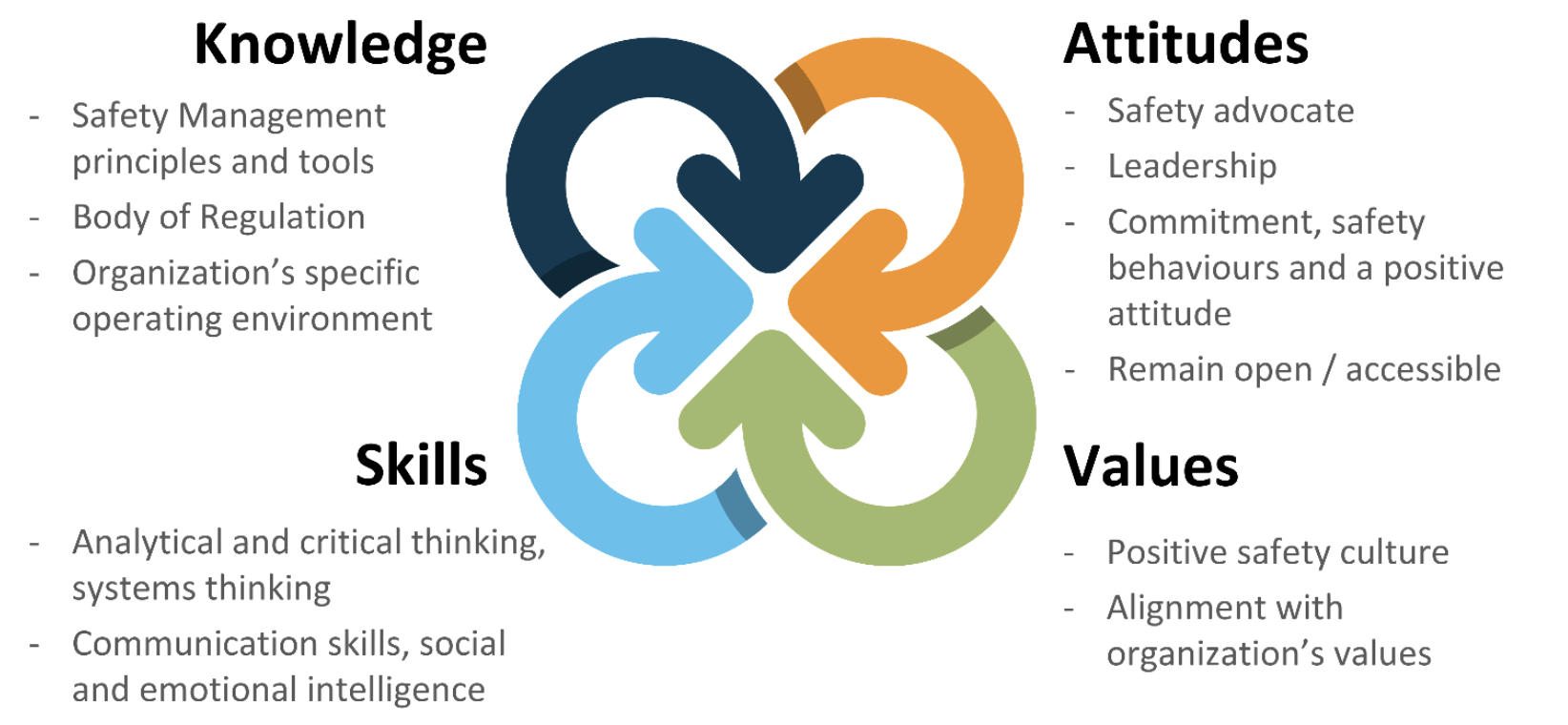
Key areas of knowledge required by the Safety Manager include:
- Safety Management principles and tools used to support the application of these concepts. For example, it would be expected that the Safety Manager has a sound understanding of risk management principles and is aware of and able to demonstrate the use of risk assessment methodologies.
- Applicable regulations of the regulatory authority and any other regulatory requirements under which the organization operates.
- Knowledge of the organization’s specific operating environment, the operation’s context, and the associated safety risks. The Safety Manager should be able to apply this knowledge within the organization’s SMS. This requires at least a basic knowledge of the typical aspects of the organization. This knowledge will assist the Safety Manager in ensuring that the organization’s activities remain within the “safety space.”
Safety Managers should ensure that all the key personnel (i.e., themselves, their subordinates, and other safety analysts and practitioners) have the most current training and knowledge of tools, policies, and data sources for the organization.
Skills relate to the ability to perform an activity or task. They include the application of knowledge. Proficiency in the execution of skills requires training and practice. Typically, a person acquires the knowledge of how to perform a task and then begins to perform the task. For example, one would learn the concepts and steps involved in conducting a safety assessment (knowledge), and then perform and document it (skill).
Don’t ignore training for safety employees!
Methods, policies, tools, data sources, and organizational SMS maturity always evolve. Keeping the safety organization updated on these elements maximizes the value of safety work being done.
The Safety Manager is required to have a set of skills to fulfill the roles and responsibilities. The Safety Manager must:
- Be able to utilize and apply analytical and critical thinking; be able to apply knowledge to the day-to-day duties from a systems thinking perspective; and
- Have excellent engagement and communication skills, both written and oral; be able to demonstrate social and emotional intelligence, which enables the Safety Manager to work and interact effectively within an organization.
- The Safety Manager must be approachable and easy to engage. The Safety Manager must be able to discuss and deliver safety messages and information across all levels of the organization. Employees need to feel comfortable approaching and raising safety concerns to the Safety Manager without fear of retribution or blame.
- The Safety Manager must work to build relationships based on trust to achieve the best safety outcomes and to help foster and build a strong organizational safety culture in which trust plays a large role. The Safety Manager must remain objective, impartial, fair, and ethical in their actions. The Safety Manager must sometimes demonstrate tenacity and patience while negotiating challenging situations.
- The Safety Manager must exercise judgment and tactfulness. This is particularly relevant when assigning individual or operational departments responsibilities to address safety issues.
- The Safety Manager needs managerial and leadership skills.
Attitudes and Values
The Safety Manager should act as a focal point and a facilitator for the safety and deployment of the SMS within the organization. The Safety Manager is a role model for the organization and must demonstrate the organization’s approach and belief towards safety. Overall, the individual must be a safety advocate who demonstrates commitment, safety behaviors, and a positive attitude toward safety at all times.
The attitudes and behaviors demonstrated by the Safety Manager can help foster a positive safety culture within the organization and achieve positive safety outcomes. The Safety Manager should avoid a punitive or blaming approach while investigating safety issues unless willful misconduct or gross negligence is apparent.
Safety Manager “DOs”
- Remain open/accessible
- Remain alert to any signal of safety erosion
- Stay independent (unbiased) and fair when advice on safety matters is needed
- Be able to coordinate and communicate across the organization
- Be able to listen and be people-oriented
- Lead, inspire, encourage (e.g., show enthusiasm)
- Be assertive and challenge/encourage employee critical thinking
- Be supportive to everyone
- Instruct, train and guide on SMS
Safety Manager “DON’Ts”
- Be the owner of the risks
- Work in isolation
- Be entirely responsible for safety
- Be complacent
In summary:
Visit “The Safety Manager’s Role in Safety Management Systems.” for more.