
FRA is amending its regulations related to occupational noise exposure in three (3) ways.
Special NOTE: although I agree with this new requirement, it will be virtually impossible for the railroads to comply by March 2024. There are NOT enough EEBAs in inventory to supply the Class 1s. Then there is the written program and training that has to be put in place, and one month is impossible if we want to do it RIGHT.
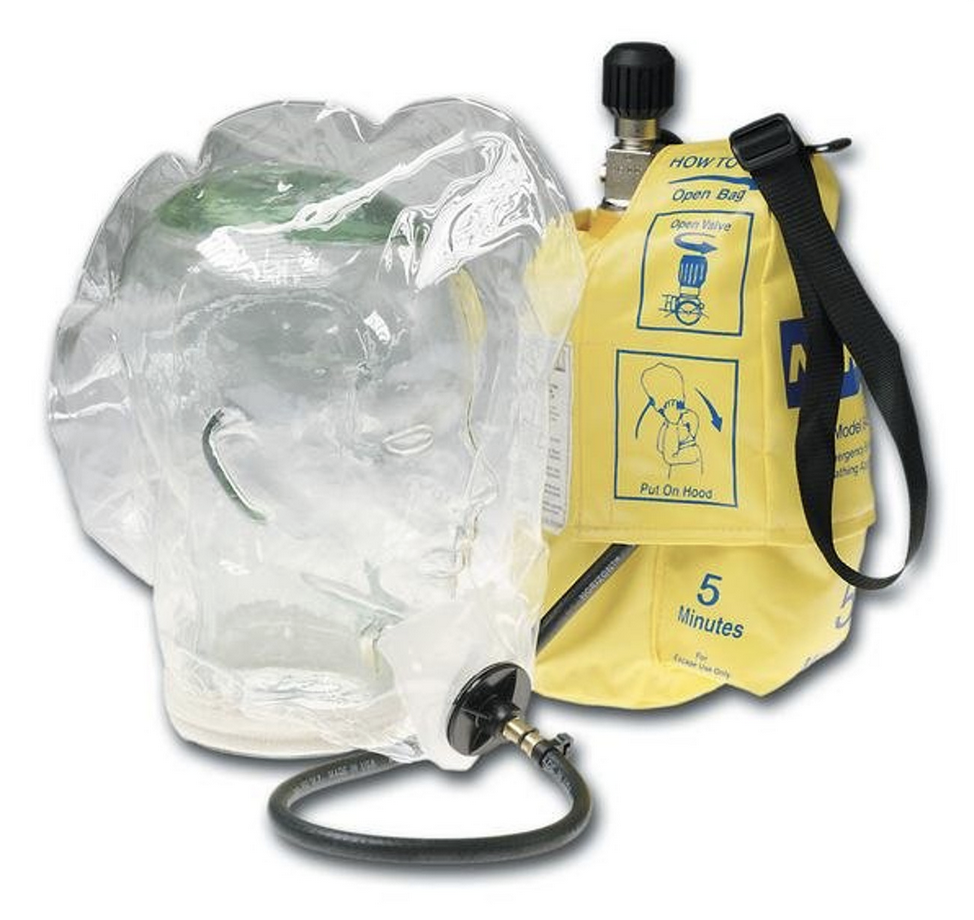 |
First, in response to a congressional mandate, FRA is expanding those regulations to
SAFTENG members can read what this entails below.
Second, FRA is changing the name of this part of its regulations from “Occupational Noise Exposure” to “Occupational Safety and Health in the Locomotive Cab” to reflect the additional subject matter of this final rule and to make other conforming amendments.
Third, FRA is removing the provision stating the preemptive effect of this part of FRA’s regulations because it is unnecessary. |
The rule requires railroads to “provide convenient storage in each freight train locomotive to enable crewmembers to access such apparatus quickly.”
FRA has adapted the storage requirements promulgated by OSHA at 29 CFR 1910.134(h)(2) to this final rule
The rule requires each railroad to establish procedures to ensure that EEBAs required to be present in the locomotive cabs are fully functional. This is adapted from OSHA’s inspection documentation requirements. 29 CFR 1910.134(h)(3)(iv). Since the EEBAs selected may have differing requirements for inspection, maintenance, and replacement, this section is mostly written as a general standard. However, minimum repair and adjustment requirements also have been adapted from OSHA’s regulations. 29 CFR 1910.134(h)(4)
In paragraph (b), FRA requires that railroads create and maintain pre-trip and periodic inspection records and retain these records for a period of 92 days and one year, respectively. Paragraph (d) requires railroads to create and maintain an accurate record of all turn-ins, maintenance, repair, and replacement of EEBAs required by paragraph (c) of this section, including EEBAs that are used, and retain these records for three (3) years.
The rule identifies the elements of the instructional program that the railroad must establish and carry out for train employees and other employees who are part of the railroad’s general EEBA program under § 227.211 and will be provided with EEBAs. The elements are partly adapted from OSHA’s regulations. 29 CFR 1910.134(k). The program should be considered the MINIMUM, and the railroads are encouraged to provide additional relevant information depending on the types of EEBAs selected.
- why an EEBA is necessary;
- how improper fit, usage, or maintenance can compromise the protective effect of an EEBA;
- the limitations and capabilities of the type of EEBA provided by the railroad, including the timeframe for effective use;
- how to deal with emergency situations involving the use of EEBAs or if EEBA malfunctions;
how to inspect, put on, remove, and use an EEBA, including the inspection of seals; - procedures for maintenance and storage of EEBAs;
- employee responsibilities under subpart C;
- employee rights concerning access to records; and
- identification of hazardous materials that are classified as PIH materials
FRA is particularly concerned that the employees know the limitations of the EEBAs provided so that the employees can avoid circumstances that would lead to reliance on the EEBAs for conditions or time frames beyond the EEBA’s capabilities.
The rule establishes the timing of the initial and refresher training. Initial instruction must occur no later than 30 days prior to the date of compliance with subpart C for the subject railroad. New employees must receive initial instruction either by 30 days before the applicable date of compliance with subpart C or prior to being assigned to jobs where EEBAs are required to be provided on a locomotive, whichever is later. The initial instruction must be supplemented with periodic instruction AT LEAST ONCE EVERY THREE YEARS.
FRA requires railroads to adopt and comply with a general EEBA program to ensure that the selection and distribution of the EEBAs is done in a technically appropriate, sustainable manner and supported by a comprehensive set of policies and procedures, as discussed in detail in section IV.
Many of the procedures will likely be used as a basis for aspects of the required instructional program.
Paragraph (b)(1) requires that each railroad’s general program IDENTIFY THE RAILROAD’S EEBA MANAGER BY TITLE and requires that the EEBA manager is qualified to oversee the program.
Section 227.211(b)(4) requires the following individuals to be placed in the railroad’s general EEBA program:
(1) employees of railroads subject to this subpart who perform service subject to the provisions of the hours-of-service law governing “train employees,” 49 U.S.C. 21103, in the locomotive cabs of freight trains that transport a PIH material;
(2) the direct supervisors of these train employees; and
(3) any employees who deadhead in the locomotive cabs of such trains.
The term “train employee” refers to employees who are engaged in functions traditionally associated with train, engine, and yard service; for example, engineers, conductors, brakemen, switchmen, and firemen. 49 U.S.C. 21101(5); 49 CFR part 228, appendix A; and 74 FR 30665, June 26, 2009.
A railroad may also identify other employees and designate them IN WRITING to be included in its general EEBA program. In making this assessment, the railroad should consider an employee’s work over the period of a year. In doing so, the railroads must consider how they use their workforces, i.e., review the work that their employees perform, determine which employees will occupy the cab of the locomotive of an in-service freight train and therefore experience the risk of the release of an inhalation-material from the consist, and then place those employees in the general EEBA program.
Given the nature of the railroad industry, FRA is aware that some of these employees may not always work in the cab. Due to longstanding labor practices in the railroad industry concerning seniority privileges and concerning the ability of railroad employees to bid for different work assignments, these railroad employees are likely to change jobs frequently and to work for extended periods of time on assignments that involve duties outside the cab. For example, an employee might start the year in a job that involves mostly outside-the-cab work, spend three months working primarily inside the cab, and then return to outside-the-cab work for the rest of the year. In this type of situation, these regulations govern the exposure of this employee throughout the year despite the fact that the employee only spent three months inside the cab. This employee is covered by this part because he or she spent time, no matter how little, in a locomotive cab where the use of an EEBA may be required. As a result, the railroad must ensure that the employee is properly instructed in how to inspect and use an EEBA and provide an EEBA for those time periods in which the employee is serving as a train employee, as a direct supervisor of a train employee, or in a capacity that the railroad has determined, in its discretion and designated in writing, should be provided an EEBA while any of these individuals is working in the cab of the locomotive of an in-service freight train transporting a PIH material.
Note that placement of an employee in the railroad’s general EEBA program means different things depending on the nature of the program that the railroad chooses to adopt. For example, if the railroad’s program states that the railroad will equip its fleet of locomotives with sets of EEBAs sufficient to accommodate the train crew and possible deadheading train employees, the railroad would have to provide the EEBA to the employee in that way, in the locomotive cab. On the other hand, if the railroad’s program states that the railroad will provide the EEBA to the employee as part of his or her personal equipment, the railroad would have to provide the EEBA in that manner. If the employee, for whatever reason, did not have the EEBA with him or her while in the locomotive cab, the railroad would be prohibited from using the locomotive by § 227.201(a)(2), which bars using a locomotive to transport a covered train if a covered employee occupying the cab of the locomotive does not have access to a working EEBA. One constant is that all railroads, subject to this part, are required to instruct employees placed in their general EEBA program in how to use EEBAs; the provision on instruction at § 227.209 requires that all employees, identified in § 227.211, be provided instruction on EEBAs.
Since employees who must be provided EEBAs are not always directly supervised by managers who can ensure the identified tasks are done at the appropriate time and frequency, this section establishes certain responsibilities on the part of employees. Some of these tasks may involve making records of such tasks as pre-trip inspections that must be done to ensure the EEBAs are ready for use. Additionally, FRA prohibits employees from willfully tampering with or vandalizing an EEBA in an attempt to disable or damage the device. (49 CFR part 209, appendix A, for definition and discussion of “willfully.”)
FRA Resource: https://railroads.dot.gov/sites/fra.dot.gov/files/fra_net/16838/Guidance%20For%20Developing%20An%20EEBA%20Program%20FINAL.pdf
More on EEBAs
Knowing the limitations of your EEBA is CRITICAL!
EEBAs and their inspection and maintenance schedules and requirements
EEBAs and their limitations
EEBAs… Do you know just how far they will get you?
Proper application of Emergency Escape Breathing Apparatus (EEBA)
PRCS Fatality on ship (1 entrant; O2 deficiency)