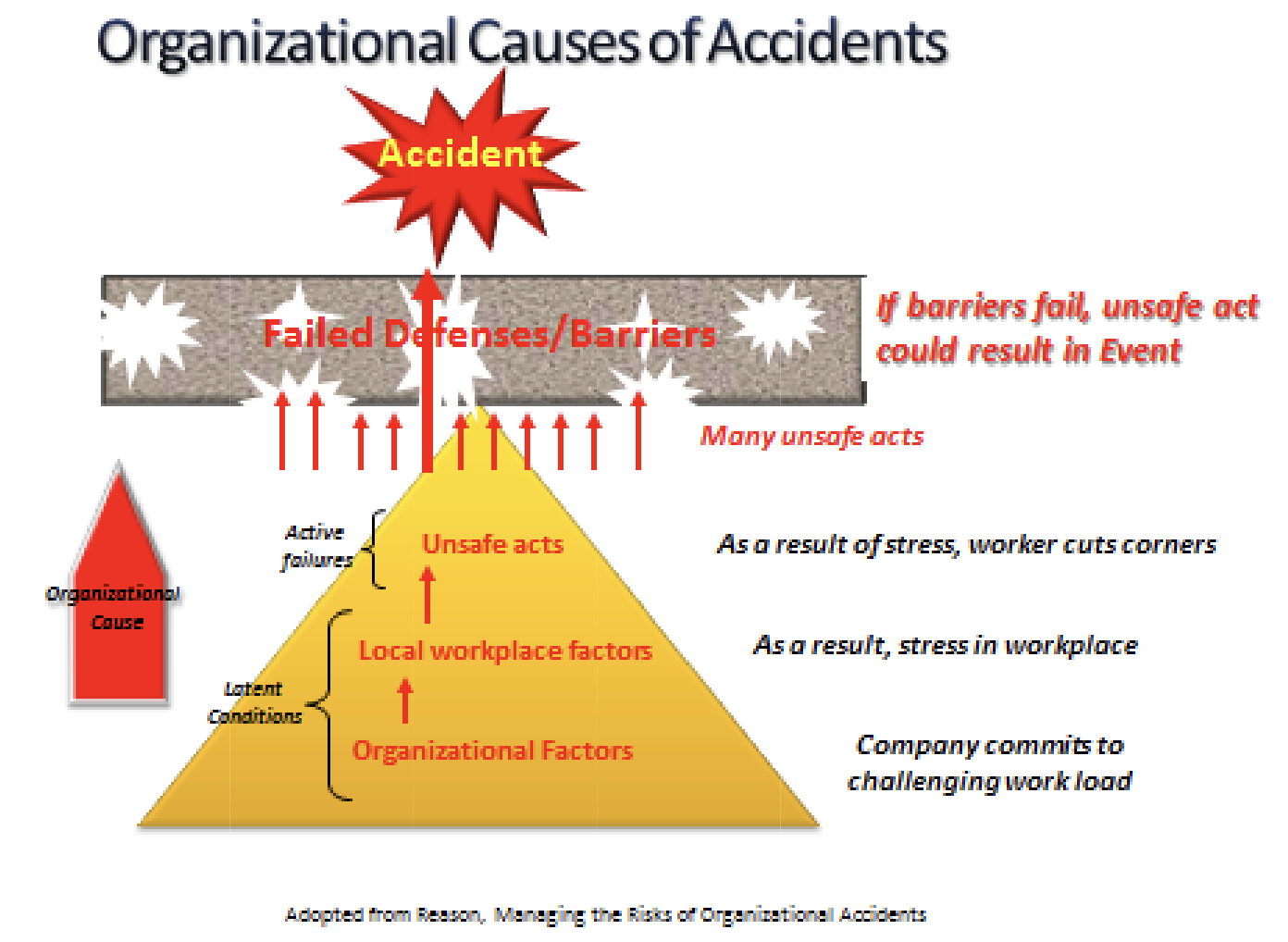
As an accident investigator this has to be one of my favorite books. Of course, I am a massive fan of Dekker’s books and videos. He has a newer book on this topic that is also a MUST-READ for safety professionals and accident investigators. After nearly 16 years as a safety professional in the chemical industry, I came to the realization that errors, mistakes, and violations (James Reason’s Human Failure Model) that I learned about in the early 90s while at Murray State University were accurate. I just failed to use it in my investigations, and for that, I apologize to the many operators, mechanics, and engineers that we tagged as the “root cause” of the events they were involved in.
This little quip from Dekker’s original book says it all…
Have you ever caught yourself asking, “How could they not have noticed?” or, “How could they not have known?”? Then, you were reacting to failure.
We all react to failure. In fact, our reactions to failure often make that we see human error as the cause of a mishap; they promote the bad apple theory. Failure, or people doing things with the potential for failure, is generally not something we expect to see. It surprises us; it does not fit our assumptions about the system we use or the organization we work in. It goes against our beliefs and views. As a result, we try to reduce that surprise—we react to failure.
Reactions to failure, such as in the example above, share the following features:
- Retrospective. Reactions arise from our ability to look back on a sequence of events, of which we know the outcome;
- Proximal. They focus on those people who were closest in time and space to causing or potentially preventing the mishap;
- Counterfactual. They lay out in detail what these people could have done to prevent the mishap;
- Judgmental. They say what people should have done, or failed to do, to prevent the mishap.
Reactions to failure interfere with our understanding of failure. The more we react, the less we understand. But when you look closely at findings and conclusions about human error, you can see that they are often driven by reactions to failure, and written in their language.
Source: The Field Guide to Human Error Investigations, Sidney Dekker, 2001