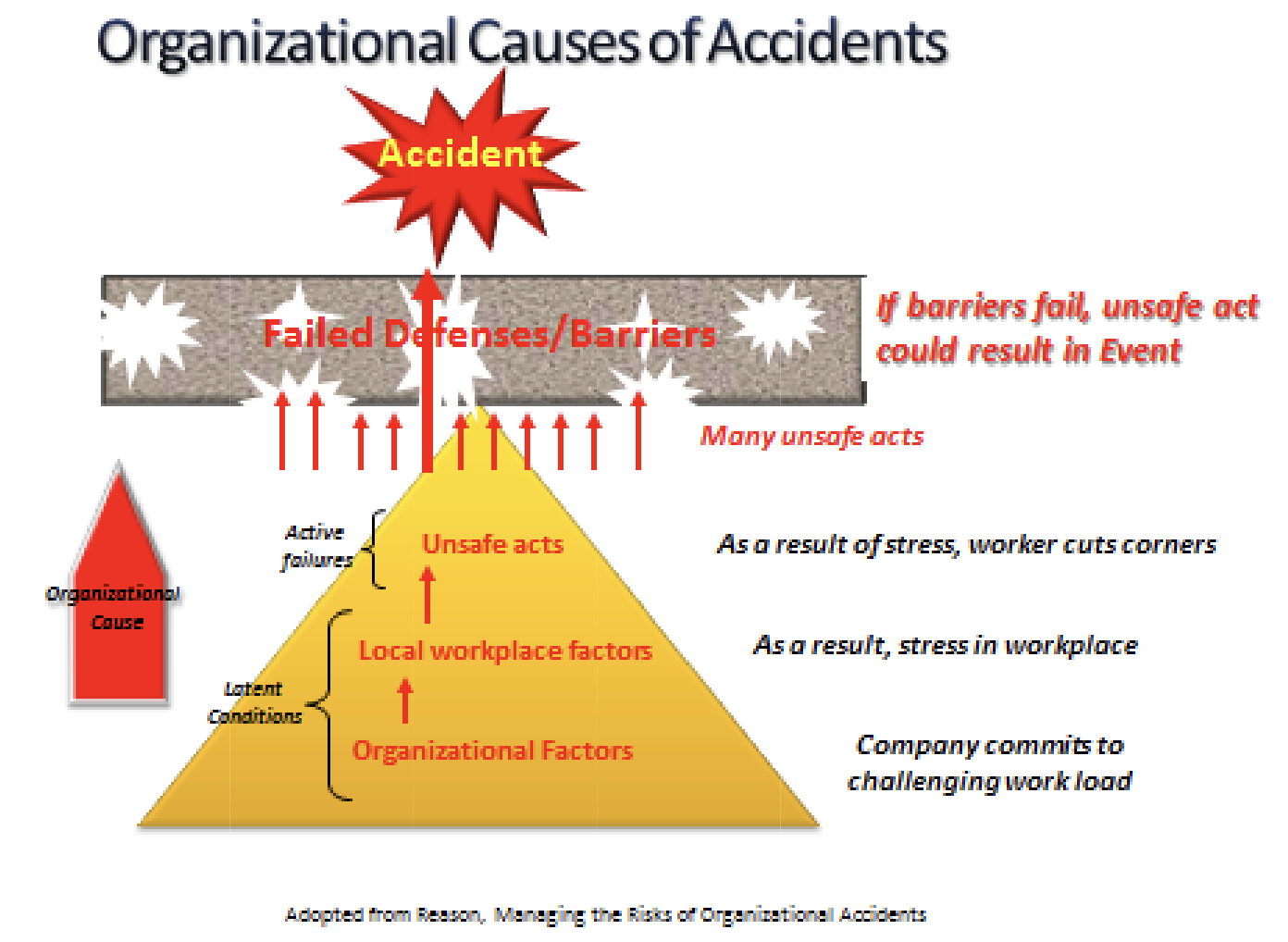
The accidents described in this chapter are not due to a fifth type of error. They are due to the failure of senior managers to realize that they could do more to prevent accidents. They are thus mainly due to lack of training, but some may be due to lack of ability and a few to a deliberate decision to give safety a low priority. As stated in Section 5.1, these accidents are sometimes said to be due to organizational failures but organizations have no minds of their own. Someone has to change the culture of the organization and this needs the involvement, or at least the support, of senior people. During my time as a safety adviser with ICI Petrochemicals Division, my team did bring about a change in the Division’s attitude to safety, but we could only do so because everyone knew that the Board supported our activities.
If output, costs, efficiency, or product quality require attention, senior managers identify the problems, agree on actions, and ask for regular reports on progress. This approach is rarely seen where safety is concerned. Although senior managers repeatedly say that safety is important, they rarely show the level of detailed interest that they devote to other problem areas. Many look only at the lost-time accident rate, but in many companies today, all it measures is luck and the willingness of injured employees to return to work. If senior managers comment on the lost-time accident rate and nothing else they give staff the impression that they are not interested in the real problems. The results are the opposite of those intended: everyone thinks, ‘If the senior managers are not interested, the problems can’t be important.’
If output, costs, efficiency and product quality fall, the results are soon apparent and obviously require immediate action. In contrast, if safety Standards fall, it may be a long time before a serious accident occurs. The fall in standards is hidden or latent. This may be one reason why safety is given insufficient detailed attention and instead exhortation to work safely replaces consideration of the real problems. Another reason is that senior managers want a single measure of safety performance. The lost-time accident rate seems to supply this, but does not.
Source: An engineer’s view of human error, Third edition, Trevor Kletz, 2001