 The FRA report is a shining example of how a CEO can impact the culture within an organization. CEO Joe Hinrich has made a huge impact at CSX in all aspects, but what he’s done for safety sets him apart. For the FRA to call his work out in their Cultural Assessment is unique across the six Class 1 railroads. Hell one of the railroads got their assessment canceled because of suspected management fowlplay and attempting to influence the FRA Assessment.
This report documents the results of the 60-day safety culture assessment of CSX Transportation, Inc. (CSX) conducted by the Federal Railroad Administration (FRA). The CSX safety culture assessment (assessment) occurred between January 22 and March 22, 2024. Since this report only covers results found during the 60-day assessment, it does not address any follow-up activities or corrective actions by CSX. FRA will monitor CSX’s progress on the recommendations1 made in this report.
FRA has had longstanding engagement in efforts to improve railroad safety culture by developing voluntary programs like the Confidential Close Call Reporting System and peer-to-peer coaching programs, as well as by issuing regulations that require railroads to measure and improve their safety cultures. Additionally, FRA has included an assessment of safety culture as part of its comprehensive railroad safety audits. Following a catastrophic derailment in East Palestine, Ohio, on February 3, 2023, FRA conducted an assessment of Norfolk Southern Railway (NS) between March 15 and May 15, 2023, and conducted a similar assessment on BNSF Railway (BNSF) between October 10 and December 8, 2023. To gain insight into common safety culture issues and to identify best practices for the railroad industry, FRA plans to perform assessments consecutively until all Class I freight railroads are assessed. FRA expects to complete this task in calendar year 2025.2 FRA’s assessment of CSX is the third Class I freight railroad assessment to be completed.
FRA conducted this assessment in three parts:
1) a safety culture review, including structured field interviews of CSX’s craft employees conducted primarily by FRA inspectors, as well as semi-structured interviews (fixed questions with open-ended responses) conducted by FRA staff of CSX’s leadership, management, and union officials;
2) focused inspections and investigations designed to evaluate safety-critical elements of CSX’s operations; and
3) an evaluation of CSX’s responses to prior FRA safety recommendations.
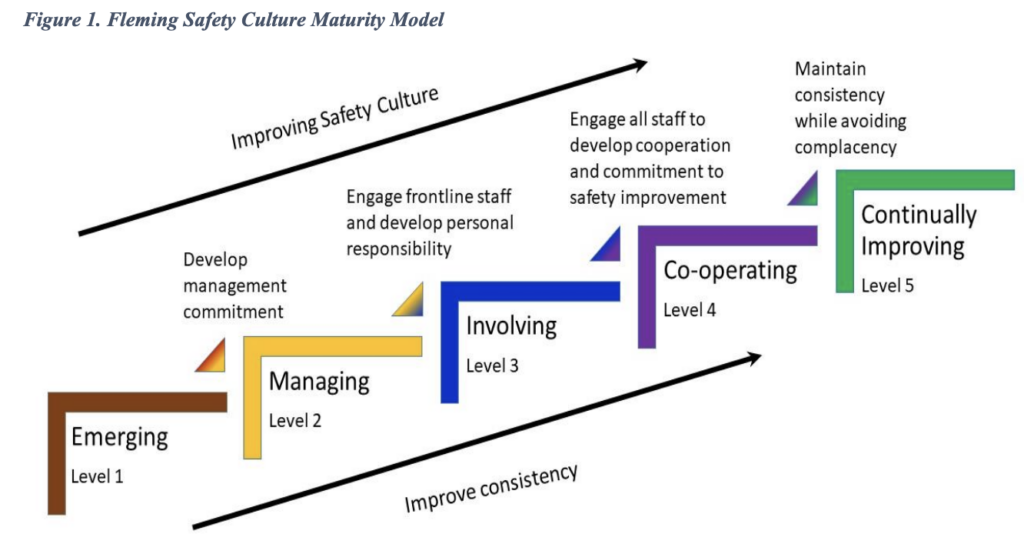
As part of the safety culture review, FRA evaluated the current safety culture at CSX using the Fleming Safety Culture Maturity Model (FSCMM)3 as a guide. FRA collected baseline information on 10 essential safety culture elements. FRA used information from the field and structured interviews, observations, focused inspections, and the FSCMM to determine the relative maturity, or advancement, of CSX’s safety culture. Figure 1 below illustrates the different maturity levels within the FSCMM.
The lowest levels of safety culture maturity are focused primarily on minimal compliance with relevant statutes, regulations, and industry standards or reactive efforts to prevent accidents. The highest levels of safety culture maturity focus on continuous learning and improvement. As an organization’s safety culture matures, safety practices become more ingrained in all aspects of an operation. Safety culture is dynamic, and even at the highest levels of maturity everyone in the organization must continuously work together to refine programs and enhance efforts to improve safety and avoid complacency, so as not to slip to a lower level of maturity As noted above, the assessment is not based solely on the numerical scores derived from the short form field interviews; FRA applied its expert judgement to combine the disparate data sources from long form interviews, inspection activities, and responses to prior safety recommendations to assess the maturity level for each of the 10 core safety culture elements individually. To arrive at its assessment of the overall safety culture at CSX, FRA, considered the aggregate assessments of the individual core elements, and holistically factored in any information derived from the sources described above that seemed to address safety culture broadly.
The information FRA collected during this assessment serves as a “snapshot” of the current safety culture at CSX. The information collected is used to determine the maturity of each safety culture element at the time of the assessment and will be used as a benchmark for future assessments.
CSX Safety Practices
When reviewing the overall findings of the CSX assessment, there is an indication that safety culture at CSX is currently in a period of transition. Although this assessment found that the safety culture maturity at CSX is currently at the involving level of maturity, there is evidence of improvements, as well as a commitment from leadership, indicating that CSX’s safety culture is likely moving into more mature stages. Many CSX employees, managers, craft employees, and labor leaders cited the leadership of CEO Joseph Hinrichs as heralding a new commitment to safety at CSX. Although several employees spoke of the impact that CSX’s CEO has had on safety in general terms, a few provided examples of specific changes that have been made under Mr. Hinrichs’s leadership.
For example, employees noted improvements to the CSX discipline policy, stating that the policy is now fairer and more consistent than it was previously. Furthermore, employees indicated that there is a movement away from punishment and towards more coaching and counseling to support safer workplace behaviors. Although not mentioned directly, this shift is consistent with moving towards a “just culture” environment, in which both management and labor share accountability in a way that makes a distinction between mistakes and deliberate acts.3 In contrast, some employees indicated that discipline at CSX is often inconsistently applied or dependent upon managers. As FRA has observed with other railroad assessments, the fostering of mutual trust is an area where railroads struggle.
Moving towards a discipline policy that is fair, consistent, and focused on redirecting behaviors rather than punitive action will help to increase trust within CSX. Consistently, employees speaking to FRA during the assessment period indicated that there is a renewed focus on safety and that the CEO has worked to make changes within the railroad to demonstrate CSX’s prioritization of safety. FRA observed the results of some of these changes during the assessment period. However, the implementation period for some of these positive changes was still in its early days. As such, they were not always reflected in the data collected during the assessment period.
Although data collected by FRA indicates that CSX’s safety culture is moving in a positive direction, there are still areas for improvement. Specifically, CSX’s safety culture would benefit from changes to address how CSX approaches training and continuous learning opportunities. Data from the assessment reveal that both managers and frontline employees are not aware of continuous learning opportunities available at CSX. Providing opportunities for continuous learning is one of the key safety culture elements (Element two4). CSX has also declined to provide additional training opportunities to employees in response to FRA safety advisories. Offering additional training and continuous learning opportunities gives employees the chance to improve their performance, learn new skills, and continue performing their jobs safely. Continuous learning opportunities also allow the railroad to address any safety concerns or failures raised in FRA safety advisories. Addressing how CSX publicizes training opportunities to its employees and managers and providing additional continuous learning prospects is an area where CSX has the greatest ability to affect positive change in its safety culture.
CLICK HERE for the full report