
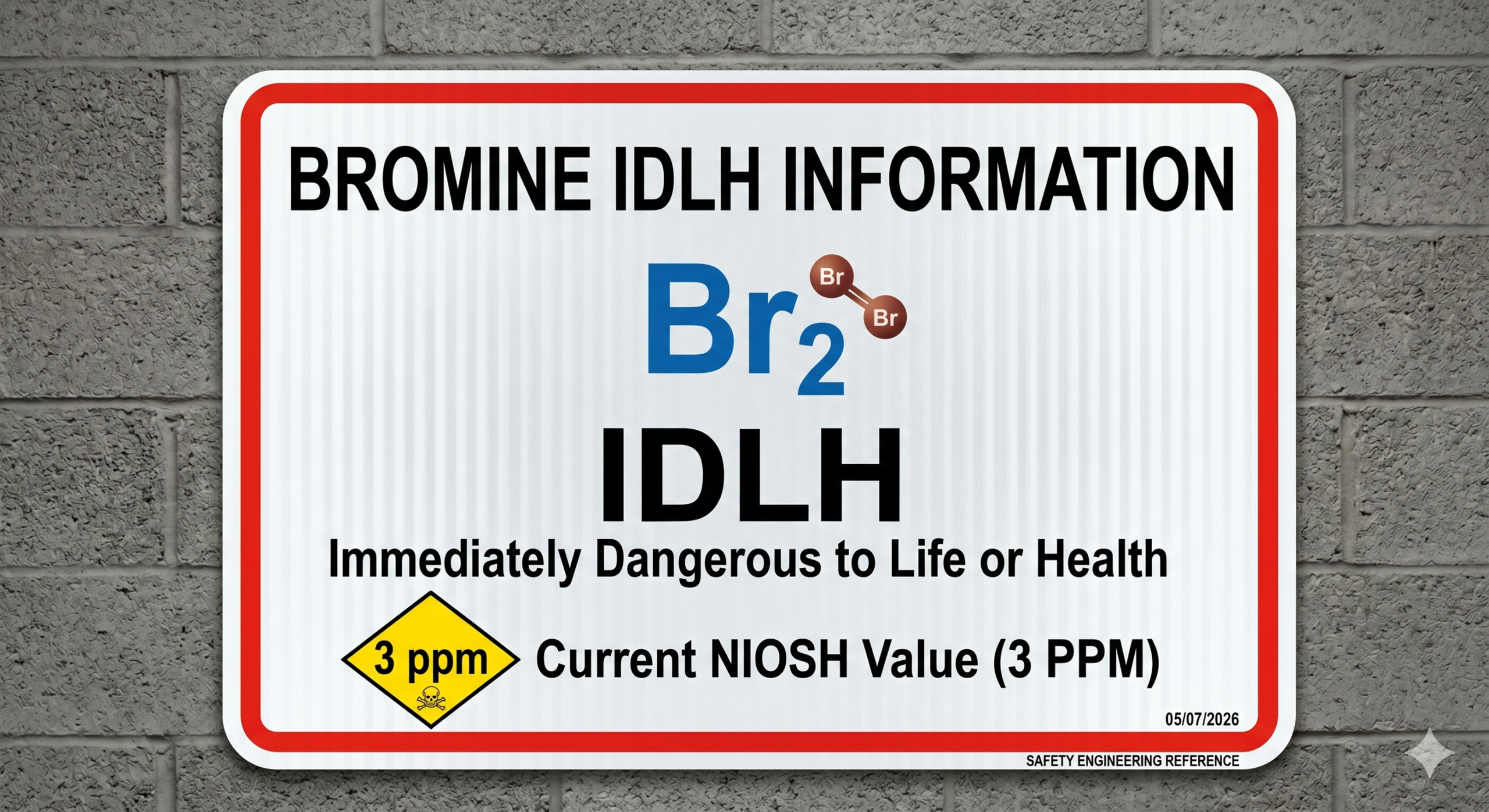
The Immediately Dangerous to Life or Health (IDLH) history for bromine follows a trajectory similar to that of chlorine, though the data pool has historically been smaller, leading to greater reliance on comparative toxicology.
The Standards Completion Program (1974)
When NIOSH and OSHA first established the IDLH values in 1974, the limit for bromine was set at 10 ppm.
- The Basis: This original value was derived from early industrial hygiene literature and human case studies. It was determined that 10 ppm was the concentration that could be tolerated for a short duration without causing permanent damage or preventing escape.
- Early Observations: Historically, it was noted that concentrations of 10 ppm caused severe respiratory irritation and “glottal spasms,” but were not immediately fatal to humans.
The 1994 Re-evaluation
During the 1994 NIOSH review process, bromine was one of the chemicals scrutinized to ensure the limits were truly protective against “incapacitation” during an escape. After reviewing the available animal and human data, NIOSH lowered the IDLH from 10 ppm to 3 ppm.
The Rationale for 3 ppm
The decision to drop the limit significantly was based on a more modern understanding of bromine’s extreme potency as a pulmonary irritant compared to other halogens.
- Animal Lethality Data: Research showed that bromine was more toxic than chlorine in acute inhalation studies. For example, $LC_{50}$ values in rodents indicated that death could occur at lower concentrations than previously estimated for short-term exposures.
- Human Tolerance: Clinical data suggested that 3 ppm represented a threshold where severe respiratory distress and lacrimation (tearing) would likely impair a worker’s ability to see and breathe well enough to navigate an exit.
- Extrapolation: Because bromine is a heavy vapor that tends to settle, the potential for high-concentration “pockets” in a spill made the 3 ppm limit a more robust safety buffer for emergency planning.
Current Occupational Exposure Limits
The 3 ppm IDLH remains the current standard. To put this in perspective, bromine has some of the lowest exposure limits of the common industrial halogens:
| Standard | Concentration | Exposure Type |
| NIOSH IDLH | 3 ppm | Immediately Dangerous to Life or Health |
| OSHA PEL | 0.1 ppm | 8-hour TWA |
| ACGIH TLV | 0.1 ppm | 8-hour TWA (with 0.2 ppm STEL) |
| AIHA ERPG-3 | 5 ppm | Life-threatening effects (1-hour exposure) |
Bromine vs. Chlorine: The Toxicity Comparison
It is often helpful to compare bromine to its chemical “cousin,” chlorine, to understand why the IDLH is so much lower:
- Potency: Bromine is generally considered 2 to 3 times more toxic than chlorine in terms of acute respiratory impact.
- Physical State: Bromine is a liquid at room temperature but highly volatile. Its vapors are much heavier than air ($Specific Gravity \approx 5.5$), meaning it lingers at ground level far longer than chlorine gas.
- Physiological Impact: Bromine causes more profound tissue damage to the respiratory tract (bronchospasms and pulmonary edema) at lower concentrations than chlorine.
The reduction from 10 ppm to 3 ppm in 1994 reflects the industry’s recognition that even very small amounts of bromine vapor can rapidly incapacitate a responder.