
I do some shock-prevention training for electrical work (Gloves, Meters, LOTO, etc.), but I leave the big stuff like arc flash to those better qualified than me. But as safety pros, we have to stay informed of changes to this world-class standard. We see some crazy situations in our audits and assessments regarding electrical installations and work practices, and many facilities just do not have Electrical Safety-Related Work Practices (ESRWPs), let alone ESRWPs that meet NFPA 70E. So here are the changes to the 2027 Edition of NFPA 70E, and one of them is a BIG CHANGE…
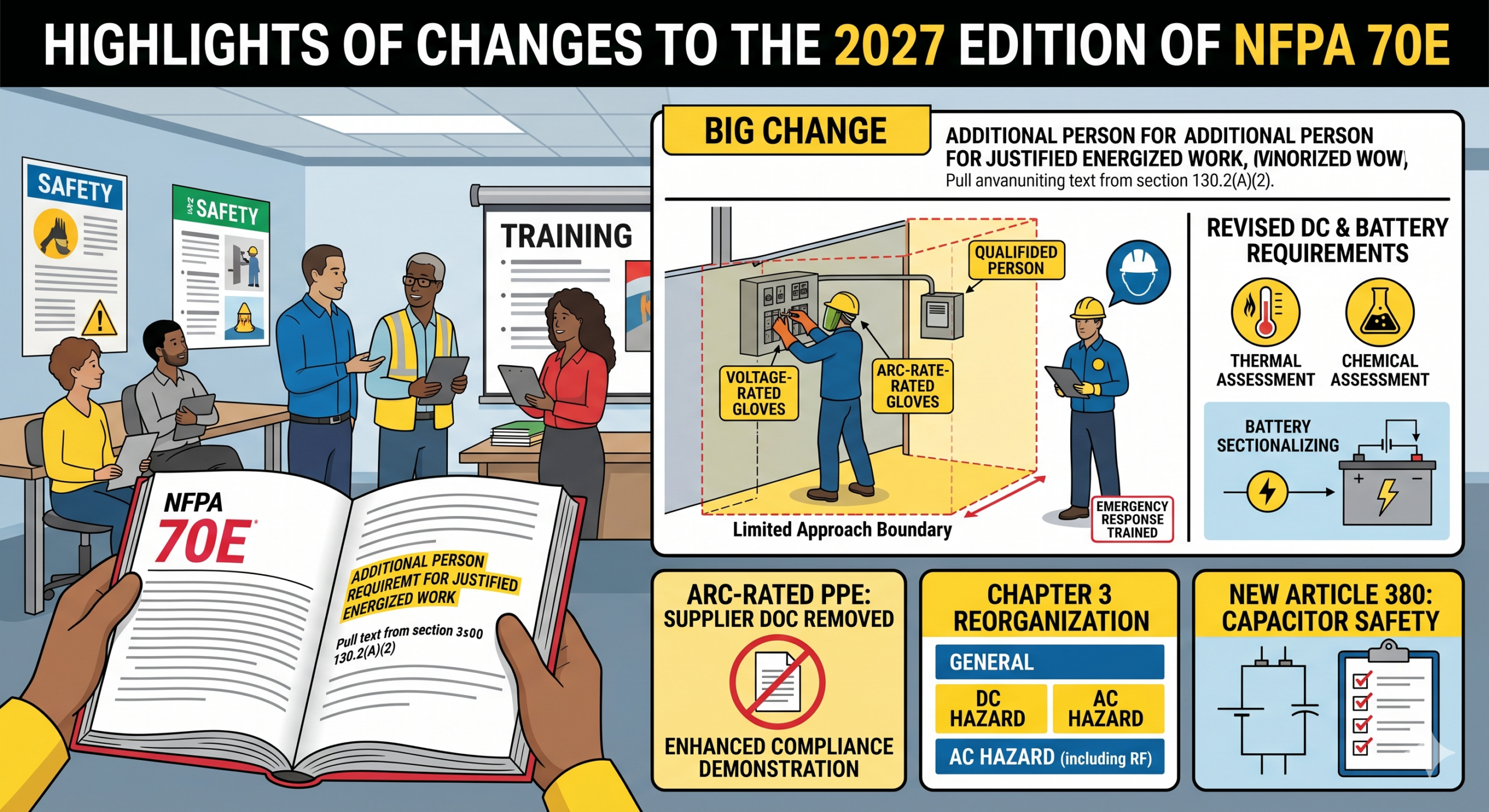
- A new requirement in Article 130 calls for an additional person to be present when justified energized work is required under the energized work permit. (see below for the specifics of this new requirement)
- DC and battery requirements were clarified, revised, and added to Chapter 1 and Chapter 3. Article 360 introduced requirements for battery risk assessments, including contact thermal and chemical assessments. Section 360.4 was added to allow for establishing a lower risk condition in batteries, including battery sectionalizing.
- The option for solely using a supplier’s Declaration of Conformity for demonstrating compliance of arc-rated PPE has been REMOVED
- Chapter 3 articles were reorganized to address general hazards, to group dc hazards and to group ac hazards. AC hazards were further separated into sub-RF, RF, and mixed frequencies other than dc and 50/60 Hz.
- Article 380 was added to address safety-related work practices specific to electrical double layer capacitors.
130.2 Work Involving Electrical Hazards.
Safety-related work practices shall be used to safeguard employees from injury while they are exposed to electrical hazards from electrical conductors or circuit parts that are or can become energized.
(A) Energized Electrical Parts Not in an Electrically Safe Work Condition.
(1) Energized Work in Accordance with 110.2(B).
When energized electrical conductors and circuit parts operating at voltages equal to or greater than 50 volts are not put into an electrically safe work condition, and work is performed as permitted in accordance with 110.2(B), all of the following requirements shall apply:
    (1) Only qualified persons shall be permitted to work on electrical conductors or circuit parts that have not been put into an electrically safe work condition.
    (2) An energized electrical work permit shall be completed as required by 130.3.
    (3) An electric shock risk assessment shall be performed as required by 130.4.
    (4) An arc flash risk assessment shall be performed as required by 130.5.
(2) Additional Person.
If an energized electrical work permit is required in accordance with 130.3, and the energized electrical work permit specifies the use of electric shock or arc flash PPE, or both, in accordance with 130.3(B)(5)d. and 130.3(B)(6)b., at least one additional person meeting the emergency response training requirements of 110.4(C)(1) shall be present at, but outside of, either the limited approach boundary or arc flash boundary, whichever is greater.
Source: NFPA 70E, 2027