
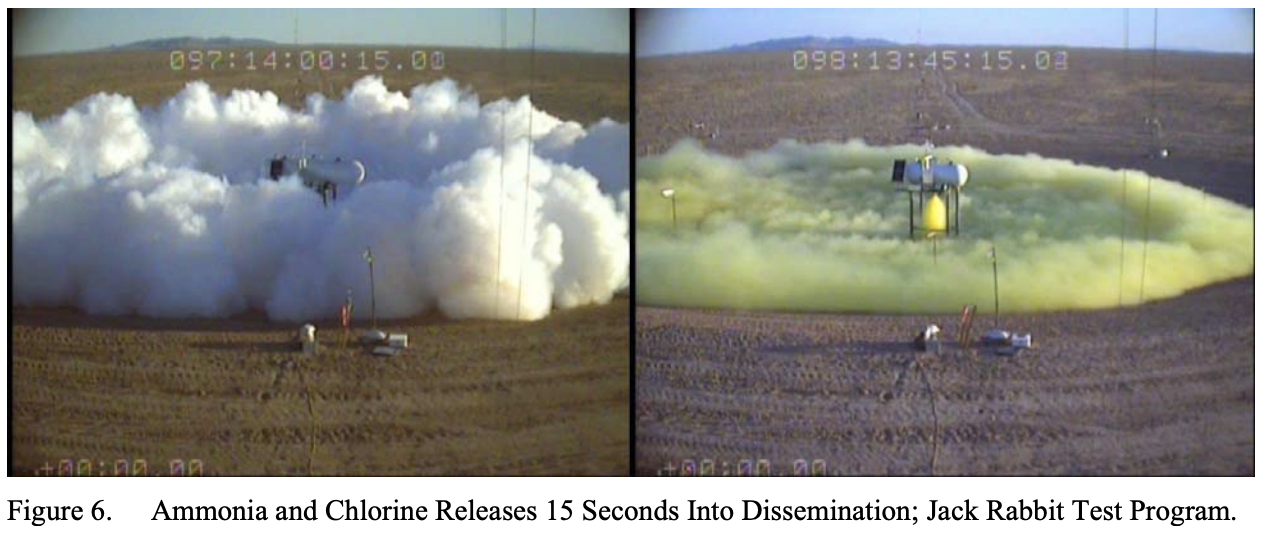
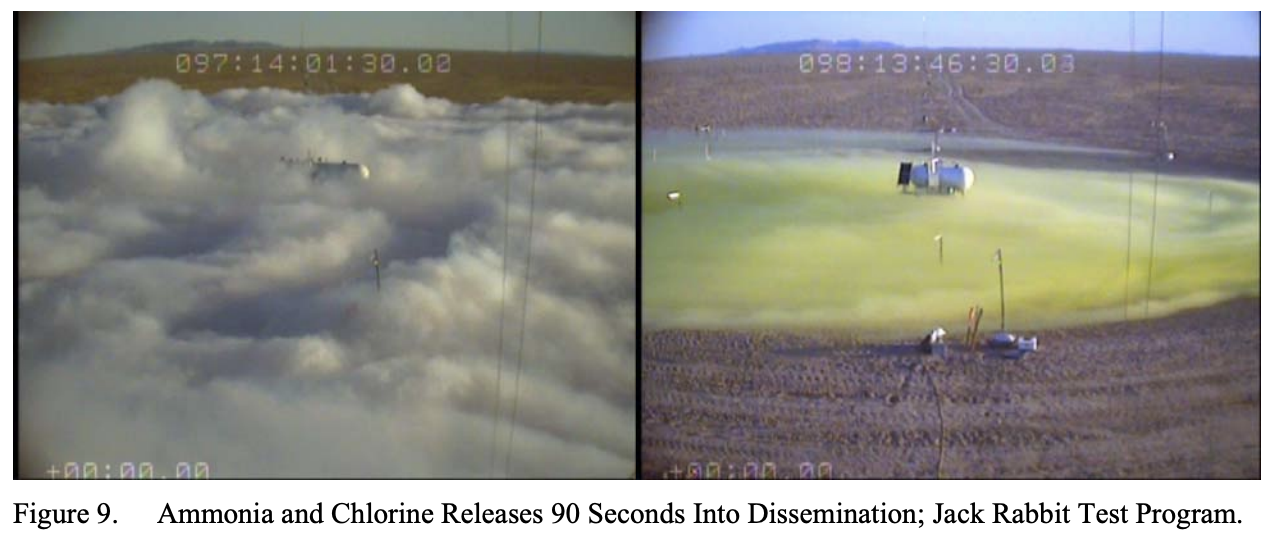
The data from the Jack Rabbit tests done over the past decade is immense and exceptional learning tools. I always make sure my students, whether it be a HAZMAT responder class or a Process Safety course, fully understand how Vapor/Gas Density impacts us in a LOPC event. Using Chlorine and Ammonia, the contrast is stark and unforgettable…
Please keep in mind that Ammonia is a colorless gas; the white cloud you are seeing is the ammonia is condensing the moisture in the air to make the cloud. Opinions vary wildly on how much ammonia does it take to create a visible cloud, but most can agree on 2,000 ppm and above. The key point is… we will never (even on the most humid day) see NH3 at 300 ppm (IDLH)! The chlorine is an actual colored gas, yellowish-green. This higher the concentration the more “fluorescent” it begins to appear. It has an IDLH of just 10 ppm, which is very difficult to judge by sight as to when we achieve that level.
But look at how these materials behave after the LOPC event begins:
- Both are stored as a Liquidfied Pressurized Gas
- Both leaks points are the same size and location (liquid release on the bottom of the container)
- NH3 Density is 0.7 and Cl2 Density is 2.5
The first image is after 15 seconds and the other image is at 90 seconds (i.e. container is empty of liquid)
Imagine this, it really happened…
Another notable anomaly occurred during trial 07-RC, which was also the chlorine VIP day. Approximately 20 minutes after the dissemination of chlorine, a flock of birds landed on the disseminator and remained perched there for roughly 2 minutes. What makes this event so peculiar is that the birds were within 7 feet of a visible chlorine cloud for a significant period of time and they suffered no ill effects.