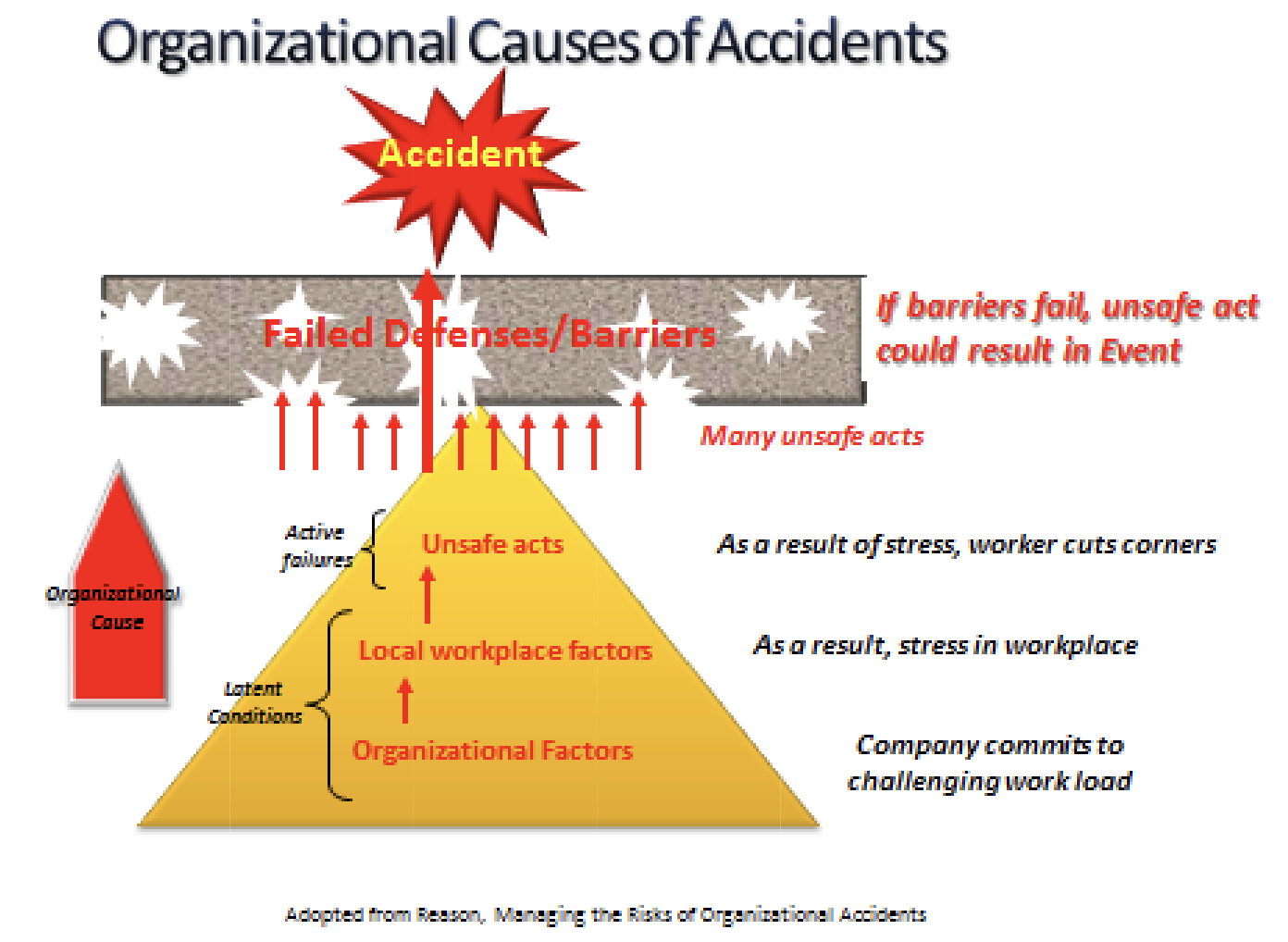
Accident Investigation – Barrier Analysis
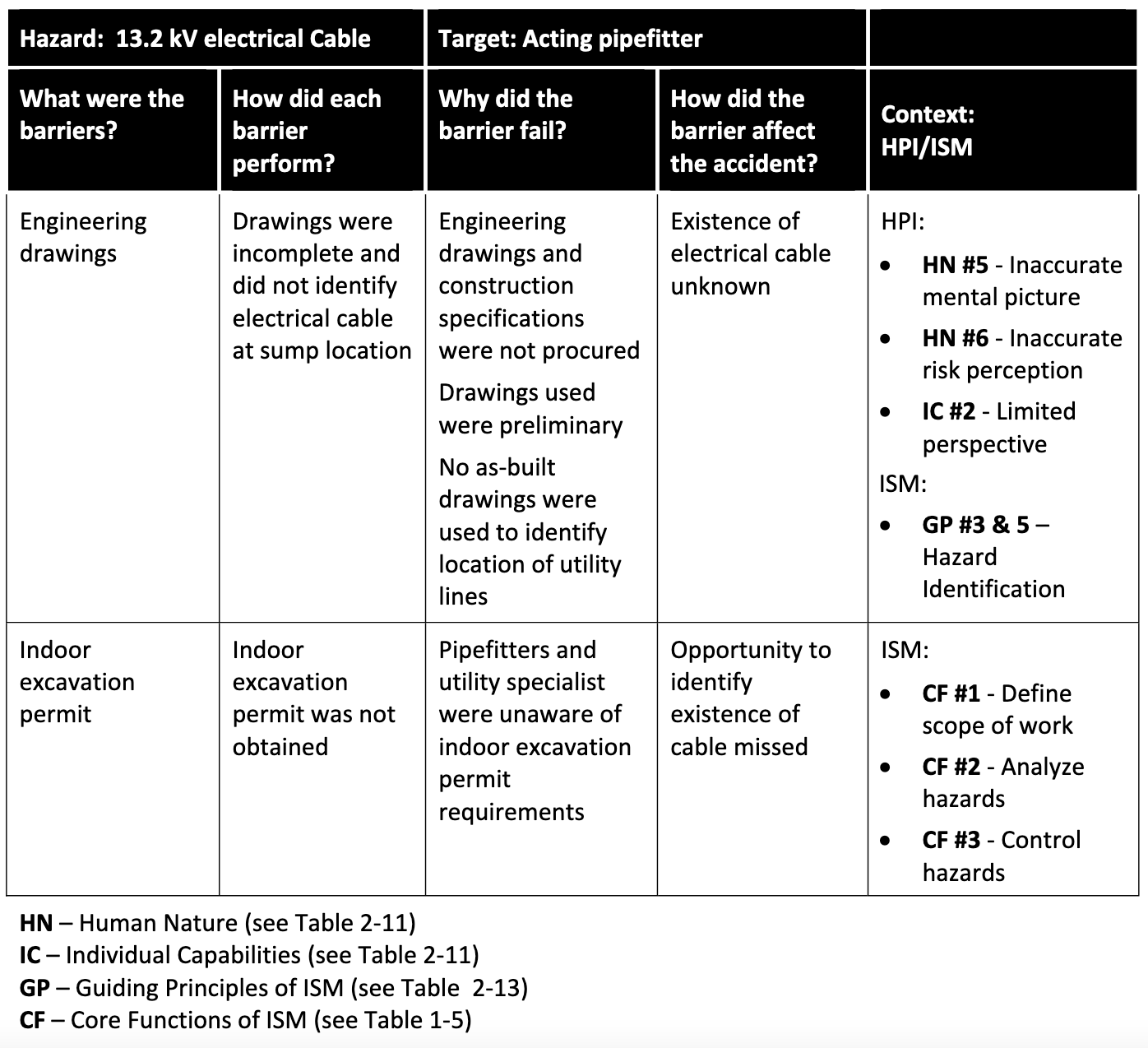
Barrier Analysis Worksheet

When analyzing barriers, investigators should first consider how the hazard and target could come together and what was in place or was required to keep them apart. Obvious physical barriers are those placed directly on the hazard (e.g., a guard on a grinding wheel); those placed between a hazard and target (e.g., a railing on a second-story platform); or those located on the target (e.g., a welding helmet). Management system barriers may be less obvious, such as the exposure limits required to minimize harm to personnel or the role of supervision in ensuring that work is performed safely. The investigator must understand each barrier’s intended function
and location, and how it failed to prevent the accident.

To analyze the performance of physical barriers, investigators may need several different types of data, including:

  • Plans and specifications for the equipment or system
  • Procurement and vendor technical documentation
  • Installation and testing records
  • Photographs or drawings
  • Maintenance histories.

To analyze management barriers, investigators may need to obtain information about barriers at the activity, facility, and institutional levels responsible for the work. At the activity level, the investigator will need information about the work planning and control processes that govern the work activity and the relevant safety management systems. This information could include:

  • Organizational charts defining supervisory and contractor management roles and responsibilities for safety
  • Training and qualification records for those involved in the accident
  • Hazard analysis documentation
  • Hazard control plans
  • Work permits
  • The work package and procedures that were used during the activity.

The investigator may also need information about safety management systems at the facility level. This kind of information might include:

  • The standards and requirements that applied to the work activity, such as occupational exposure limits or relevant Occupational Safety and Health Administration (OSHA) regulations
  • The facility’s technical safety requirements and safety analysis report
  • Safety management documentation that defines how work is to be planned and performed safely at the facility
  • The status of integrated safety management implementation.

At the institutional level, the investigator may need information about senior line management organizations’ safety management direction and oversight. This kind of information might include:

  • Policy, orders, and directives
  • Budgeting priorities
  • Resource commitments.

The investigator should use barrier analysis to ensure that all failed, unused, or uninstalled barriers are identified and that their impact on the accident is understood. However, the investigator must cross-validate the results with the results of other core analytic techniques to identify which barrier failures were contributory or root causes of the accident.


Constructing a Worksheet

A barrier analysis worksheet is a useful tool in conducting a barrier analysis. A blank Barrier Analysis Worksheet is provided in Appendix D.4 Analysis Worksheets. Table 2-12 illustrates a partially completed worksheet using data from the case study. The steps used for completing this worksheet are provided below.
Although a barrier analysis will identify the failures in an accident scenario, the failures may not all be causal factors. The barrier analysis results directly feed into the events, causal factors chart, and subsequent causal factors determination.

Example:

Barrier Analysis Worksheet

Step 1: Identify the hazard and the target.

“13.2 kV electrical cable. Acting pipe fitter.”

Record them at the top of the worksheet.


Step 2: Identify each barrier.

“Engineering drawings. Indoor excavation permit. Personal protective equipment.”

Record in column one.


Step 3: Identify how the barrier performed

What was the barrier’s purpose?

Was the barrier in place or not in place?

Did the barrier fail?

Was the barrier used if it was in place?

“Drawings were incomplete and did not identify electrical cable at sump location. Indoor excavation permit was not obtained. Personal protective equipment was not used.”

Record in column two.


Step 4: Identify and consider probable causes of the barrier failure.

“Engineering drawings and construction specifications were not procured. Drawings used were preliminary, etc.”

Record in column three.


Step 5: Evaluate the consequences of the failure in this accident.

“Existence of electrical cable unknown.”

Record evaluation in column four.


Step 6: Evaluate the context of the consequences of the barrier in terms of both human performance (HPI) AND Safety Management system (SMS).

Use the Human Error Precursor Matrix, Seven Guiding Principles Chart, and the ISM Five Core Functions.

A more detailed discussion and list of Human Error Precursors will be found in Table 2‐11.

Record evaluation in column five.

Scroll to Top