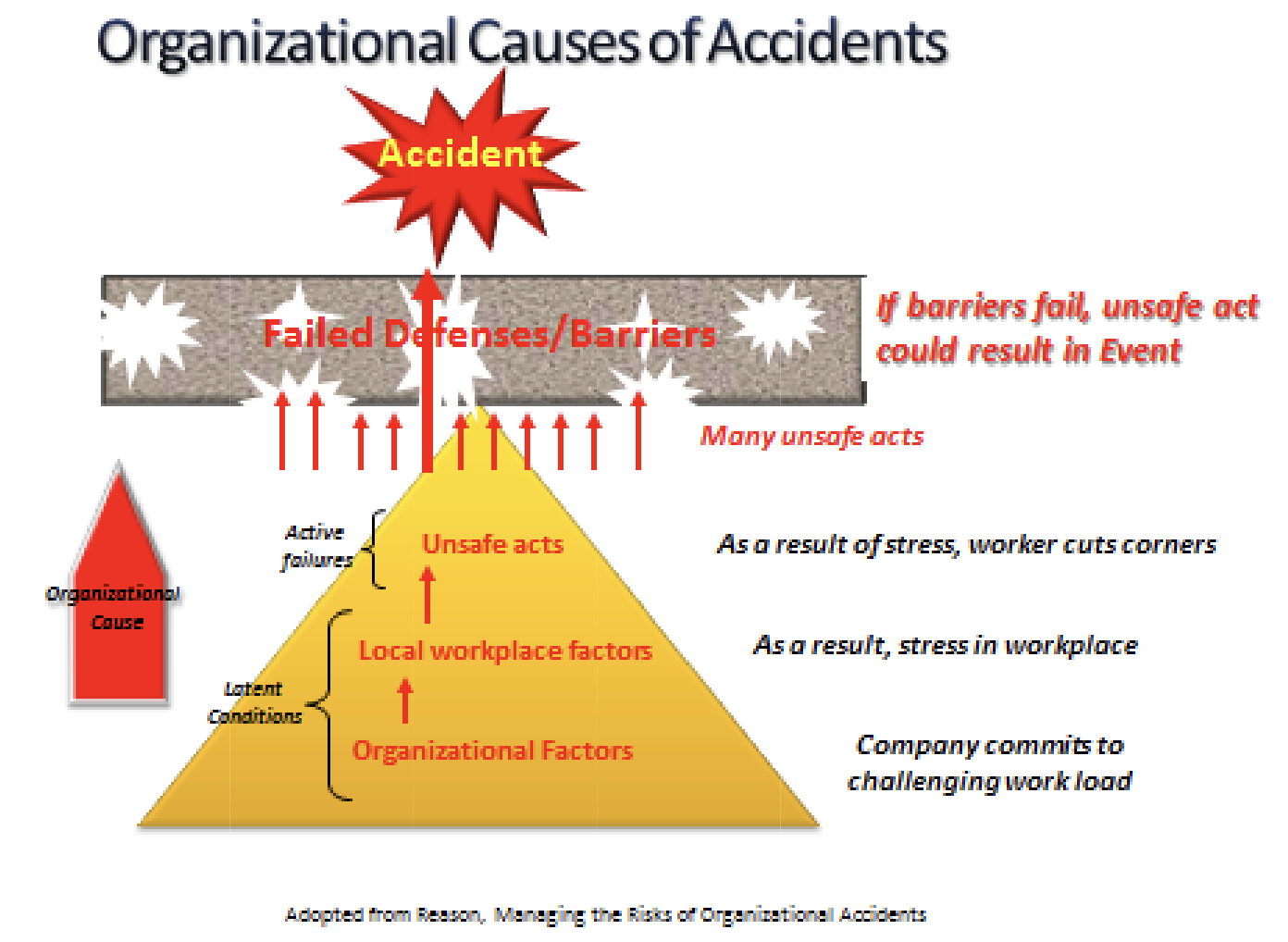
The basis for conducting any event investigation is to understand the organizational, cultural, or technical factors that, left unattended, could result in future accidents.
Guiding concepts may be summarized as follows:
- Within complex systems, human error does not emanate from the individual but is a bi-product or symptom of the ever-present latent conditions built into the complexity of
organizational culture and strategic decision-making processes. - The triggering or initiating error that releases the hazard is only the last in a network of errors that often are only remotely related to the accident.
- Accident occurrences emerge from the organization’s complexity, taking many factors to overcome the system network of barriers and allowing a threat to initiate the hazard release.
- Investigations require delving into the basic organizational processes: designing, constructing, operating, maintaining, communicating, selecting and training, supervising, and managing that contain the kinds of latent conditions most likely to constitute a threat to the safety of the system.
- The inherent nature of organizational culture and strategic decision-making means latent conditions are inevitable.
- Systems and organizational complexity mean not all problems can be solved in one pass.
- Resources are always limited, and safety is only one competing priority. Therefore, event investigators should target the latent conditions most in need of urgent attention and make them visible to those who manage the organization so they can be corrected.
[Hollnagel, 2004] [Dekker, 2011] [Reiman and Oedewald 2009]
Source: DOE HANDBOOK, Accident and Operational Safety Analysis, Volume I: Accident Analysis Techniques