
Book review: The Classic (Defending H.W. Heinrich series)

This article was written by Carsten Busch, Safety Mythologist and Historian. The “Indiana Jones of Safety.” Experienced safety, quality, and productivity enabler.
[email protected]

It was translated from Dutch to English using Google Translator and Grammarly.  I follow Carsten on LinkedIn as he, too, is a defender of H.W. Heinrich.  He was kind enough to allow me to share this with the SAFTENG community.  You can follow him on LinkedIn using the link above; you won’t be disappointed.


On the occasion of the NVVK anniversary (Dutch Association for Safety Science), we are looking at a classic that has enormously influenced our field: Industrial Accident Prevention, A Scientific Approach, by Herbert William Heinrich. Most safety experts have come into contact with Heinrich’s work or a derivative of it, whether consciously or not, in the course of their careers.

Heinrich spent most of his career working for Travelers Insurance, one of the largest insurers in the United States. He was also involved in various other activities, such as a working group that drew up a standard for reporting accidents and various committees commissioned by the government to guarantee and improve occupational safety during the Second World War. Heinrich was an exceptionally active speaker at (security) conferences and congresses; he wrote over fifty articles and several books1. He did not limit himself to safety; his work during the 1940s was almost exclusively about management and leadership, in general, and applied to safety and production.

It will surprise many, but Industrial Accident Prevention is actually primarily a management book. The book, which has appeared in no less than five editions (the last one almost 20 years after the author’s death2), contains many practical instructions about shielding machines, workplace lighting, and company emergency response. However, the core of all versions is in the first chapters, which are about steering accident prevention and are primarily aimed at (top) management.

The first edition appeared in 1931. The book’s core was based on a handful of articles written between 1926 and 1929. These contain some of the subjects for which Heinrich is best known:
  • Accidents generally have hidden costs that are far greater than the direct damage,
  • most accidents have a direct cause that can be found in man and
  • most serious accidents are preceded by events without serious consequences that can serve as a reason for improvement.

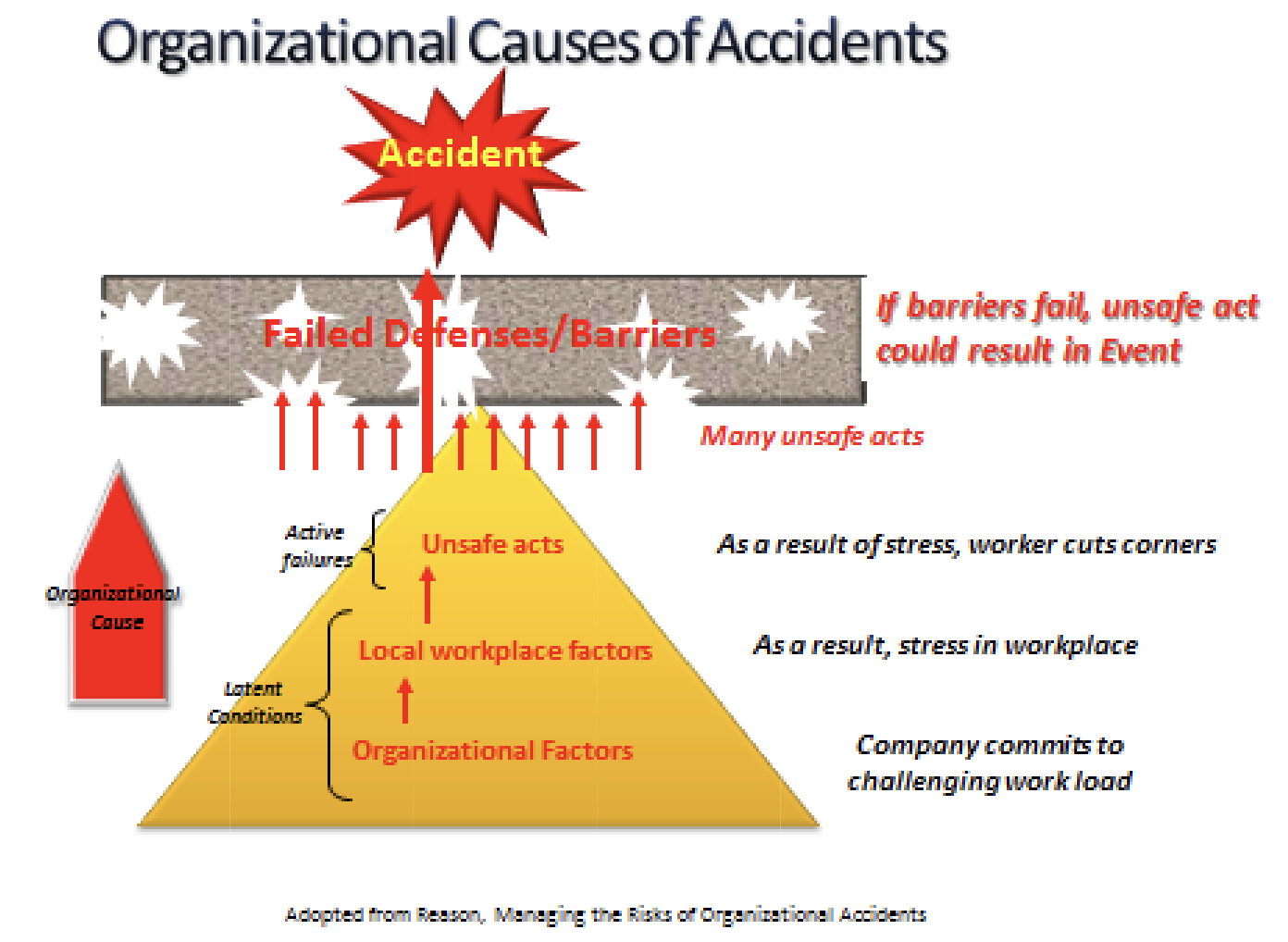
The latter is perhaps known to many as the “accident pyramid.”

Heinrich was adept at getting his message across. He told stories, gave examples, and was particularly adept at wrapping the message in graphical models and metaphors, such as the pyramid, and easy-to-remember sequences of numbers, such as a 1:4 ratio of direct and indirect costs or 1:29: 300 for serious, minor and near misses. In addition, he presented relatively simple roadmaps and principles intended for managers that reflected his “scientific approach” to accident prevention:

  1. Interest and support from top management
  2. Knowledge of facts through analysis of causes
  3. Choice of measures based on facts
  4. Follow-up of measures

Footnotes:
1 Some of these can be found online; see: https://mindtherisk.com/heinrich/2-uncategorised/218-heinrich-sources

2 The 1980 edition is an adaptation by Dan Petersen and Nestor Roos and can’t really be seen as the same book. Although it still contains original pieces by Heinrich, it is more of an overview of safety models and ideas of the time.


Heinrich’s basis presented in the first edition has been edited and supplemented at intervals of about ten years. The reworkings reflected technical and social developments and also a further development of Heinrich’s ideas. In the second edition from 1941, Heinrich presented one of his most famous metaphors: the domino series. This is probably the first safety accident model we encounter in various forms today. Another noteworthy addition was a chapter on practically applied psychology for motivating managers and employees. The third edition (1950) emphasized safety management and introduced a ladder metaphor as the basis for a simple safety management system. This edition was clearly influenced by Heinrich’s work on management during the 1940s (including three booklets for first-line managers).

The last update by Heinrich (in collaboration with his friend and colleague Edward Granniss) in 1959 brought a new structure and new topics, such as radiation hazards. In this edition, there was also attention to discussing some misunderstandings. They already existed then and have certainly not diminished in the following sixty years.

Heinrich’s ideas became an important part of the safety curriculum; many have interpreted and presented his work in various ways. Not all interpretations were for the better. For example, some have come to regard the numbers as laws, while Heinrich clearly wrote that they were based on averages and used the numbers mainly to communicate. Perhaps most grievous was the 88:10:2 ratio of direct causes that are still cited in various forms as “scientific proof” that humans cause most accidents – while Heinrich talked about direct causes and emphasized in many places that measures had to start with redesigning workplaces and not correcting people.

There are voices that think that Heinrich’s ideas should be quickly banned from safety science and forgotten. Despite the shortcomings, the fact that some ideas are now almost a century old, that some things fit less in our modern, more complex world, and that there are all kinds of misinterpretations, I don’t think that’s a good approach. Heinrich’s work has laid a foundation for safety science that was not there before. He also made a number of contributions (for example, paying attention to situations before they lead to injury and damage) that were innovative. Rather, I advocate seeing Heinrich’s work in its historical context, recognizing its limitations (including the nuances that Heinrich himself already made) and appreciating the contributions it has made. Understanding and knowledge of the basics also helps us to better understand and apply more modern approaches.


Heinrich, H.W. (1931) Industrial Accident Prevention – A Scientific Approach. New York: McGraw-Hill.

Heinrich, H.W. (1941) Industrial Accident Prevention (second edition). New York: McGraw-Hill.

Heinrich, H.W. (1950) Industrial Accident Prevention (third edition). New York: McGraw-Hill.

Heinrich, H.W. & Granniss, E. (1959) Industrial Accident Prevention (fourth edition). New York: McGraw-Hill.

Heinrich, H.W., Petersen, D. & Roos, N. (1980) Industrial Accident Prevention – A Safety Management Approach. New York: McGraw-Hill Book Company.

Scroll to Top