Several years back, I worked with an organization that had an in-house Operational Testing program with a really catchy name. I actually loved the name, but as I learned more about the process, it was simply a catchy name for a very bad process. It was an attempt by a business to have BOTH a Behavior-Based Safety Process (BBS) and a Skills Testing program required by the government agency that regulated safety in the industry. This is the story of their mistakes in the hopes that others may learn from them.
Their Operational Testing and Inspections program was a blend of Observations to determine COMPLIANCE with safety regulations and company policies. This program was called COMMIT (Coaching, Observing, Mentoring and Motivating with Integrity and Trust). And I can assure you there was very little coaching, mentoring, or motivating, and the program certainly lacked integrity and trust. The lack of trust in this organization was so bad that the Union would not share its BBS observation data with me, so I could see whether the two efforts were aligned in the data it produced. This was an effort to VALIDATE both programs’ data. I did not want the names of those who had been observed; I merely wanted the data on what both programs were producing, as management was paying attention to the COMMIT program (as it was REQUIRED by the regulations) but had zero oversight of the Union’s BBS process.
According to Webster’s, a COACH is someone who instructs, trains, or directs, particularly in sports, or one who acts as an advisor to help people reach goals. It involves intense training, demonstrations, and guidance to improve individuals’ skills or performance.
Think back to your days of playing sports. Where was the COACH during practice? Was he/she hiding from the team and waiting for a player to make a mistake so they could appear from the shadows to correct the behavior? Hell no, they are there WITH THE TEAM, providing correction as the team practices the plays. In this organization’s program, the “observer”, a member of management, would spend time finding the perfect hiding spot to watch his crews work. I even witnessed this being done from very far away with binoculars. I also witnessed the management member breaking safety rules while trying to get into position in time to catch the crew doing something the manager “knew they were going to violate”. You see, managers had goals in this program, and they were rewarded for observing more issues. So it’s not a people problem; it’s a management and metrics problem.
According to Merriam-Webster Dictionary, OBSERVATION is defined as the act or power of noticing, watching, or fixing the mind upon something, particularly for scientific, educational, or informational purposes.
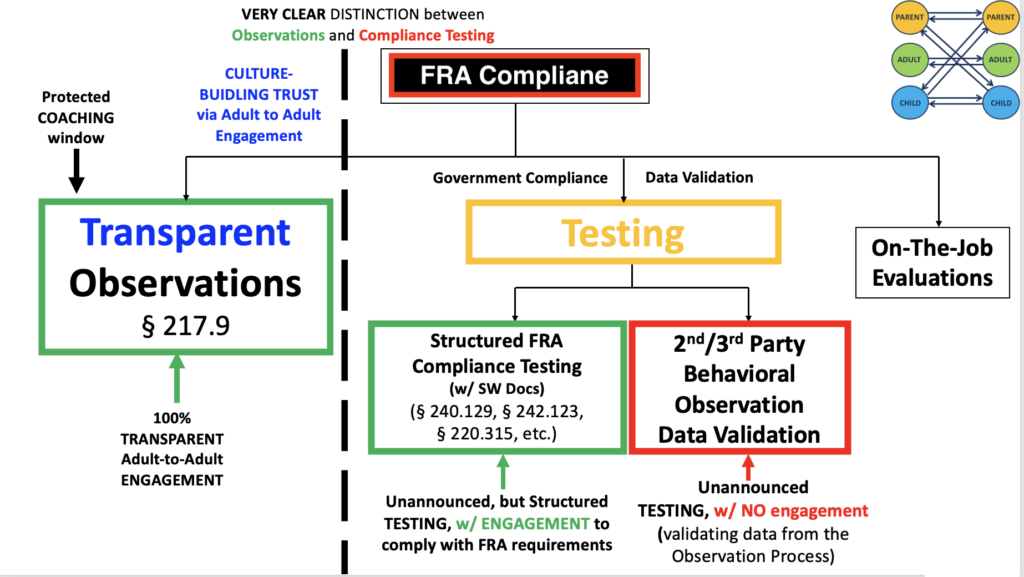
As anyone trained in Behavior-Based Safety Principles knows, observing needs to be KNOWN by those being observed. We are COACHING during the OBSERVATION. It is a tool to help CORRECT mistakes/errors/violations (Reason, J. 1990) firsthand while the worker performs high-risk tasks. This is NOT about accountability; it is COACHING, just like our sports coaches. The accountability comes during TESTING, which we will discuss later.
According to Merriam-Webster, a MENTOR is a “trusted counselor or guide”. As a verb, mentoring is defined as teaching, advising, or training a less experienced person. It involves providing guidance, support, and positive influence, often, but not exclusively, to a younger person
To be a MENTOR during an Observation, one has to be present! There is no mentoring when the observer is hiding in a vehicle or behind a vehicle or tree using binoculars! This type of behavior is the exact opposite of “mentoring.” This same organization actually implemented a “mentoring” program. It was a very unique program; far different than the ones I participated in during the early years of my career and even today, now that my role is one of a mentor. You see, this program, you had a way in. But when I asked how a troubled worker could exit the program, there was NO PATH. This is playing with words again: a mentoring program that lacks an exit path is simply a program to document failures so the worker can be fired. And trust me, every worker that I interviewed in this program had already figured this out.
According to Merriam-Webster, MOTIVATING is the present participle of motivate, defined as giving someone a reason to act or as the impetus behind an action. It describes the process of inciting, stimulating, or inspiring someone to behave or work in a certain way
The Safety Team members really tried to conduct their Observations more effectively. Although they still wanted to hide (as part of this program was intended to be a TESTING program, more on that later), their engagement was very professional and positive. They made a serious (almost over-the-top) effort to make the opportunity worthwhile, knowing full well that 99% of the other engagements the worker had with managers were not as positive. Tough to be MOTIVATING, facing those kinds of numbers.
According to Merriam-Webster, INTEGRITY is defined as the firm adherence to a code of moral or artistic values (soundness of character), the state of being complete or undivided (wholeness), and being free from damage or defect. It implies trustworthiness and an incorruptible nature, often associated with honesty and high moral standards.
For an observation or testing program to have integrity, the core mission MUST be to improve SPECIFIC at-risk behaviors. The entire process from training observers, the actual observations, AND THE DATA MANAGEMENT has to be about IMPROVING SAFETY and not a “gotcha” process. This single issue is the #1 failure of all Observation processes. When the workers being observed have the right to refuse to be observed by their peers, and the rejection rate exceeds 30%, there is a serious issue, and I would say a serious integrity issue. Most of these issues arise from the workers feeling they are a “target” and that the entire process is to hang them out to dry. While they also witness other unsafe acts occurring around them with no response. They even report unsafe conditions and either get no response or a response that the issue is not a hazard. This drives the mindset that the worker begins to think management thinks they are the problem, not the environment/culture they are working in. This disconnect can be VERY TOXIC and can destroy all safety efforts.
According to Merriam-Webster, TRUST is defined as the assured reliance on the character, ability, strength, or truth of someone or something. It also refers to a firm belief, a confident hope, or a person/thing in which confidence is placed.
Without INTEGRITY, there can be NO trust! We earn trust through our ACTIONS and WORDS, but when our ACTIONS and WORDS do not align, we lose BOTH integrity and trust. And without these last two (2) characteristics, the Coaching, Mentoring, and Observing is a waste of time, as we sure as hell are not influencing behaviors. We are simply going through the motions to meet some arbitrary metric in the number of observations we do each week/month/quarter. This lack of credibility is a rot in safety that destroys CREDIBILITY in safe, and every effort that comes later will be rejected by the workforce!
Here is a graphic I attempted to use to educate Sr. Management on HOW COMMIT is a process to ensure workers can PASS THE TEST. It very much like our days in school. The teacher covers the material repeatedly during the week, and we have some homework to do and maybe some quizzes to prepare us for the TEST. Everything done before the test is to PREPARE the student to PASS the test. This time is VERY DIFFERENT from Test Day. This is the time where the teacher COACHES, OBSERVES, and MENTORS their students in order for them to be successful… pass the TEST! During the test, the teacher is simply assessing students’ ability to answer the questions and pass the test. The standard has already been set for what is PASSING and FAILING, and everyone involved KNOWS!
So testing is a critical function in safety. Without testing, we will never know if behaviors are changing for the better. Let’s be honest about BBS, when the worker(s) know they are being observed and yet still make errors/mistakes/violations, is this really a behavioral issue, or could there be something else INFLUENCING those observed behaviors? The time to INFLUENCE the observed behaviors is via the COACHING, MENTORING, and MOTIVATING during the observation. If the Observer or Observation Team has CREDIBILITY with those being observed, then the observation can have a profound impact on everyone involved. Lacking credibility, everyone involved is more worried about ending the observation and walking away without all the “hassle”. This approach is FAR WORSE than not even having a BBS process in place!