
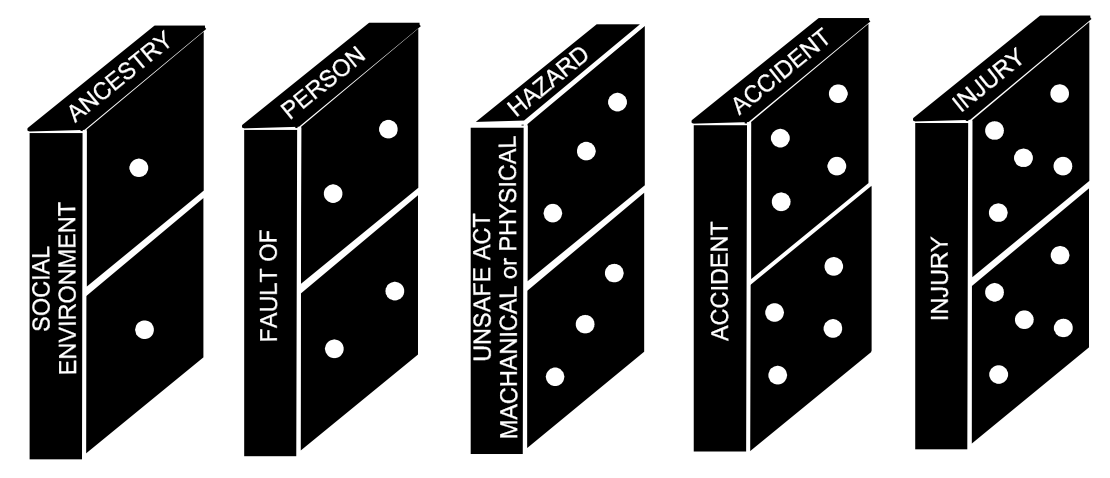
Comparing the Domino and the ILCI causation models

Heinrich Domino Theory

Accident causation models were originally developed in order to assist people who had to investigate occupational accidents so that such accidents could be investigated effectively.  Knowing how accidents are caused is also useful in a proactive sense in order to identify what types of failures or errors generally cause accidents. So action can be taken to address these failures before they have the chance to occur.

The Domino Theory
In 1931, H.W. Heinrich presented a set of theorems known as “the axioms of industrial safety”. The first axiom dealt with accident causation, stating that

the occurrence of an injury invariably results from a complicated sequence of factors, the last one of which being the accident itself.”

Alongside, he presented a model known as the “domino theory” as this accident sequence was likened to a row of dominoes knocking each other down in a row. The sequence is:

  • Injury, caused by an;
  • Accident, due to an;
  • Unsafe act and/or mechanical or physical hazard, due to the;
  • Fault of the Person, caused by their;
  • Ancestry and Social Environment.

Heinrich Domino Theory

The accident is avoided, according to Heinrich, by removing one of the dominoes, normally the middle one or an unsafe act. This theory provided the foundation for accident prevention measures to prevent unsafe acts or conditions.

The first update of the Domino Theory was presented by Bird & Loftus [ Heinrich et al., 1980; Bird & Germain, 1986].

This update introduced two new concepts;

  • The influence of management and managerial error;
  • Loss, as the result of an accident, could be production losses, property damage, wastage of other assets, and injuries.

This model (known as the International Loss Control Institute or ILCI model) is shown in the  figure below:

ILCI model

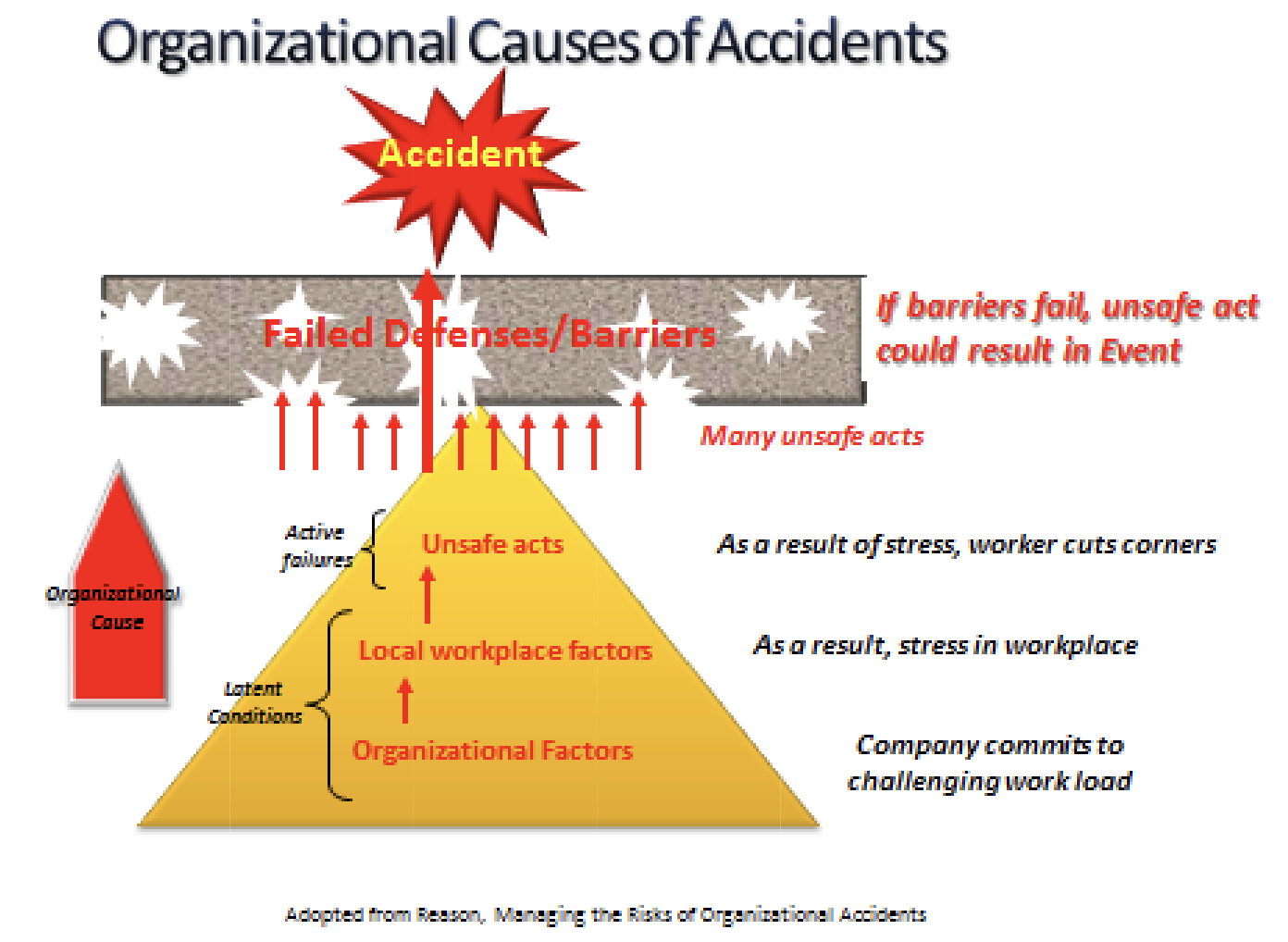
The domino model has been noted as a one-dimensional sequence of events. Accidents are usually multi-factorial and develop through relatively lengthy sequences of changes and errors. This has led to the principle of multiple causations.

According to Peterson, behind every accident, there lies many contributing factors, causes, and sub-causes. The theory of multiple causations is that these factors combine randomly, causing accidents. So, during accident investigations, there is a need to identify as many of these causes as possible, rather than just one for each stage of the domino sequence.

The accident model is in reality, an amalgam of both the domino and multi-causality theories, such as that shown below.

ROOT CAUSES

(Lack of Control)


BASIC CAUSES


IMMEDIATE CAUSE


INCIDENT

LOSS

cause a

cause b

cause c

cause d

cause e

cause f


Conclusion

  • All accidents, whether major or minor, are caused; there is no such thing as an accidental accident
  • Very few accidents, particularly in large organizations and complex technologies, are associated with a single cause
  • The causes of accidents are usually complex and interactive
Scroll to Top