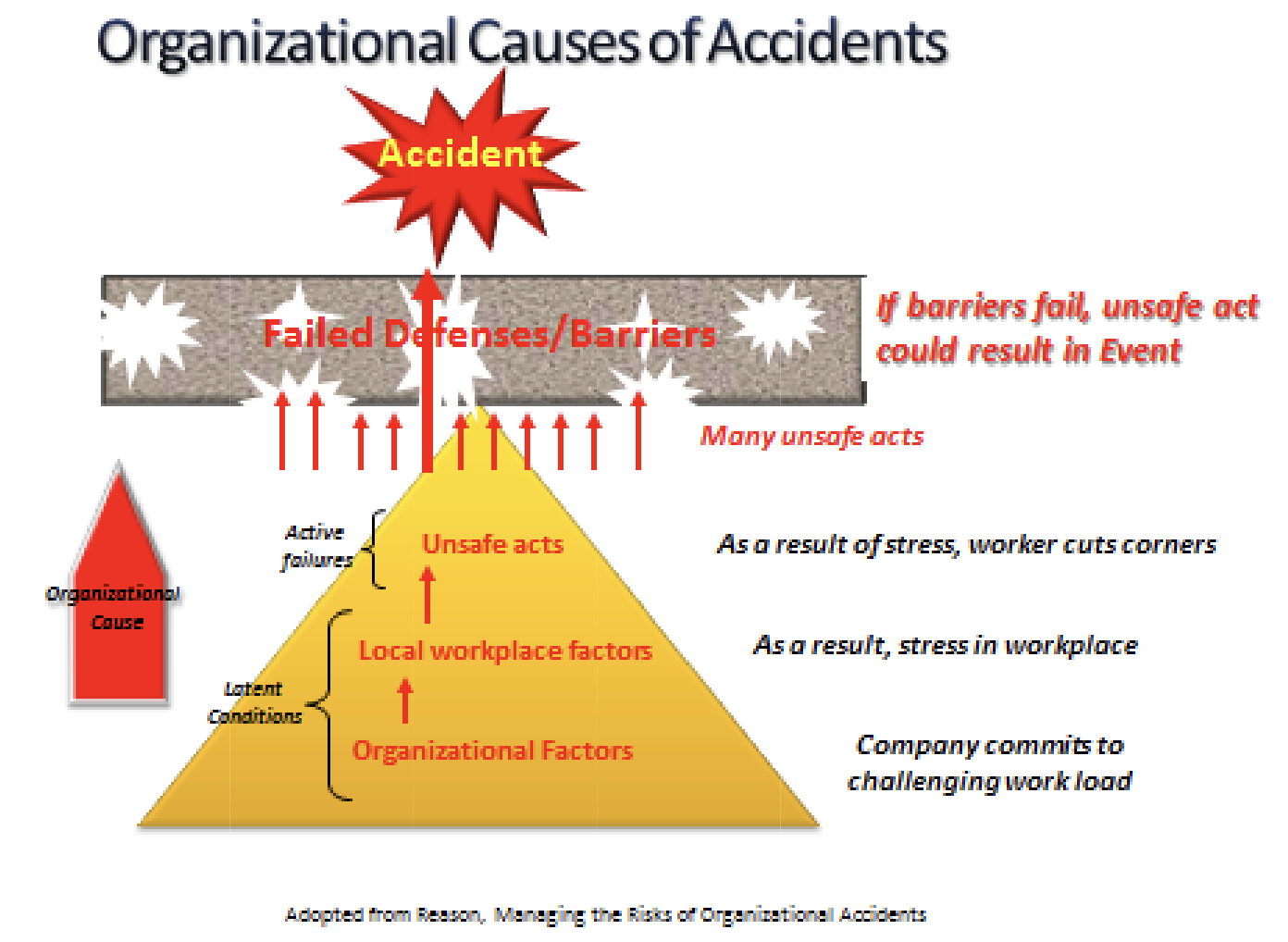
 Another article defending the work of H. W. Heinrich, Assistant Superintendent Engineering and Inspection Division, The Travelers Insurance Company. I feel the need to explain how many have misstated Heinrich’s Accident Pyramid in this article. His Accident Pyramid is probably his most famous piece of work and by far what most attribute to his work. But in recent years, his pyramid has been used as a flawed model; but these criticisms tend to distort what Heinrich was trying to say with his model. For me, although the numbers can vary wildly, the concept is as strong today as it was in the 1930s and for this to be developed in the 1920s and 30s was certainly ground-breaking work.
Fundamentally speaking, Heinrich was very clear that his pyramid model was about SIMILAR ACCIDENTs and not random unsafe acts, as many have attempted to portray it. In his 1941 book, Industrial Accident Prevention – A Scientific Approach, he made it clear that this model was looking at SIMILAR ACCIDENTS… (emphasis by me)
|
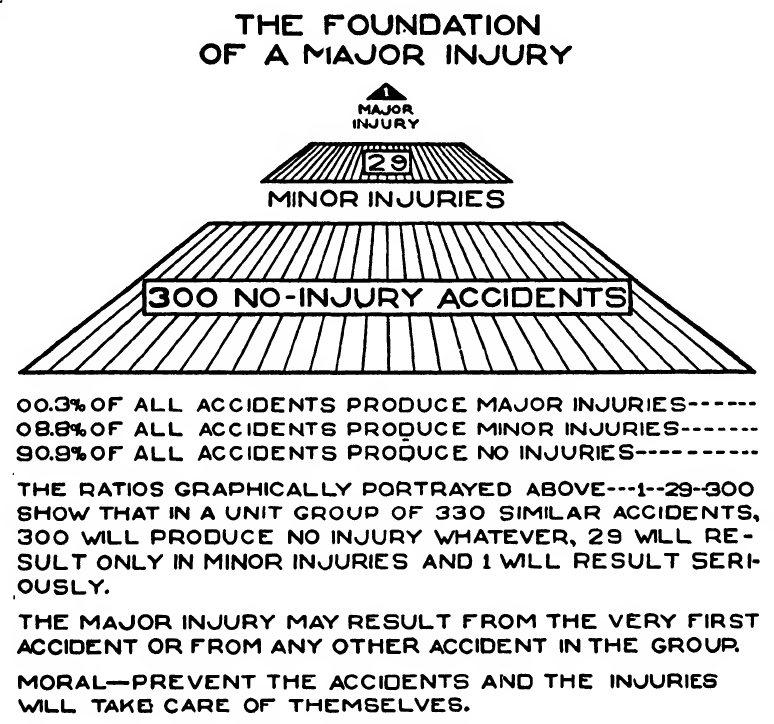
SECTION 4.—FOUNDATION OF A MAJOR INJURY 00.3% of all accidents produce major injuries 08.% of all accidents produce minor injuries 90.9% of all accidents produce no injuries The ratios graphically portrayed above (1-29-300) show that in a unit group of 330 similar accidents, 300 will produce no injury whatever, 29 will result only in minor injuries and 1 will result in seriously. The major injury may result from the very first accident or from any other accident in the group. Moral—prevent the accidents and the injuries will take care of themselves.
|
Let’s look at this further. Did you see his statement… “Moral—prevent the accidents and the injuries will take care of themselves.“
To understand this statement, we have to look back to his Domino Model which shows the next to last domino being the “Accident” and the last domino being the “injury”.
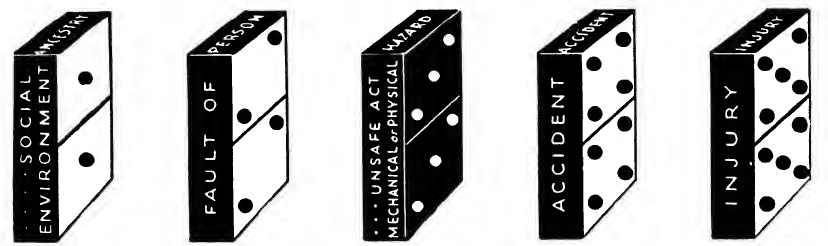
So his explanation is that if we can prevent the “accidents” we will reduce the “injuries”. Look at “accidents” as a precursor to “injuries”.
Consider a group of workers who perform “grinding work” on a regular basis. I think most of us can see his model is NOT completely out of the realm of reality. Think how many times we have observed workers grinding unsafely; whether it is the lack of proper PPE, wrong size/type wheel, missing grinder guard, etc, I think we can relate that 300 times this unsafe act results in NO injury. 29 could result in an accident in which there was no injury (e.g. think about all the pics we see where the safety glasses or faceshield saved the worker from serious injury. And most of us have witnessed a serious injury from unsafe grinding.
Although the numbers may be wildly different for different groups of workers and the hazardous tasks they do; the model is merely meant to give a VISUAL representation of the ratio between serious injury accidents, minor injury accidents, and near-misses. I think most experienced safety professionals can agree there is certainly a ratioed pattern of some type between these three types of events.
Industrial Accident Prevention – A Scientific Approach, H. W. Heinrich, Assistant Superintendent Engineering and Inspection Division, The Travelers Insurance Company, 1941