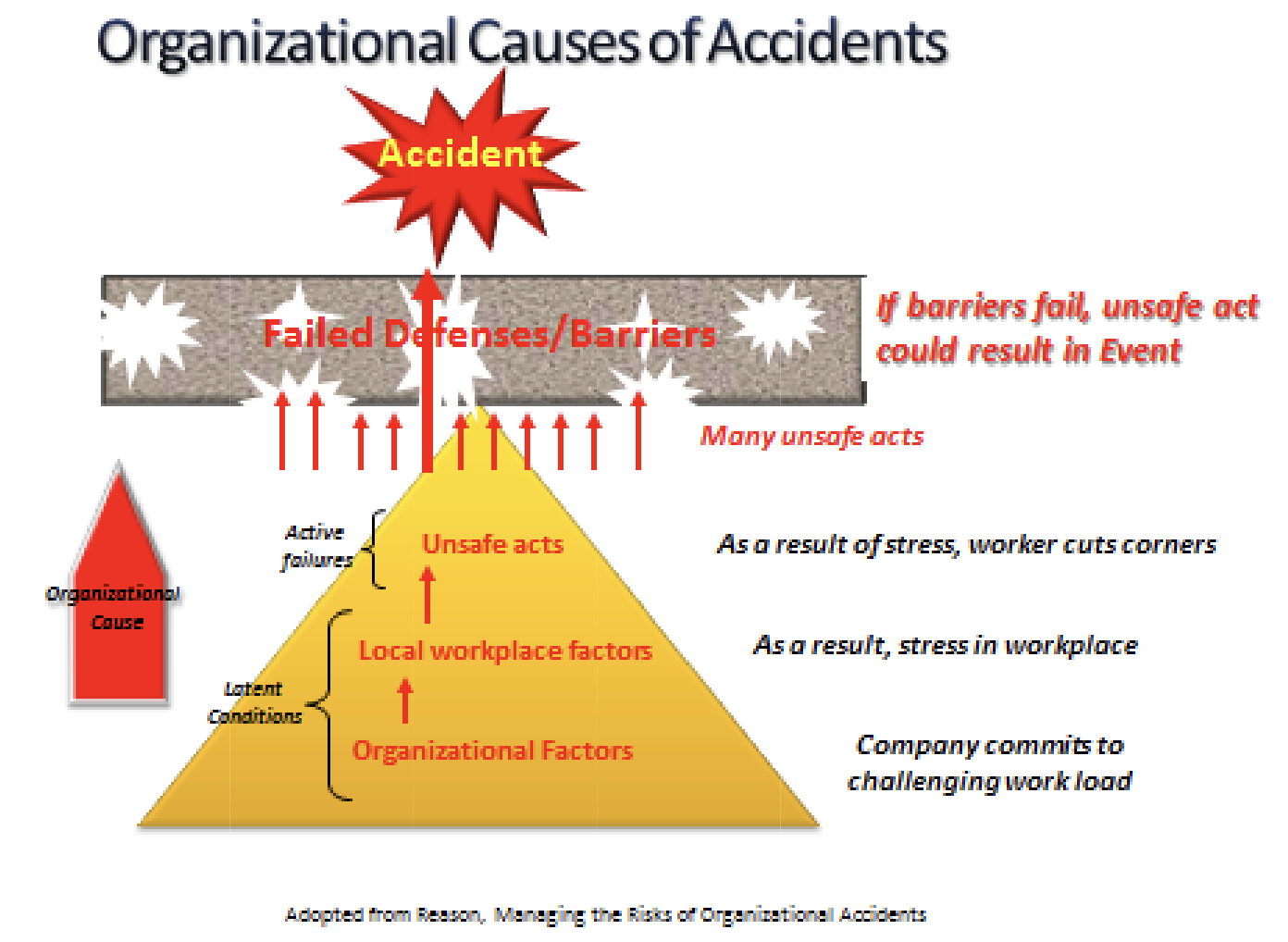
The assessment checklist below was developed by Dr. James Reason and presented at the 2000 Safety Conference. In Managing the Risks of Organizational Accidents, Dr. Reason argues that three (3) elements are vital for driving a company’s safety performance, all of them the purview of top managers:
- commitment,
- competence and
- cognizance
The three Cs.
But managers come and go. So how does a company maintain a commitment to safety in the face of personnel turnover, volatile market forces, and economic reality?
Dr. Reason suggests that this is where an organization’s safety culture comes into play. Dr. Reason stated that:
“A good safety culture is something that endures and so provides the necessary driving force.”
Dr. Reason prepared the following checklist to determine if your organization is well on its way to having a good safety culture.
WARNING!
High scores on this checklist provide no guarantee of immunity from accidents or incidents.
Even the “healthiest” institutions can still have bad events. But a moderate to good score (8–15) suggests that the organization may be striving hard to achieve a high degree of robustness while still meeting other organizational objectives.
The price of safety is chronic unease: complacency is the worst enemy. There are no final victories in the struggle for safety.
SCORING:
YES = This is definitely the case in my organization (score 1);
? = “Don’t know,” “maybe,” or “could be partially true” (scores 0.5);
NO = This is definitely not the case in my organization (scores zero).
|
1. MINDFUL OF DANGER: Top managers are ever mindful of the human organizational factors that can endanger their operations.
2. ACCEPT SETBACKS: Top management accepts occasional setbacks and nasty surprises as inevitable. They anticipate that staff will make errors and train them to detect and recover from them.
3. COMMITTED: Top managers are genuinely committed to aviation safety and provide adequate resources to serve this end.
4. REGULAR MEETINGS: Safety-related issues are considered at high-level meetings on a regular basis, not just after some bad event.
5. EVENTS REVIEWED: Past events are thoroughly reviewed at top-level meetings and the lessons learned are implemented as global reforms rather than local repairs.
6. IMPROVED DEFENCE: After some mishap, the primary aim of top management is to identify the failed system defenses and improve them rather than to seek to divert responsibility to particular individuals.
7. HEALTH CHECKS: Top management adopts a proactive stance toward safety. That is, it does some or all of the following: takes steps to identify recurrent error traps and remove them; strives to eliminate the workplace and organizational factors likely to provoke error; brainstorms new scenarios of failure; and conducts regular “health checks” on the organizational process known to contribute to mishaps.
8. INSTITUTIONAL FACTORS RECOGNIZED: Top management recognizes that error-provoking institutional factors (under-staffing, inadequate equipment, inexperience, patchy training, bad human-machine interfaces, etc.) are easier to manage and correct than fleeting psychological states, such as distraction, inattention, and forgetfulness.
9. DATA: It is understood that the effective management of safety, just like any other management process, depends critically on the collection, analysis, and dissemination of relevant information.
10. VITAL SIGNS: Management recognizes the necessity of combining reactive outcome data (i.e., the near-miss and incident reporting system) with active process information. The latter entails far more than occasional audits. It involves the regular sampling of various institutional parameters (scheduling, budgeting, fostering, procedures, defenses, training, etc.), identifying which of these vital signs most need attention, and then carrying out remedial actions.
11. STAFF ATTEND SAFETY MEETINGS: Meetings relating to safety are attended by staff from various departments and levels.
12. CAREER BOOST: Assignment to a safety-related function (quality or risk management) is seen as a fast-track appointment, not a dead end. Such functions are accorded appropriate status and salary.
13. MONEY VS. SAFETY: It is appreciated that commercial goals and safety issues can come into conflict. Measures are in place to recognize and resolve such conflicts effectively and transparently.
14. REPORTING ENCOURAGED: Policies are in place to encourage everyone to raise safety-related issues (one of the defining characteristics of a pathological culture is that messengers are “shot” and whistleblowers dismissed or discredited).
15. TRUST: The organization recognizes the critical dependence of a safety management system on the trust of the workforce—particularly in regard to reporting systems. A safe culture—an informed culture—is the product of a reporting culture that, in turn, can only arise from a just culture.
16. QUALIFIED INDEMNITY: Policies relating to near-miss and incident reporting systems make clear the organization’s stance regarding qualified indemnity against sanctions, confidentiality, and the organizational separation of the data-collecting department from those involved in disciplinary proceedings.
17. BLAME: Disciplinary policies are based on an agreed (i.e., negotiated) distinction between acceptable and unacceptable behavior. It is recognized by all staff that a small proportion of unsafe acts are indeed reckless and warrant sanctions but that the large majority of such acts should not attract punishment. The key determinant of blameworthiness is not so much the act itself—error or violation—as the nature of the behavior in which it was embedded. Did this behavior involve deliberate, unwarranted risk-taking or a course of action likely to produce avoidable errors? If so, then the act would be culpable regardless of whether it was an error or a violation.
18. NON-TECHNICAL SKILLS: Line management encourages their staff to acquire the mental (or non-technical) as well as the technical skills necessary to achieve safe and effective performance. Mental skills include anticipating possible errors and rehearsing the appropriate recoverable recoveries. Such mental preparation at both individual and organizational levels is one of the hallmarks of high-reliability systems and goes beyond routine simulator checks.
19. FEEDBACK: The organization has in place rapid, useful, and intelligible feedback channels to communicate the lessons learned from both the reactive and proactive safety information systems. Throughout, the emphasis is on generalizing these lessons to the system at large.
20. ACKNOWLEDGE ERROR: The organization has the will and the resources to acknowledge its errors, to apologize for them, and to reassure the victims (or their relatives) that the lessons learned from such accidents will help to prevent their recurrence.
|
Interpreting your score
16 – 20 = So healthy as to be barely credible.
11 – 15 = You’re in good shape but don’t forget to be uneasy.
6 – 10 = Not at all bad, but there’s still a long way to go.
1 – 5 = You are very vulnerable.
0 = Jurassic Park