











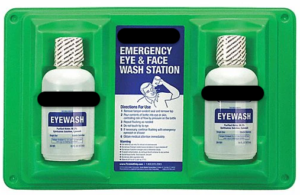
In a 2024 LOI, OSHA reiterated its position that an Eyewash (EW) station must be capable of delivering 15 minutes of water flow. This means these EW bottles are NOT an “approved” EW station. Even the double barrel wall mount with two (2) squirt bottles does not meet the minimum flow rates.
However, OSHA has stated that these squirt bottles CAN help flush a worker’s eyes; they...
Read More

OSHA will not issue citations to an employer that properly uses a non-metal guard so long as the guard is constructed of a substantial and suitable material. OSHA standard, 29 CFR § 1910.219(m)(1)(i) states:
Standard conditions shall be secured by the use of the following materials. Expanded metal, perforated or solid sheet metal, wire mesh on a frame of angle iron, or iron pipe securely fastened...
Read More

Two (2) workers injured after HAND SANITIZER BOTTLES spark "minor explosion," fire at waste facility
The investigation found that they were processing hand sanitizer bottles by shredding them and separating the plastic from the hand sanitizer. During this process, a spark was created from the machine, which initiated a minor explosion and fire.
The business has refuted the fire chief’s official account, saying,
“There was no explosion at the site.“
“There was a loud noise,...
Read More
This can be related to process vessels, hoppers, pits, etc.- just about any “open-topped” space. Now, when it comes to hoppers, these will fall into the PRCS category based solely on their design with “inwardly converging walls or by a floor which slopes downward and tapers to a smaller cross-section.”
But even then, a very shallow hopper does not pose the same hazards by...
Read More
OSHA found an animal food producer exposed employees to the risks of explosions, fires and long-term respiratory illnesses from excessive amounts of airborne dust, among two dozen safety and health violations they identified. The findings follow an inspection after the agency received complaints of unsafe working conditions.
OSHA inspectors found the company’s
poor housekeeping,
its failure...
Read More
One of the acceptable “protection techniques” for electrical enclosures within a Hazardous Location is to “pressurize the enclosure.” Here are the three (3) Types of Pressurized Enclosures and the HAZLOC they are permitted to be used, and their design basis:
NFPA 70, 500.7, (D) Purged and Pressurized. This protection technique shall be permitted for equipment...
Read More
As I have mentioned a few times, there is a substantial difference between a Safe Work Practice design to make OSHA happy and one that functions as a “management system” for the risk the “program” is trying to control. Far too many “safety programs” are simply regurgitating the OSHA standards they intend to comply with. Sometimes, we come across a cut-and-paste...
Read More
The respondent owns and operates a single-site aerosol can manufacturing facility that uses, stores, and handles Isobutane (CAS# 85-28-5), a regulated substance, at the Facility in amounts over the threshold quantity for Isobutane of 10,000 lbs. The facility used, stored, and handled Butane (CAS# 106-97-8), a regulated substance, at the Facility in amounts over the threshold quantity for Butane of...
Read More
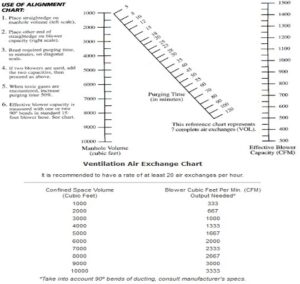
The following are my tips to ensure PRCS are properly ventilated when necessary. Far too often, ventilation is nothing more than a “nice effort,” which can lead to disastrous results. So, in my time in safety at petrochemical and semiconductor facilities, the safety team managed the ventilation equipment (blowers and flexible ductwork). Still, the entry supervisor was responsible...
Read More
I was working on another PRCS Entry program this week and thought I would offer some tidbits I include in my programs regarding:
Space Isolation
Atmospheric Monitoring
My programs are lengthy and are intended to include every aspect of managing the risks associated with working around and inside PRCSs.
SPACE ISOLATION
ALL connections to a confined space that can convey a hazard to the space...
Read More
If you really want to get a feel for the culture around safety, STOP with the surveys and get with today’s technology
Three of my five bosses throughout my career all had this same practice, which is far more telling than a “survey.” And with today’s technology, such as cameras and drones, there is a far better way to gauge the “safety mindset” of our workforce. It works like this…
Hire a...
Read More
“… an attitude of frustration or an internal state of distress can certainly influence driving behaviors, and vice versa. Indeed, internal (unobserved) personal states of mind continually influence observable behaviors, while changes in observable behaviors continually affect changes in person states or attitudes. Thus, it is possible to “think a person into safe behaviors” (through education,...
Read More