












I have been involved with emergency response for over 30 years. During those years, I trained thousands of municipal and private responders, specializing in traditional Hazardous Materials Responses. During all those years, when I received continuing training from the likes of Texas A&M, LSU, NFA, and SERTC, these advanced courses only validated my first HAZWOPER course at Murray State University...
Read More
Not all “simple asphyxiants” are created equal; thus, not all make for good purging or blanketing. Would you believe me if I told you that one very common simple asphyxiant gas should NEVER be used for purging or blanketing flammable atmospheres?
Many folks view Nitrogen (N2) and Carbon Dioxide (CO2) as very similar. This is based on how we, as humans, respond to both of these...
Read More
Yes.
OSHA’s standards at 29 CFR § 1910.212 and 29 CFR § 1910.219 apply to the safeguarding of machines and mechanical power-transmission equipment and require guarding to protect the operator and other employees in the area from hazards such as those created by ingoing nip points, rotating parts, flying chips, and sparks.
In regard to the gap dimension between belts and their respective guards,...
Read More
I am a proponent of accountability in safety; however, I also believe that accountability is necessary at all levels of the organization. We tend to be very quick in identifying the ACTIVE failures by those who made the error, mistake, or violation, and a negative consequence was the result (vs. all those times, the outcome was positive). Heck, in today’s world, we may even have caught...
Read More
Some of the more eye-opening revisions:
Outlining STOP-WORK procedures in Program 3 employee participation plans
A justification in the risk management plan is required when:
hazard evaluation recommendations are NOT adopted
facility-siting hazard recommendations are NOT adopted
Safer Technology Alternatives Analysis (STAA) recommendations are NOT adopted
third-party compliance audit recommendations...
Read More
DOT/PHMSA have compiled the most important changes from ERG2020 to ERG2024, organized by the color of the corresponding section in the guidebook
White
Yellow/Blue
Orange, and
Green
In addition to the changes listed below, all sections have undergone minor editorial changes for accuracy and consistency.
In this edition, DOT/PHMSA has added QR codes to the back cover of the hard copy version of...
Read More
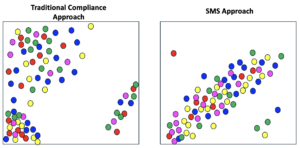
One of the top questions I get from “cold callers” or those who have joined SAFTENG and have digested my 400+ articles on Safety Management Systems and all their elements is:
So, what does an SMS do for me and my facility?
The best way to explain this is by an old scatter chart I had done in 1995 by a consulting firm we hired to help us achieve OSHA’s VPP STAR level of safety. ...
Read More
NOTE: I have never managed a facility/workforce where we required Hi-Vis garments, except for Fire Watches and PRCS Entry Attendants, but those requirements were not for the user’s safety, so we did not get into all the ANSI requirements for these vests. However, I do equate this Hi-Vis effectiveness concern to what I dealt with regarding Flame Retardant Clothing (FRC) and its continued effectiveness. ...
Read More
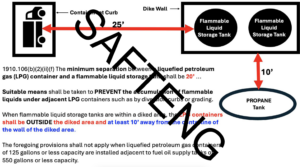
This is another opportunity for facility sitting to apply specific metrics to the exercise. Just as the distances for Tank Truck and Rail Car Unloading/Loading facilities are intended to protect our bulk storage tanks, this is intended to prevent BLEVE(s) that could impact the above-ground storage tank.
(emphasis by me)
1910.106(b)(2)(ii)(f) The MINIMUM SEPARATION between a liquefied petroleum...
Read More
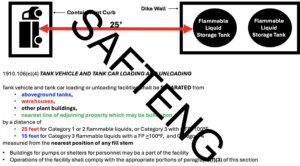
In some cases, we can actually put specific measurements in our “facility siting” analysis. Take, for example, an old but often missed distance between the tank truck/railcar and the closest aboveground tank.
(emphasis by me)
1910.106(e)(4) Tank vehicle and tank car loading and unloading.
1910.106(e)(4)(i) Tank vehicle and tank car loading or unloading facilities shall...
Read More
At 7:30 p.m. on July 2, 2021, Employee #1, Employee #2, and Employee #3 performed two maintenance tasks in the M2 crude rectification section on the ground and second levels at tower M2-T250 and vessel V-207. On July 2, 2021, during the night shift, three (3) gas monomer chemical operators were exposed to toxic fluorocarbons and other hazardous chemicals while performing the maintenance tasks at M2-T250,...
Read More
We often refer to the ABC Model when discussing “Behavior Based Safety.” ABC stands for Antecedent ⇒ Behavior ⇒ Consequence
An antecedent comes before a behavior and may trigger that behavior.
A behavior is what/how the individual does an action. (good or bad).
A consequence is something that follows the behavior (good or bad).
So, an OSHA citation could be considered a...
Read More