











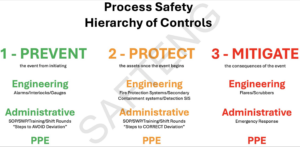
Facilitating Process Hazard(s) Analysis (PHA) is one of my favorite process safety skills. From having the honor to be the author of Part II in the CCPS’s Hazard Evaluation Techniques (3rd Edition) to working with several software companies on the development of their PHA products, there is nothing better than facilitating an actual PHA with a talented team of Engineers, EHS professionals,...
Read More
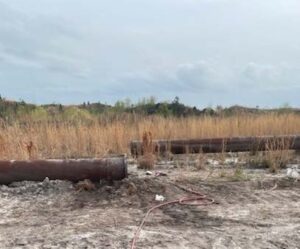
On March 1, 2024, a miner died after a metal slurry pipe struck him.
The miner was removing the last bolt connecting two metal slurry pipes when the pipe broke free and swung in his direction.
Best Practices
• Prevent miners from positioning themselves in a manner that will expose them to hazards while performing a task.
• Examine work areas before and during the shift for hazards.
• Ensure that blocking...
Read More
This is me doing a Process Hazards Analysis (PHA) with my non-American clients who use the metric system!Go ahead and laugh – but know the struggle is real.? ?
Read More
An Oklahoma City employer’s failure to follow federal safety procedures left a 30-year-old worker suffering fatal asphyxiation as they tried to make repairs inside a water tank at a McClain County well site in September 2023. Responding to the report of a fatality in Purcell, OSHA investigators determined the worker had entered a permit-required confined space to fix a leaking bulkhead valve...
Read More
We hear it often… “Who would turn the machine on while I’m working on it?” It happens more often than most think.
Employee # 1 and Coworker #1, Coworker #2, and Coworker #3 were cleaning two (2) concrete mixers.
Employee #1 was paired with Coworker #1 to clean out a mixer.
Employee #1 entered Mixer #1 and began chipping out the concrete build-up while Coworker #1...
Read More
A former client had an amputation accident, and an OSHA inspection followed, with several citations following that. We were hired to help the company digest all that OSHA found wrong, and there was plenty that OSHA found, but there was even more that OSHA did not see or address with its inspection or citations. The client wanted help with the “abatement plans” to close out the OSHA...
Read More
When meeting with executive teams, I like to conduct an exercise to gauge the leadership team’s level of knowledge and direct involvement in the safety and health of their employees. Before getting deep into the organization’s specific barriers/controls/safeguards regarding their top 3 risks (which the team picks), I ask the team to take 10 minutes and identify the barriers/controls/safeguards...
Read More
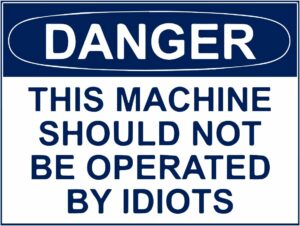
We see these silly stickers occasionally in our work with clients. Although they are not official company positions, I am curious as to why they aren’t removed from company machinery and equipment.
Could this be because management/supervisors believe this to be an accurate statement/belief?
But let’s talk about the message these silly stickers really convey and to do so, I ask the question:
Who...
Read More
The seven C’s of being all we can be as safety professionals.
Compassionate
Confident
Collaborative
Contemplative
Civil
Curious, and
Courageous
Let us remember WHY we became safety professionals AND, more importantly, putting those we have the privilege to protect # 1 in our efforts.
Source: 7 C’s of Compassionate Leaders (Forbes)
Read More
I have grown up in safety and emergency response and found that the tools used in both aspects can cross over to the other. For example, I use the National Incident Management System (NIMS) Incident Command on accident investigations to bring structure to the team. In that IC we have a “span of control” of no more than seven (7) people reporting to any one person. This...
Read More
This is an unusual case in that it involved a 20-pound release of NH3 during a “line break” on a refrigeration system. There was only a single citation and it came at a price of $38,500. The employee was injured. I have been unable to locate an OSHA investigation regarding this incident, which occurred in TX. This case is also interesting in that the company agreed...
Read More