











This is just an FYI to my NH3 clients. Although the changes are NOT significant (0.1 – 0.2 miles), they are indeed changes to the Downwind Protective Action Distances.
If you have used the 2020 ERG Distances in your Pre-Plans that you or I did for your Emergency Response Plan (ERP), it may be beneficial to update these pre-plans/ERP.
REDUCED distances are highlighted
…
HomeRead More...
Read More
One of the many changes to the 2024 ERG, includes considerations for lithium battery and electric vehicle (EV) fires fire control.
NOTE: the print editions are NOT yet available, but we can download the app (CLICK HERE)
Water spray cools batteries and helps suppress and slow the release of toxic gases but does not stop the chemical reaction (thermal runaway). Other extinguishing agents...
Read More
The Respondent formerly operated an ammonia refrigeration process at a distribution center and warehouse, which maintained a maximum inventory of the regulated toxic substance anhydrous ammonia at the Facility, which exceeds the threshold quantity of 10,000 pounds of anhydrous ammonia as set forth in Table 1 at 40 C.F.R. § 68.130 and, therefore, has had a regulated substance present in more than a...
Read More
Are “safety cans” created equally? Nope, and which UL standard they meet will dictate how much “safety they provide.”
OSHA’s 1910.106 defines a “safety can” as
Safety can shall mean an approved container, of not more than 5 gallons capacity, having a spring-closing lid and spout cover and so designed that it will safely relieve internal pressure when...
Read More
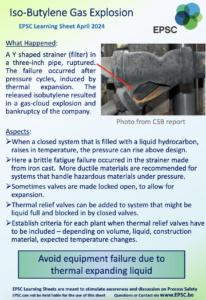
A Y-shaped strainer (filter) in a three-inch pipe ruptured. The failure occurred after pressure cycles induced by thermal expansion. The released isobutylene resulted in a gas cloud explosion and the company’s bankruptcy.
Aspects:
When a closed system filled with a liquid hydrocarbon raises the temperature, the pressure can rise above the design.
Here, a brittle fatigue failure occurred in the...
Read More
Have you ever walked up to a atmopsheric storage tank and seen the paint bubbling and the hazard signs/placards faded/peeling off? Look up and you will most likely see the atmopsheric vent line on that side of the tank. What are these indicators of? The tank being over filled, which is a serious event and is certainly a Loss of Primary Containment (LOPC) event. But these days,...
Read More
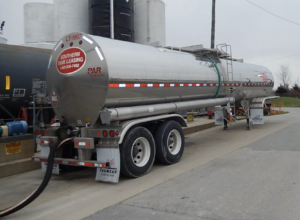
Although it is done often, most state Fire Codes PROHIBIT the use of DOT tank vehicles and tank cars as “Flammable Liquid Storage Tanks.” We call this “dropping trailers,” and my 2014 Article “Dropping Trailers of Flammable Liquids” got quite the debate going. But trust me, there are sound engineering reasons why we can not and should not use DOT shipping...
Read More
Recently, a facility experienced firsthand why the IFC and its state fire code PROHIBIT the movement of hazardous materials via the facility’s “tunnel system.” The code does not prohibit the use of the tunnel system or even in enclosed corridors. Still, the design requirements for these tunnel systems or enclosed corridors to move HAZMATs are usually not cost-effective. ...
Read More
Respondent owns and operates a cheese manufacturing facility. On March 22, 2022, EPA inspected the Facility to evaluate compliance with CERCLA Section 103, EPCRA Sections 304-312, and the GDC of CAA Section 112(r). Based upon the information gathered during the Inspection and subsequent investigation, EPA determined that Respondent violated certain provisions of CERCLA, EPCRA, and the CAA.
At all times...
Read More
On March 28, 2024, the U.S. Environmental Protection Agency (EPA) published its Final Rule: Clean Water Act Hazardous Substance Facility Response Plans (Final Rule), requiring certain facilities to develop Facility Response Plans (FRP) for a worst-case discharge of Clean Water Act (CWA) hazardous substances, or threat of such a discharge.
A worst-case discharge is the largest foreseeable discharge...
Read More
“Most adverse events have their origin in two places:
the systems we design around the humans
and
the choices of humans within those systems
The resulting harm and the human errors (slips, lapses, and mistakes) that may have caused it are really two forms of outcome—outcomes to be monitored, studied, and perhaps grieved. Systems and choices are where the action is, with culture referring...
Read More
Goodhart’s law says…
“When a measure becomes a target, it ceases to be a good measure.”
This “law” is often used when denouncing poorly devised safety metrics and/or incentive programs. In most situations where there is a weak/immature Safety Process/SMS, the “law” makes sense; however, this is because, without strong leadership and a functioning Safety...
Read More