









This Notice cancels STD 01-12-002 Guidelines For Robotics Safety, which has been replaced by the OSHA Technical Manual Section IV: Chapter 4 –Industrial Robot Systems and Industrial Robot System Safety. The 1987 STD 01-12-002 Guidelines For Robotics Safety was outdated. The 2021 update to the OSHA Technical Manual Section IV: Chapter 4 – Industrial Robot Systems and Industrial Robot System...
Read More
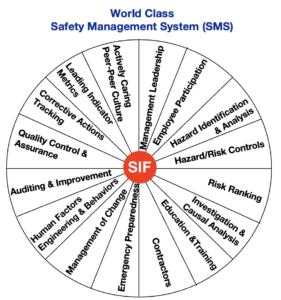
Lots of talk about SIF (Serious Injuries & Fatalities) these days. It even has a new acronym some of you may have seen being used… STKY (Stuff [or Sh_t] That Kills You). Leave it to the safety profession to package this risk management approach into a “program” that can be marketed and sold as another silver bullet to fix all of our struggles. Hence, SIF has many catchphrases...
Read More
Heinrich wrote this in 1941. So many want to decry his belief that unsafe acts play a significant role in accidents. In my earlier posts, I shared his position that unsafe acts are a reflection on management and not so much on the worker who carried out the unsafe act. In this quote from his book, we can see that he was a believer in engineering controls as a major means to prevent accidents.
“The...
Read More
One of my pet peeves in safety is emergency egress lighting. From not having any to having some serious deficiencies in the setup and functioning of the lighting. OSHA has failed to establish a minimum lighting intensity for this emergency lighting. OSHA has established the brightness for EXIT signs, but when it comes to the egress path lighting OSHA has not QUANTIFIED its minimum...
Read More
“Very few unsafe acts will result in damage or injury. In a highly protected system, the probability that the consequences of an isolated action will penetrate the various layers of defense is vanishingly small. Several causal factors are required to create a ‘trajectory of opportunity’ through these multiple defenses. Many of the causal contributions will come from latent failures in the organizational...
Read More
The Entry Supervisor is an ABSOLUTE CRITICAL PATH in safely performing entries into PRCSs. With that said, if entry supervisors simply attend the same training that everyone else attends, we have FAILED them. We were asked to assist with a 2012 PRCS fatality incident where the abject failure of the facility to train its entry supervisors was undoubtedly the root cause of the tragedy. ...
Read More
What is an Injury & Illness Prevention Program (I2P2)? It is a very basic, 8-element, safety management system (SMS). It is OSHA’s attempt to fundamentally change from the complaince model to an SMS model to manage workplace safety and health. OSHA has been talking about I2P2 for nearly 20 years and has faced relentless pushback from the industries. But it is time...
Read More
We hear it all the time… “yes of course we have a safety management system.” Then we ask one simple question, “can we see your OSH auditing plan for the year/3-years/5-years?” The most common response we get is “OSHA does not require us to conduct overall workplace audits.” That is true and it is also evidence that the facility does NOT have...
Read More
In his 1990 paper, The contribution of latent human failures to the breakdown of complex systems Jame Reason presented us with three classifications of organizations. As usual, his work and results were spot on! The three (3) categories are:
Pathological organizations
Calculative organizations
Generative organizations
When we read these descriptions, as well as what Westrum (1988) provided...
Read More
As the “safety culture” debate rages on, I came across this 2019 research paper that I found to be spot on. Of course, those are my biases shining through as I believe all organizations have a culture; in fact, they will have multiple cultures. So I am not one who subscribes to the idea that organizations do not have a “safety culture”. I like to use the phrase...
Read More
At 3:00 p.m. on August 18, 2022, an employee entered an empty liquid propane gas (LPG) tank for servicing at an industrial equipment wholesaler facility. Earlier in the day, the employee approached a supervisor and stated that he wanted to enter the tank to spray a penetrating oil product on an internal valve to loosen it overnight so it could be worked on the next day. The supervisor told the employee...
Read More
There are many concepts related to the science and practice of human factors. However, from a practical standpoint, having a unified view of what we should be concerned about is most helpful when considering aviation maintenance human factors. An excellent way to gain this understanding is by using a model. For over a decade, “PEAR” has been used as a memory jogger, or mnemonic, to characterize human...
Read More