











Image Source
The infamous LPG Cylinder Exchange “Cage”. Pull into any convenience mart/gas station these days and you will most likely see one of these cages. I have always claimed that these cages require Vehicular Barrier Protection (VBP) where they are in the path of vehicles and I still stand behind my position. But NFPA and the National Propane Gas Association...
Read More
Most adults have seen Sky Lanterns in movies, and some of you may have even participated in their release. They are very popular at weddings, festivals, and memorials. But these devices pose serious fire hazards and are being banned by many local Authorities Having Jurisdiction (AHJ). They are essentially a paper hot air balloon with an open flame that drifts in the wind and eventually...
Read More
Respondent is the owner and/or operator of a facility that uses, handles, and/or stores more than a threshold quantity of ammonia (anhydrous), ammonia (concentration 20% or greater), and chlorine, which are regulated substances, as specified at 40 C.F.R. §§ 68.115 and 68.130.
During the inspection, the EPA representative observed alleged violations of section 112(r) of the CAA, 42 U.S.C. § 7412(r),...
Read More
Respondent is an owner and operator of a petroleum refinery. Refining operations at the Facility are currently idled. EPA conducted an inspection of the Facility on September 20 – 26, 2022, to assess compliance with Section 112(r) of the CAA (the “Inspection”). During the Inspection, and in a letter dated October 13, 2022, EPA informed Respondent of observations made during the Inspection. EPA...
Read More
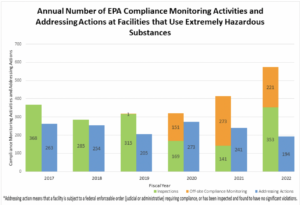
In FY 2022, the agency continued its efforts to reduce risks of accidental releases at industrial and chemical facilities, such as:
Concluded three (3) judicial actions,
145 administrative penalty actions, and
18 administrative compliance orders
In FY 2022, EPA renewed its presence in the field and increased its on-site inspections by more than 150% compared to FY 2021.
EPA has addressed serious...
Read More
As we have discussed at length, OSHA is in the process of updating the HAZCOM Standard (1910.1200) to reflect GHS Rev. 7. The most significant change in this adoption will be how Flammable Gases are categorized in 1910.1200 Appendix B, and this will also impact the PSM standard (1910.119) application. Here is OSHA’s official justification for these changes:
…
HomeRead More...
Read More
The Respondent operates plastics material and resin manufacturing processes at the Facility that produces polymers used in various applications and products, meeting the definition of “process “, as defined by 40 C.F.R. § 68.3. The Respondent produces, processes, handles, and stores 1,3-Butadiene, Chlorine, Propylene oxide, and Acrylonitrile at the Facility.
On February 2, 2022, an incident...
Read More
OSHA’s VPP efforts in process safety has offered the following questions regarding the PSM activities in the process. Here are seven questions that will help you gauge your level of PSM expectations related to ammonia refrigeration:
…
HomeRead More »
Read More
Mr. Trevor Kletz is, without a doubt, my favorite author. In 2001 he published his book on Human Factors in process safety – “An engineer’s view of human error” (Third edition). It is a MUST-READ for those who practice process safety, significantly if you facilitate process hazard(s) analysis (PHA), including the Human Factors analysis. His book is quite telling,...
Read More
Admiral Rickover’s 7 Steps to Safety Success need to be adhered to today more than ever! They are simple and timeless, as he lived by them in the 1950’s and 60’s while building the U.S. Navy’s Nuclear Power program.
…
HomeRead More »
Read More
A safety management system should mirror the manufacturing process’s quality management system. The only difference is the “customer”… in the manufacturing process the customer is external – in the safety process, our employees are our customers.
Both management systems REQUIRE SAMPLING and ACCURATE process measurements.
Read More
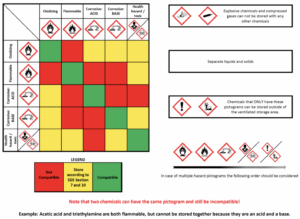
Safe storage, handling, and transfer of hazardous materials is key to reducing chemical accidents and dangerous mixtures of incompatible materials. Close storage of incompatible chemicals could create a risk of fire, explosion, or release of toxic gases and fumes. Storage locations should be according to the fire code, have proper fire protection, and are structurally appropriate.
The Emergency Planning...
Read More