








Earlier this year we were asked to assist in a site assessment after a tragic accident. During this assessment, it was hard not to notice all of the brand new exit signs the facility had put up (i.e. stuck up as they were stickers). These signs were super clean as compared to the rest of the facility so they really stood out during our “side-walk tour” of the facility and the...
Read More

Be careful, experience shows that most who read this will find it offensive…
Meet “Ed”, he is just a maintenance worker I meet in 1994. My first impressions of Ed were he was safe (i.e. always followed the safe work practices, always had on his PPE properly, etc.) based on my personal observations. One day I mentioned Ed and was quickly shut down and mocked for even mentioning...
Read More
Respondent owns and operates a chemical manufacturing facility that has a chlorine (Cl2) process at the stationary source in excess of the applicable threshold quantity. The chlorine-covered process is subject to the “Program 3” requirements of the Risk Management Plan (RMP) regulations and must, among other things, to comply with the Program 3 Prevention Program of 40 C.F.R. Part 68, Subpart...
Read More
I love the Line Break and Equipment Opening (LEO) SWP because it is one of the most hazardous tasks a worker will perform within a covered process AND the fact that there is no OSHA standard dictating how a business manages these risks. This lack of “OSHA Control” spoon-feeding us safety requirements causes most management groups to be lost in the risk and allows us (safety engineers/professionals)...
Read More
This case involves a citation regarding the “grandfather training clause” found in both OSHA’s PSM and EPA’s RMP. I have never seen it cited before, but I take my hat off to the EPA inspector for peeling that onion!
Basically, this food facility had two (2) employees who had been hired in January and September 1996. The facility was unable to produce certification...
Read More
See if this sounds all too familiar… three (3) workers remove a manhole cover to a sanitary sewer to check for water and blockage. Unable to see anything, Employee #1 climbs down into the sewer to look for problems. A co-worker working nearby sees Employees #2 and #3 enter the manhole and comes over to check on his co-workers. He finds Employees #2 and #3 trying to revive...
Read More
Line Breaking and Equipment Opening (LEO) hazards are oftentimes not well recognized or respected, even in PSM/RMP-covered processes. Once we are removed from a “covered process,” the lack of recognition and lack of respect only increases. But in my career, some of the more serious accidents involving LEO on lines/equipment did NOT involve processes covered by PSM/RMP; instead,...
Read More
Please note this citation was issued as a General Duty Clause (GDC) citation by a State OSHA Plan and the incident was not a PSM/RMP incident (at least OSHA did not cite .119). The practice at issue is one that is done routinely in just about all companies and on just about every type of chemical process and utility. This is the first time I have seen it “cited” in an OSHA citation,...
Read More
A few years ago we were asked to participate in an engineering review/facility siting for a proposed facility. The business was in a $ crunch so one way they decided to save some $ was to utilize DOT-306 tankers as “temporary storage tanks”, thus reducing the number of above-ground storage tanks AND a reduction in the size of secondary containment. As we got into this review, we noticed...
Read More
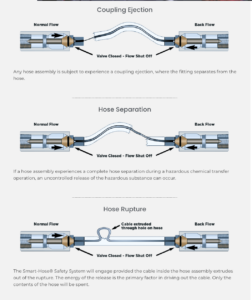
Years back a facility had to apply for a “Special Permit” (example of a permit at link) to get an exemption for their HAZMAT Attendance requirements and then it was very specific to the loading/unloading station and came with many caveats. Now 49 CFR 177.834 has this exception built into the standard and it reads:
…
HomeRead More »
Read More
Back in January 2019, I posted an article titled “Is API 570 your Piping Inspection/Repair RAGAGEP… Repair Requirements are now crystal clear” and this posting caused quite the stir with many of you. Most of you followed the code(s) and went and verified what I shared in the article, but as usual, I got a lot of negative “feedback” as if I were trying to sell my...
Read More
This past week I learned that what used to be allowed only under a “special permit” is now part of the regulation for unloading (and loading) HAZMATs. It was very popular during my time as a safety/PSM manager and all my plants applied for and received the DOT Special permit(s) to unload both Railcars and Tanker Trucks of HAZMATs. But now, plants do not have to apply for a special...
Read More