





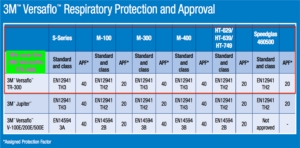
What is the Assigned Protection Factor (APF) for a Powered Air-Purifying Respirator (PAPR)? Most people will claim 1,000 and with that, we are already off the rails!!! SAFTENG members can refer back to my 2015 article (What is the ACTUAL assigned protection factor for Powered Air Purifying Respirators (PAPR) WITHOUT a tight-fitting facepiece?) where I explain how we can get to an APF of...
Read More

Have you ever seen the Wizard of Oz? It is a classic and I highly recommend it, even as an adult first-time viewer. But the theme of the movie can relate to the safety profession. During my internship in the summer of 1992, I worked with a great safety professional, Garth Newman. Garth was preparing for retirement and he told me I was his “last project”; I was not...
Read More
OSHA titled the standard, “Mini Respiratory Protection Program“, but when we read it we see that it could very easily be applied to “voluntary use” NOT associated with COVID 19. So I ask, could this “emergency standard” become permanent and have 1910.134(c)(2) refer to this “standard”? OSHA has made it VERY clear that at this time, 1910.504 applies ONLY...
Read More
NIOSH is recommending a new standard in face masks for workplaces, called
Workplace Performance and
Workplace Performance Plus masks
Manufacturing masks that comply with the new NIOSH criteria can help protect people in the workplace from SARS-CoV-2, the virus that causes COVID-19. These masks CANNOT be used as a replacement for respiratory protection when it is needed. The new mask criteria and...
Read More
In the 2021 revisions to the National Board Part 4 – Pressure Relief Devices, the code formally recognizes the need for an “intervening valve” on the discharge side of a relief valve. The code, section 2.5.6 allows this in the following manner:
…
HomeRead More »
Read More
The 2021 NBIC Draft Edition has been officially approved by the NBIC Committee. The list of major changes found below will appear in the 2021 NBIC. The four-part set:
Part 1- Installation (162 Pages)
Part 2- Inspection (402 Pages)
Part 3- Repairs and Alterations (312 Pages)
Part 4- Pressure Relief Devices (144 Pages)
will cost $325 or you may purchase each part separately for $115 to $150 each. ...
Read More
Much like The National Board did, ASME is now splitting out its relief systems into a new section. The NB created Part 4 – Pressure Relief Devices in 2017 and now ASME is following suit and has created Section XIII, Rules for Overpressure Protection (available 7/31/21). This new section in the 2021 edition of the BPVC will include:
…
HomeRead More »
Read More
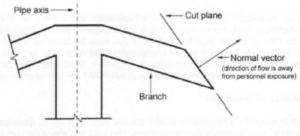
For 20 years now, when teaching any of my process safety courses I make the student repeat this three times: UPWARDS and UNOBSTRUCTED, UPWARDS and UNOBSTRUCTED, UPWARDS and UNOBSTRUCTED. We do this when we get to the Relief System design basis. The vents to the atmosphere almost will always be required to be UPWARDS and UNOBSTRUCTED based on just about any RAGAGEP for hazardous materials. ...
Read More
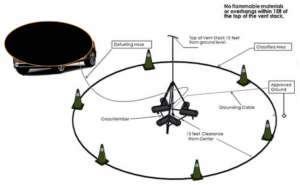
A few years ago I was asked to participate in a hazard assessment for a manufacturer who wanted to review the procedure for hydrogen-powered vehicles to be freed of hydrogen gas. I got the feeling very early into this hazard assessment that those in the room knew about an event of some type, but wanted me to walk them through the venting process so they could quietly find their error(s).
I conducted...
Read More
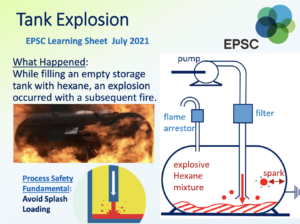
This is an EXCELLENT 1-page Alert on the hazards of “Splash filling” non-conductive flammable liquids. SPEED MATTERS, as does process design!
To read more on handling non-conductive flammable liquids CLICK HERE
Read More
On January 17, 2020, EPA performed an inspection of the Facility pursuant to Section 112(r) of the CAA, Sections 304-312 of EPCRA, and Section 103 of the Comprehensive Environmental Response, Compensation, and Liability Act. Based upon the information gathered during this inspection and subsequent investigation, EPA asserts that Respondent violated certain provisions of the CAA and EPCRA. At all times...
Read More
So in my previous post, we covered the SIZE of the EXIT signs and in this post, I want to cover the “illumination” requirements of these EXIT signs. Simply stated, OSHA and the IBC require the face of the sign to be illuminated to at least 5-foot candles or 54 Lux at ALL TIMES. Which is NOT a lot of light. Of course, when the area has its normal lights on, meeting this illumination...
Read More