












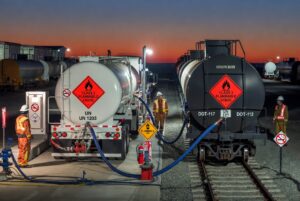
I have had a numerous discussions with companies regarding this new push for “trans-loading”. Trans-loading is defined as:
"Transloading means the transfer of a hazardous material by any person from one bulk packaging to another bulk packaging, from a bulk packaging to a non-bulk packaging, or from a non-bulk packaging to a bulk packaging for the purpose of continuing the movement of...
Read More
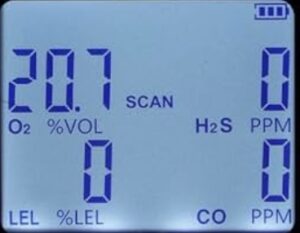
Low humidity makes most LEL (Lower Explosive Limit) detectors read lower than they should, because catalytic‑bead sensors depend on moisture for heat transfer and baseline stability. This can lead to under‑reporting of gas concentration, slower response, and—in extreme dryness—temporary sensor desensitization.
Below is a clear, technically grounded explanation based on how LEL sensors work and what...
Read More

“Wolf Syndrome” in the context of false alarms refers to a pattern where repeated false alerts cause people to stop responding, even when a real danger appears. It’s based on the classic “crying wolf” concept and is widely discussed in psychology, emergency management, and safety‑system design.
The term is not a medical diagnosis—it’s a metaphorical description of what happens when someone or a system...
Read More

The dome failed at a repair patch that had been improperly welded and did not provide the minimum thickness needed to contain the dome’s operating pressure. The steel mill’s mechanical integrity program lacked effective inspection and weld repair practices, contributing to the incident.
In iron manufacturing, a blast furnace operates at high temperatures to convert iron ore into molten iron. Hot,...
Read More
Updates to align with the UN’s GHS Revision 7 begin taking effect this month. Manufacturers and importers must have updated labels and Safety Data Sheets (SDS) for chemical substances. Employers have until July 2026 to ensure their onsite programs and training reflect these revised classifications.
Read More
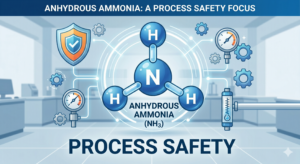
In March 2026, NIOSH issued a formal request for information to update the IDLH Value Profiles. While ammonia has an established IDLH of 300 ppm, the agency is seeking new toxicology and human health effects data to refine these values.
The Focus: The RFI specifically looks for “weight-of-evidence” data on how chemical modes of action—such as the rapid desensitization of olfactory receptors—impact...
Read More
I stumbled across this international study regarding community effects from a large scale NH3 release in 2022. The study wanted to validate or in-validate community complaints years after the event. Residents, numbers unknown, had been complaining of “loss of smell” after being exposed to hundreds of ppm’s of NH3. The study was interesting in that it claimed that some people were...
Read More
We continue to see NH3 LOPC events from piping and piping components. We could debate whether PSM/RMP has had an impact on this industrial sector. I have no idea what actually failed nor do I know the failure mode. What I do know is that NH3 makes the news weekly. Compared to Chlorine, #2 HHC/EHS in ranking of locations, I hardly see any leaks; maybe one (1) quarter and most of those are at Government...
Read More
I really struggle to understand how so many smart people that use the acronym “PSI” dozens of times a day, but never really grasp what it means. I have debated this topic hundreds of times as it always comes up in my LOTO and Process Safety courses and daily work I do in these safety arenas. I even asked AI if my scenario was “crazy” and it explained it the same way I was taught...
Read More
On March 9, 2009, Employee #1 was testing a newly-installed 6 in. steel fire protection water main. When it was pressurized with air, a 6 in. pipe cap flew off the end of the pipe and struck Employee #1’s forehead, killing him.
Violations/Penalties
Serious
Total
Initial Violations
5
5
Current Violations
3
3
Initial Penalty
$13,550
$13,550
Current Penalty
$5,175
$5,175
FTA Penalty
$0
$0
#
Citation...
Read More
On May 4, 2013, Employee #1, a 40-year-old male construction worker was blinded by a test plug that burst while conducting a leak test on a new 4″ diameter sewer line which was made of cast iron. Employee #1 said that he inserted a 2″ diameter by 2′ long test plug into the new cast iron sewer pipe. Employee #1 inflated the test plug with air using a compressor with a defective gauge....
Read More
Employee #1 was a maintenance technician at a company that performs epitaxial processes for semiconductor manufacturing. He reported to work in the fabrication area and was briefed by a coworker, also a maintenance technician, about the day’s projects. After a few minutes, other workers began to smell a strong chemical odor, and some saw a yellow or red cloud. They quickly evacuated the area....
Read More