











This debate reaches far into the safety profession and the opinions will vary widely among us. But recently a state, which will remain un-named for this article, passed a fire code requirement for Flaming food and beverage preparation. One year, many years ago, we were performing audits for a business, and during each audit, we were treated to a nice dinner. One night it was someone’s...
Read More
The criteria for a dust hazard are typically based on an evaluation of dust accumulations in areas of the facility. The combustible dust accumulation level that would support a fire and/or explosion, if there was an ignition source present, depends on numerous factors. For some dusts, accumulation limits are specified. For other dusts, accumulation limits can be calculated. The following standards...
Read More
OSHA has been piece-mealing its own standards along with NFPA standards to formulate a Combustible Dusts National Emphasis Program (NEP) since the 2008 Port Wentworth, GeorgiaSugar Refinery explosion. There is always some confusion about OSHA using consensus standards outside of their own safety standards and when it comes to Com Dust enforcement, they rely heavily on the NFPA standards. ...
Read More
Ever wonder what an OSHA Compliance Safety and Health Officer (CSHO) looks for to establish that a combustible dust hazard may be present? Here are the top 10 indicators they look for when wondering if the business has a Combustible Dust…
…
HomeRead More »
Read More
During the pandemic, OSHA’s Combustible Dust team was updating OSHA’s Technical Manual with a new chapter on Combustible Dust. If you are looking to learn more about the hazards of Com Dusts, this would be a great starting point for your reading. And if your business manages Com Dusts, this is a MUST READ.
The chapter provides technical information to help OSHA Compliance...
Read More
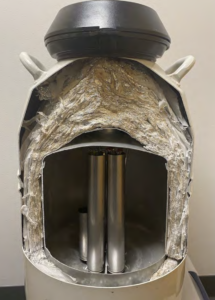
Many thanks to DS at the U of MO for sharing this excellent safety guide on liquid nitrogen containers. The document (FREE DOWNLOAD) covers the following:
Understanding liquid nitrogen
Structure of a liquid nitrogen tank
Storage and care
Transporting and handling
Monitoring nitrogen levels
Tank damage
The images are very helpful in their explanations, such as the one to the left. First...
Read More
For the life of me (pun intended) I can not find this fool who runs around and tells all these safety lies about OSHA compliance. I used to think it had to be Casper The Friendly Ghosts’ brother – but now I am at a loss in combating some of the most fundamental safety principles. But there is hope, my beloved Cincinnati OSHA office team (One of the 2 OSHA Technical Offices in...
Read More
Respondent owned and operated the petroleum refining facility which produces, processes, stores, or handles more than the threshold quantities of flammable substances. Respondent’s hydrocracker unit (HCU) is a covered process under Program 3 of the RMP regulations.
On April 10, 2020, there was an incident at the facility. One of the facility’s covered processes was in operation when an...
Read More
The following are highlights from the 2020 findings:
…
HomeRead More »
Read More
In response to a January 2021 complaint, the department’s Occupational Safety and Health Administration investigated a production facility and found machine operators and maintenance employees entered POWDER-COATING OVENS routinely without testing atmospheric conditions or securing natural gas lines and operating machine parts. By doing so, the employer exposed these workers to dangerous asphyxiation...
Read More
From 2011 to 2018, 1,030 workers died from occupational injuries involving a confined space. The annual figures range from a low of 88 in 2012 to a high of 166 in 2017. These data are from the Bureau of Labor Statistics, Census of Fatal Occupational Injuries (CFOI). Here is the breakdown of the data…
…
HomeRead More »
Read More
This safety alert on public safety at oil and gas upstream facilities is intended to:
Remind upstream (exploration and production) oil and gas facility owners and operators of public safety hazards associated with upstream oil and gas facilities,
Remind them of their obligations under the Clean Air Act General Duty Clause (GDC); and
Provide information on hazard mitigation efforts that can be...
Read More