











With the new 2021 International Fire Code comes some interesting changes. One such change impacts how we establish how many “control areas” within our buildings and floors. Personally, I was surprised they made this change, but after close examination, it actually makes sense. So let’s look at what liberties the 2021 edition gives us in establishing our control areas…...
Read More
I am unsure how to be any louder or more straightforward to the food industry regarding their “Tunnel Freezers.” A lot of folks are aware of the Chemical Safety Board’s investigation into the food plant accident that claimed the lives of 5 workers and injured dozens more. But did you know there was a DOUBLE fatality accident in December 2020, a month before, involving a very similar...
Read More
This information is intended to assist in assessing the human contribution to risk, commonly known as Human Reliability Assessment (HRA). There are two (2) distinct types of HRA:
qualitative assessments that aim to identify potential human failures and optimise the factors that may influence human performance, and
quantitative assessments which, in addition, aim to estimate the likelihood of...
Read More
A topic we have discussed many times here and if you have ever attended one of my process safety courses or presentations you have most certainly heard my dissertation on the criticality of pressure testing and leak testing and the fact that these safety-critical functions come with some serious risks, especially if the pressure testing is done pneumatically! Case in point…
Here are two...
Read More
An OSHA safety investigation has found another rail car products and services provider did not follow federal safety standards for working in permit-required confined spaces after two workers died from inhaling toxic fumes. OSHA determined that an employee became unresponsive after entering a natural gasoline rail car with the intent of cleaning the space on Aug. 12, 2020. A second employee entered...
Read More
A construction company has been fined $14,400 after all three (3) employees were killed while working on a utility project. The three employees, 48, 21, and 43, all of whom were killed on August 25, 2020, in an accident while working about 20 feet below ground inside a manhole. They died from asphyxia associated with a low-oxygen environment and subsequent drowning. Two of the deceased were Father...
Read More
Changing a building or space from an F-1 (Moderate-hazard factory) to an H-3 (High-hazard, physical hazard) occupancy is a significant move to a higher relative hazard category. Under the Ohio Building Code (OBC) and the International Building Code (IBC), this transition triggers a comprehensive regulatory review, and the existing space must be brought up to current code standards for an H-3 use.
Here...
Read More
I studied this incident closely while at MSU and I have never forgotten the dramatic images of what 18,000 gallons of a flammable liquid can do in a sewer!
On Feb. 13, 1981, at 5:16 a.m. a series of explosions occurred in the sewer lines of Louisville, KY. The explosions happened after a soybean extraction plant had a chemical spill of hexane which made it to the sewer. Ultimately investigators...
Read More
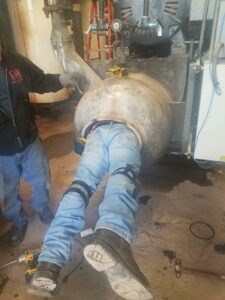
To continue with the articles I have written about Permit-Required Confined Spaces found in mechanical refrigeration processes, today I want to discuss the Compressor Oil Separator. SAFTENG Members can read my earlier post on Evaporative Condenser(s) and Sprial Freezers. Over the last several years I have shared several pics of workers halfway inside these separators and this week another...
Read More
The Respondent operates a wastewater treatment plant where Chlorine, propane, and sulfur dioxide (anhydrous) are present above their thresholds. The Respondent operates a wastewater chlorination process at the stationary source. 40 C.F.R. § 68.130 specifies a 2,500-pound threshold for chlorine, a 10,000-pound threshold for propane, and a 5,000-pound threshold for sulfur dioxide (anhydrous). The Respondent’s...
Read More
Respondent operates a gas plant where flammable mixtures and propane were present above their thresholds. The Respondent lists one process in its Risk Management Plan (RMP) with the process number 1000054282. The covered process is subject to the “Program 3” requirements of the RMP regulations and must, among other things, comply with the Program 3 Prevention Program of 40 C.F.R. Part 68,...
Read More
As I have said, this is all about the “environmental movement” to reduce the regulatory burdens on flammable refrigerants and not about worker safety! You can read OSHA’s own words about by they are proposing this change…
OSHA is proposing several changes to the Flammable Gases hazard class (Appendix B.2). Most significantly, OSHA is proposing to subdivide Category 1 of...
Read More