







Buckle up buttercup… the political winds in DC are shifting and with this comes “opportunities” – man how I hate politics! For those of you who may have thought that the RMP Amendments from the final year of the President Obama administration were long gone – THINK AGAIN! On Friday (12/4/20), the U.S. Court of Appeals – D.C. Circuit granted a request...
Read More
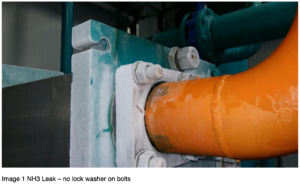
On the plate heat exchanger, a machined nut backed off on the flange bolt that holds the gasket in place. This caused part of the gasket to blow out resulting in ammonia (NH3) to leak into the machine room. The machinery room alarm was activated. Upon inspection, the following failures were found:
…
HomeRead More »
Read More
The word “potential” is defined by Merriam-Webster as:
existing in possibility : capable of development into actuality
In OSHA’s PRCS standards (both 1910 and 1926 versions) it uses the word “potential” when talking about atmospheric hazards; especially when we are talking about RECLASSIFYING a PRCS to a NON-PRCS using 1910.146(c)(7) or 1926.1203(g)
1926.1203(g)(1)...
Read More
This draft guidance document is intended to clarify to the public regarding existing pipeline safety standards. The contents of this document do not have the force and effect of law and are not meant to bind the public in any way, but pipeline operators must comply with the underlying safety standards.
(emphasis by me)
…
HomeRead More »
Read More
Most facilities will have a piece of equipment that is so large and complex that it will entail isolating many sources of all types of energy in order to get the entire system to a zero energy state (ZES). But what do we do when we have a task that involves exposure to only one (1) energy source? Do we expect the worker(s) to lock out all the isolation devices, or can they merely lock out...
Read More
The 2021 edition of the International Fire ode (IFC) basically re-wrote the entire chapter on Combustible dust; which is a major improvement from the 2018 edition. Here are the highlights from the 2021 IFC, Chapter 22 – Combustible Dust-Producing Operations…
…
HomeRead More »
Read More
In the recently released Internation Fire Code (IFC) 2021 edition, the newly designated Section 608 – Mechanical Refrigeration, the code references IIAR 2, 6, 7, 8, and 9 when the refrigerant used is anhydrous ammonia (NH3). The 2021 edition still has many of the long-time requirements that will apply to NH3 systems, such as “emergency access” and more. Here are my favorites...
Read More
Have you seen the latest meme claiming that if masks work then why do we need social distance and if social distancing works then why do we need to wear masks? This lame logic is taking hold in the world of social media so I thought I would provide a way for folks to better understand the need for BOTH face coverings/masks and social distancing. As adults, most of us drive a car daily and...
Read More
So OSHA made some serious improvements in their latest Construction Standard, 1926.1201-.1213, for confined spaces. But there is another option to “upgrade” our efforts for entry safety practices and that is NFPA 326 – Standard for the Safeguarding of Tanks and Containers for Entry, Cleaning, or Repair.
Read More
NFPA 497, Table 4.4.2. has become my “go-to” source for chemical-physical property data for my flammables (along with the SDS). Although they use Celsius rather than Fahrenheit, and this drives me crazy just because I am “old school”, this table is instrumental for understanding the “Group” your flammable gas/vapors belong to! In the 2021 edition of NFPA...
Read More
Enclosed processing areas (vs. outside and open processing areas) that are handling/using the following, shall be ventilated at a rate sufficient to maintain the concentration of flammable vapors within the area at or below 25% of their lower flammable limit (LFL).
Class I flammable liquids or as OSHA calls them Category 1/2 flammable liquids,
Class II or Class III liquids or as OSHA calls them...
Read More
Liquid storage areas where dispensing is conducted must have either a gravity ventilation system or a continuous mechanical exhaust ventilation system. If the dispensing involves Class I liquids (e.g. Category 1 & 2 liquids per OSHA terminology) mechanical ventilation is the ONLY acceptable option. Regardless of the type used there are some FUNDAMENTAL requirements that NFPA has established...
Read More